Incidents of disorderly conduct on flights and at airports have been on the rise in Nigeria, stirring fresh talks on what the law says about safety and behaviour in aviation spaces.
In January, an Ibom Air flight scheduled to leave Uyo for Abuja could not operate because a passenger protested after learning her luggage had been left behind due to weight restrictions.
The woman blocked the aisle of the aircraft and refused to sit despite several pleas from the pilot and cabin crew.
Her actions forced the airline to cancel the flight, which had 89 passengers on board, including a baby.
In June 2025, the senator for Edo north, Adams Oshiomhole, was seen at the Murtala Muhammed Airport in Lagos in a heated exchange after missing an Air Peace flight.
A video circulating on social media showed the senator seated at a gate while speaking with an airport official.
The airline later said the lawmaker disrupted its work after arriving late for his flight.
The Edo senator responded by claiming he was confronted with unclear rules and attempts at extortion.
Two months after that, the Fuji musician known as KWAM1, Wasiu Ayinde, made headlines after standing in front of a ValueJet aircraft at the domestic terminal of the Nnamdi Azikiwe International Airport in Abuja.
The aircraft swerved away from the area, with Ayinde and staff around the tarmac stepping aside to avoid the moving wings.
Airline officials had first questioned the musician about the content of a bottle he was carrying.
The airline later said he spilled a liquid, believed to be alcohol, on a crew member.
Soon after, a video of a passenger named Comfort Emmanson being dragged off an Ibom Air flight spread online.
Her clothing was torn as security personnel pulled her off the aircraft, prompting public concern.
Ibom Air alleged that she refused to turn off her mobile phone during take-off and assaulted cabin crew members when they tried to enforce the safety rule.
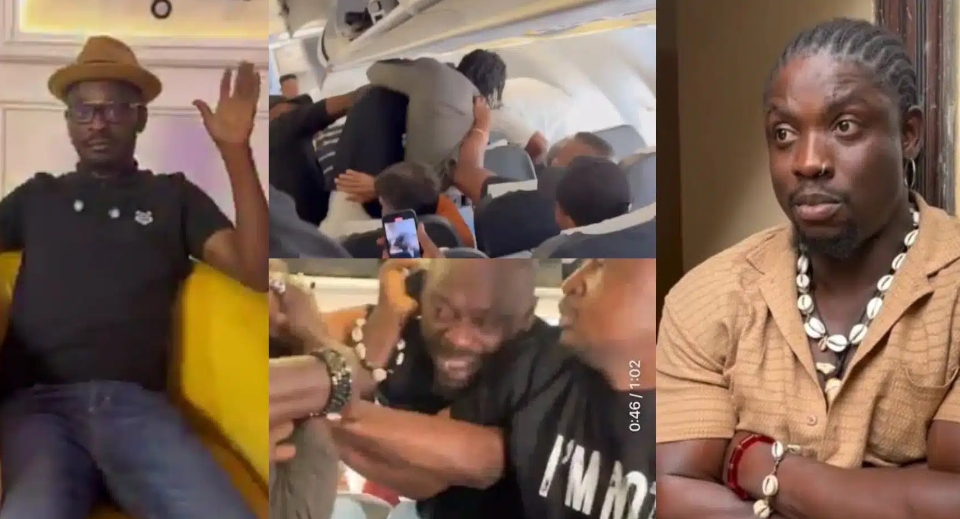
On November 17, another clip went viral showing the comedian known as Mr Jollof in a fight with social media personality VeryDarkMan on Flight UN0523 at the Asaba International Airport.
Both men were seen throwing punches inside the aircraft as other passengers attempted to separate them.
These incidents have renewed attention on what the Civil Aviation Act 2022 says about misconduct on aircraft and around airports.
The act sets out penalties for violent behaviour, interference with crew duties, and actions that put aircraft or passengers at risk.
Section 83(4) of the act states that anyone who intentionally commits violence at an aerodrome, using any object or substance, in a way that causes or could cause injury or death, has committed an offence.
The same section includes destroying airport facilities, damaging an aircraft that is not in service, or disrupting airport operations in a manner that threatens safety.
It provides that such an offender may be fined at least ₦2 million or jailed for a minimum of five years.
The law also makes it a crime to obstruct or attack flight crew members.
Section 85(1) says a passenger who interferes with a crew member in a way that stops them from doing their job is guilty of an offence and faces a fine of up to ₦200,000 or at least two months’ imprisonment or both.
Section 85(2) says anyone who assaults, intimidates, or threatens a flight crew member or engages in unruly conduct on board commits an offence and may receive a fine starting from ₦200,000, a minimum of two months in jail, or both.
Section 85(3) states that any person who uses a device or equipment, including a mobile phone, against the instruction of the pilot or crew, in a way that could affect radio signals or navigation equipment, commits an offence.
The penalty for this also includes a fine of up to ₦200,000 or at least two months in prison or both.
Aviation regulators say these rules are designed to protect travellers, aircraft, and crew at every stage of a flight.
Industry watchers say the recent rise in confrontations on flights may prompt stronger enforcement of existing laws.
Airlines have also been reminding passengers that safety instructions given by pilots and cabin crew are backed by federal law.
Some aviation unions say public awareness campaigns may help reduce confrontations and ensure passengers understand the consequences of violent or disruptive actions.
Regulators insist that compliance with the Civil Aviation Act is essential to maintaining order in Nigeria’s airspace.
As aircraft movements increase and more Nigerians travel domestically, authorities say the focus remains on ensuring that every passenger reaches their destination without disruptions caused by avoidable incidents.
The law, they add, is clear about the penalties for interference, violence, or the unsafe use of devices during flight operations.