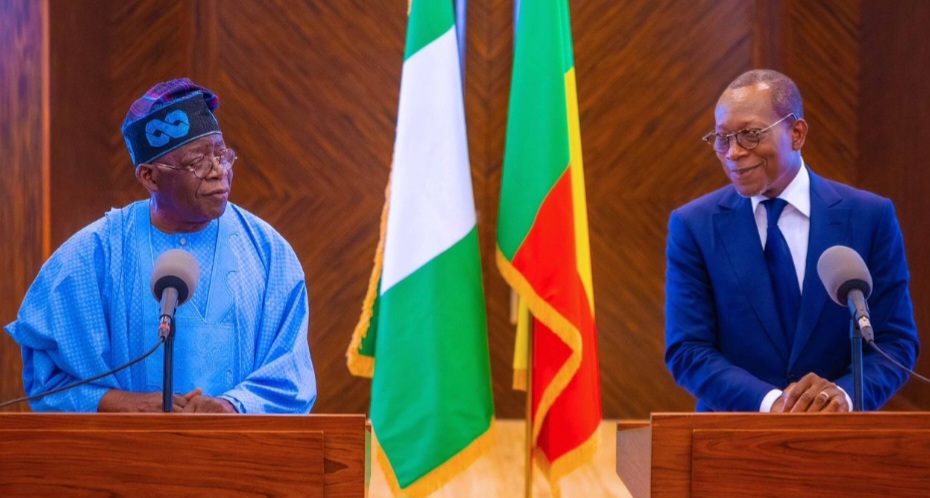
Nigeria’s decision to deploy military assets to the Republic of Benin has reignited debate over presidential powers and legislative oversight.
The development followed reports of an attempted coup in the Republic of Benin, a neighbouring West African state.
Beninese authorities later announced that the attempted takeover had been neutralised and that the government remained in control.
Shortly after, Nigerian military aircraft were observed operating within Benin Republic’s airspace.
The presidency subsequently confirmed that the Republic of Benin formally requested Nigeria’s military assistance.
The presidential spokesperson, Bayo Onanuga, said President Bola Tinubu approved the request in response to the unfolding security situation.
According to the presidency, the intervention involved air surveillance and the deployment of ground forces.
The action generated public discussion on whether the president can deploy Nigerian troops outside the country without prior approval of the senate.
Nigeria’s constitution outlines the scope and limits of presidential authority over military deployment.
Section 5 of the 1999 Constitution vests executive powers in the president, including responsibilities over national security.
However, the same section places conditions on the declaration of war and external military engagement.
Section 5(4)(a) states that the president shall not declare a state of war “except with the sanction of a resolution of both Houses of the National Assembly sitting in a joint session.”
Section 5(4)(b) further provides that “except with the prior approval of the Senate, no member of the armed forces of the Federation shall be deployed on combat duty outside Nigeria.”
These provisions establish the senate’s role in authorising overseas military operations.
The constitution, however, also contains an exception that allows limited executive discretion.
Section 5(5) permits the president, in consultation with the National Defence Council, to deploy troops on “limited combat duty” outside Nigeria under specific conditions.
The provision applies if the president is satisfied that national security is under imminent threat or danger.
It also requires that the president seek senate approval within seven days of actual combat engagement.
The section adds that the senate must then approve or reject the request within fourteen days.
Legal analysts note that this clause was designed to address emergencies requiring swift response.
In the Benin Republic case, the presidency maintained that the situation demanded immediate action.
The Nigerian government argued that delays could have allowed the crisis to escalate and destabilise the region.
Two days after the deployment, the senate considered and approved the president’s request.
The approval covered Nigeria’s participation in a regional peace-stabilisation mission.
The senate described the mission as necessary to protect democratic institutions and prevent unconstitutional changes of government.
The timing of the approval became central to the legal discussion.
Some commentators argued that troops were deployed before legislative consent was obtained.
Others pointed to Section 5(5) as a constitutional safeguard for urgent interventions.
Akintayo Balogun, a legal practitioner, said the constitution allows the president to act first in limited circumstances.
“Ordinarily, the president ought to act with the approval of the national assembly before taking up a crucial assignment of this nature outside the shores of Nigeria,” he said.
Balogun explained that the constitutional process for approval involves a joint session and deliberation, which can take time.
He said, “We must note that this is time-consuming, and the essence of the president’s action might be defeated.”
According to him, acting after the situation had fully unfolded could have rendered intervention ineffective.
Balogun added that the constitution anticipates such urgency by permitting provisional deployment.
He said the requirement to seek senate approval within a specified timeframe ensures accountability.
“With this action, the president has fully complied with the provision of the constitution with respect to the military action taken in the Benin Republic,” he said.
Security experts also note that Nigeria has previously participated in regional interventions under similar frameworks.
Nigeria has been involved in peacekeeping and stabilisation efforts through ECOWAS and other regional arrangements.
Such missions are often justified on the grounds of collective security and regional stability.
Critics, however, caution that executive discretion must not override legislative authority.
They argue that repeated reliance on emergency provisions could weaken parliamentary oversight.
Supporters counter that constitutional safeguards remain intact as long as the senate retains final approval.
The Benin Republic deployment has therefore highlighted the balance between swift security response and democratic control.
It has also drawn attention to Nigeria’s constitutional design for managing external military engagements.
As regional security challenges persist, similar questions are likely to arise in the future.
The current case underscores the importance of clear procedures and timely legislative engagement.
Ultimately, the constitution provides a framework that allows urgent action while preserving senate oversight.
How this balance is maintained may shape public confidence in Nigeria’s civil-military governance.
The Benin Republic episode has thus become a practical test of constitutional provisions on external troop deployment.