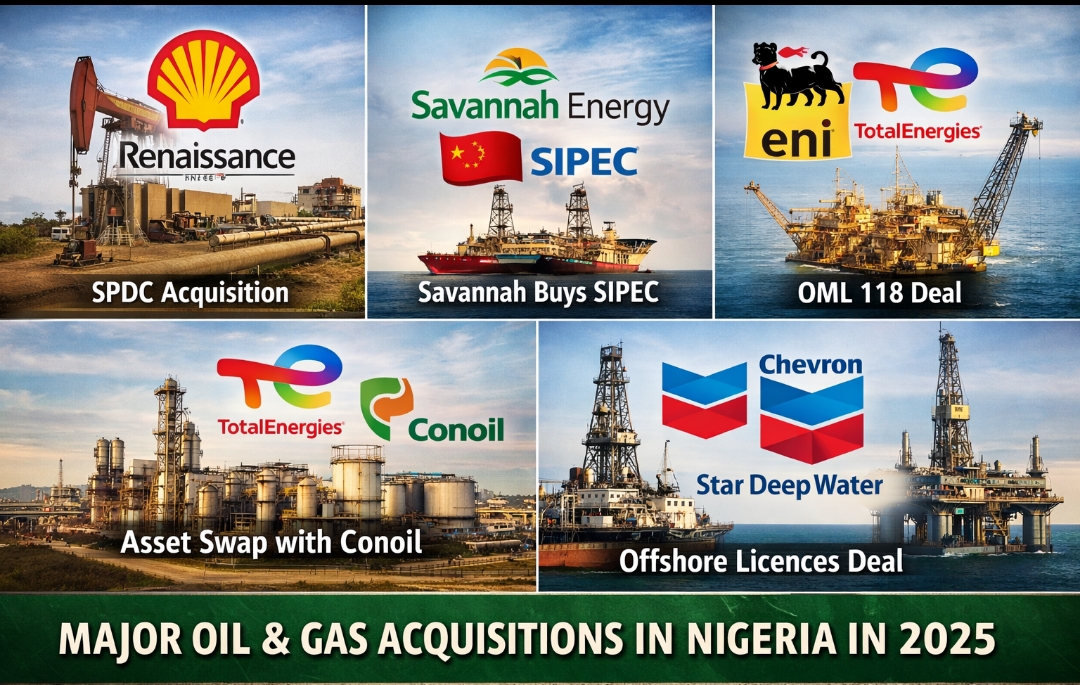
Nigeria’s oil and gas industry recorded a series of landmark acquisition transactions in 2025 as companies repositioned portfolios and adjusted to changing operational realities.
The transactions ranged from full equity transfers to partial stake purchases and asset swaps involving both indigenous and international energy firms.
The deals reflected a broader restructuring of Nigeria’s upstream sector as operators pursued efficiency, regulatory clarity, and deeper participation in strategic assets.
The year’s most consequential transactions unfolded across onshore, shallow water, and deepwater operations, reshaping ownership structures in several key blocks.
Renaissance completes Shell’s exit from onshore Nigeria
One of the earliest major developments was the completion of the sale of Shell Petroleum Development Company of Nigeria.
On March 13, Renaissance Africa Energy Holdings announced that it had completed the purchase of Shell’s 100 percent equity in SPDC.
Renaissance is a consortium comprising ND Western, Aradel Energy, First Exploration & Production, Waltersmith, and Petrolin.
The transaction followed Shell’s January 2024 agreement to divest its Nigerian onshore and shallow water assets to the consortium for more than $1.3 billion, subject to regulatory approval.
Although the federal government initially approved several divestment deals in October 2025 without listing the Shell–Renaissance transaction, approval for the SPDC deal was later granted, paving the way for completion.
The acquisition marked Shell’s formal exit from Nigeria’s onshore oil production after decades of operations.
Savannah Energy takes over Sinopec’s Nigerian arm
Another notable transaction involved Savannah Energy Plc and Sinopec International Petroleum Exploration and Production Company Nigeria Limited.
On March 10, Savannah Energy announced that it had completed the acquisition of SIPEC, a Nigerian subsidiary of China’s Sinopec.
The transaction increased Savannah Energy’s reserves and resources by about 30 percent, rising from 151 million barrels of oil equivalent to 197 million barrels.
“The transaction consideration is fully funded through a drawdown under a US$60 million Reserve-Based Lending debt facility arranged by The Standard Bank of South Africa Limited,” the company said.
“At completion the cumulative consideration paid was approximately US$35.1 million (inclusive of approximately US$19.5 million of cash available to SIPEC), with US$2 million in deferred cash consideration payable in eight quarterly installments post-completion.”
The deal represented one of the few cases in 2025 where a foreign energy firm acquired a Nigerian oil and gas company.
Eni expands its footprint in deepwater OML 118
In the deepwater segment, Eni expanded its footprint in oil mining lease 118.
On November 25, Eni announced that Nigeria Agip Exploration Limited, its Nigerian subsidiary, had acquired an additional 2.5 percent interest in the OML 118 production sharing contract from TotalEnergies EP Nigeria Limited.
“Following the transaction, which has received all necessary regulatory approvals, NAE’s share in OML 118 PSC increased from 12.5% to 15%,” the company said.
“This acquisition is fully aligned with Eni’s strategy to optimize its upstream portfolio and further strengthens the Company’s commitment to deepwater projects in the country.”
A day later, TotalEnergies confirmed that its subsidiary had completed the divestment of its 12.5 percent non-operated interest in OML 118 to Shell Nigeria Exploration and Production Company Limited and Nigeria Agip Exploration Limited.
The company said the total value of the transaction was $510 million, which it had first announced in May.
Nicolas Terraz, president of exploration and production at TotalEnergies, said the company would continue to actively “high-grade its upstream portfolio, to focus on assets with low technical costs and low emissions, and to lower its cash breakeven”.
The Nigerian Upstream Petroleum Regulatory Commission approved the sale-purchase agreement on September 25.
Under the updated terms, TotalEnergies transferred 10 percent of its interest to SNEPco for $408 million, while NAE acquired the remaining 2.5 percent for $102 million.
TotalEnergies and Conoil execute asset swap
TotalEnergies also pursued an asset swap with Conoil in late 2025.
On November 21, the company said it had signed an agreement to acquire a 50 percent operating interest in oil prospecting licence 257 from Conoil.
TotalEnergies disclosed that Conoil would, in exchange, acquire its 40 percent participating interest in oil mining lease 136.
“Upon completion of this transaction, TotalEnergies’ interest in OPL257 will be increased from 40% to 90%, while Conoil will retain a 10% interest in this block,” the company said.
The company added that the transaction would allow it “to proceed with the appraisal of the Egina South discovery, an attractive tie-back opportunity for Egina FPSO”.
Chevron enters two offshore licences via TotalEnergies farm-out
The wave of transactions continued into December with another offshore divestment.
On December 1, TotalEnergies announced plans to sell a 40 percent interest in two offshore exploration licences to Chevron.
The interests cover petroleum prospecting licence 2000 and petroleum prospecting licence 2001.
The buyer is Star Deep Water Petroleum Limited, a Chevron subsidiary.
“Further to an ongoing discussion of global exploration opportunities between TotalEnergies and Chevron, TotalEnergies EP Nigeria has signed a farmout agreement to sell to Star Deep Water Petroleum Limited, a Chevron company, a 40% participation in the PPL 2000 and PPL 2001 exploration licenses, offshore Nigeria,” the statement said.
Under the arrangement, TotalEnergies will remain operator with a 40 percent stake, alongside Chevron with 40 percent and South Atlantic Petroleum with 20 percent.
A year of structural change
By the end of 2025, the scale and spread of these transactions underscored how Nigeria’s oil and gas landscape was being reshaped through acquisitions, divestments, and strategic realignments.
The deals highlighted both the growing role of indigenous operators and the continued presence of international energy firms in the country’s upstream sector.