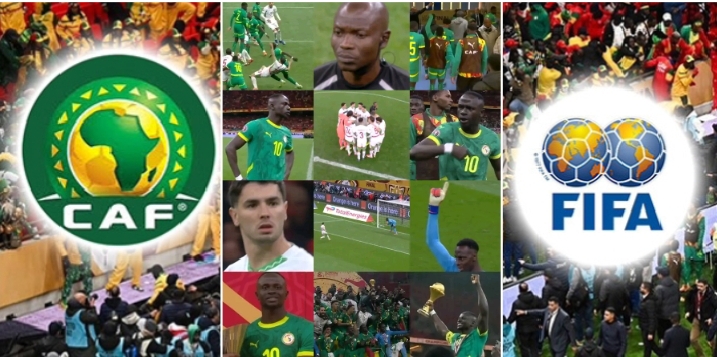
The night air in Rabat carried a quiet tension that felt almost unnatural for a stadium on the brink of history. Flags fluttered in the wind, chants bounced off the walls, but beneath the celebratory colors lay an unspoken weight.
Senegal and Morocco had arrived not only as finalists but as carriers of national expectations, dreams that stretched far beyond the pitch. Every corner, every echo, seemed to hold its breath as if the stadium itself understood that what would unfold might be remembered for decades not just for the goal but for the drama surrounding it.
Fans pressed against barriers, holding phones aloft like talismans, capturing the moment before it happened. The Senegalese contingent wore pride on their faces as heavily as their scarves, their hopes layered in every cheer and gesture. Across the field, Moroccan supporters radiated confidence tempered with anxious anticipation. Coaches paced sidelines, players adjusted jerseys and shin guards, but all eyes knew that tonight was fragile, that one decision could tilt joy into chaos and leave a scar on the history of African football.
Off the pitch, whispers of pre-match controversies lingered like smoke over the stadium. Senegal’s federation had openly criticized accommodations, ticketing allocations, and security arrangements, framing the final as not merely a contest of skill but a contest of fairness. The underlying tension gave the game a charged edge, a sense that every kick, every whistle, could ignite passions beyond control. It was a stage set for triumph but shadowed by the possibility of tumult.
As the Congolese referee Jean Jacques Ndala blew the opening whistle, it was clear that no one present would leave unchanged. The match would test more than stamina and skill; it would test nerves, diplomacy, and the ability of athletes to navigate the fine line between competition and confrontation. Senegal and Morocco were ready to write a story neither country would forget.
Early Exchanges and Tactical Chess
The opening minutes of the final unfolded like a careful dance, each team probing the other with precise movement, probing for weaknesses without committing fully. Senegal, aware of Morocco’s technical fluidity, positioned themselves in a compact formation, leaving the flanks open only for calculated counterattacks. Morocco sought to dominate possession, exchanging short passes with a rhythm that suggested control but also invited Senegal to strike at gaps with lightning transitions.
Midfield battles became the arena where psychological as well as physical tests took place. Every interception felt monumental, every misplaced pass carried immediate consequences. Senegal’s captain, Sadio Mané, orchestrated pressing patterns with quiet authority, signaling shifts and instructing teammates with gestures that revealed both calm and anticipation. Morocco’s Walid Regragui responded with micro-adjustments, moving wingers deeper and instructing defenders to tighten lanes, a chess match played at twenty-five kilometers per hour.
As the game approached the half-hour mark, the balance remained delicate. Senegal managed occasional counterattacks, testing Moroccan goalkeeper’s reflexes, but nothing definitive emerged.
Controversy Erupts Before the Final Whistle
As the match approached its final moments in regular time, Senegal seemed poised to take the lead. A cross from the right found Ismaila Sarr, who nodded the ball toward goal, sending it past the Moroccan goalkeeper and striking the post before it bounced toward the line. For a brief heartbeat, the stadium erupted with celebration, Senegalese fans waving flags, voices hoarse with anticipation, believing the breakthrough had finally arrived. The players sprinted toward each other, arms raised, pride and relief shining on their faces. But the jubilation was cut abruptly.
The referee had already blown his whistle for a foul in the build-up, a collision between Abdoulaye Seck and a Moroccan defender, and the goal was disallowed. Senegal’s players froze, disbelief etched into every movement, gesturing at officials and pleading for reconsideration, their emotions swinging from triumph to shock in seconds. The moment became a flashpoint, the first real fracture in the delicate balance of control that had defined the match until then.
Moroccan players breathed a collective sigh of relief, yet their expressions showed tension rather than celebration. The disallowed goal intensified the stakes, bringing every decision under the microscope of scrutiny and national expectation. Senegal’s coaching staff hurriedly gathered the players, attempting to calm visible frustration and refocus attention on the minutes remaining. Across the pitch, Sadio Mané moved among his teammates, his gestures a combination of instruction and encouragement, trying to channel their emotion into composure, aware that the final outcome still hung in the balance. The stadium itself seemed to pulse with anticipation, a living entity reflecting the human drama unfolding in every beat.
Barely minutes later, the referee awarded Morocco a penalty following a VAR review of a challenge at a corner. Senegal’s defenders, already unsettled by the disallowed goal, immediately protested. Players surrounded the officials, arms raised, voices pleading for reconsideration, while fans in the stands erupted in confusion, anger, and disbelief. The decision to award the penalty after the earlier disallowed goal magnified tensions, creating a moment where pride, competitive spirit, and the sense of injustice collided. Senegal’s players, veterans and rookies alike, moved toward the tunnel briefly, signaling their refusal to continue under what they perceived as unfair treatment. The stadium descended into a charged silence, punctuated by shouts, chants, and the rustle of flags, a pause heavy with questions about fairness, authority, and the rules of sport itself.
Morocco’s Brahim Díaz approached the penalty spot, a Panenka-style attempt prepared with audacity and confidence. Edouard Mendy, Senegal’s goalkeeper, remained steadfast, eyes locked on the striker, body calm and measured. The ball left Díaz’s foot and floated toward goal, only to be tipped away by Mendy in a moment that transformed tension into release. Senegal’s players, witnessing the save, regained composure and returned to the pitch under the leadership of Mané, completing the final minutes of regulation before extra time.
This sequence of events — disallowed goal, controversial penalty, missed spot-kick, and walk-off protest — crystallized the match as one of the most emotionally charged finals in African Cup of Nations history, a battle where every decision carried weight far beyond a simple scoreline.
Senegal Takes the Lead in Extra Time
As the referee signaled the start of extra time, the tension that had been simmering all match reached a fever pitch. Players returned to the field with cautious determination, aware that the first goal would likely decide the championship. Senegal, though emotionally taxed from the earlier controversies, appeared rejuvenated, their movements sharper, more deliberate, and driven by a collective will that seemed to radiate from Sadio Mané at the center of every play. Morocco, meanwhile, attempted to reset mentally, their formation tighter, defensive lines higher, wary of overcommitting and leaving gaps for the lethal counterattacks that Senegal had shown they could exploit.
In the 102nd minute, Pape Gueye seized a fleeting opportunity that would become the defining moment of the final. A quick Senegalese counter saw the ball delivered to the edge of the Moroccan penalty area. Gueye controlled it with precision, evading a defender, and unleashed a shot that curved past the outstretched arms of Morocco’s goalkeeper. The net bulged, Senegal erupted, and fans in the stands could barely contain themselves, their cheers echoing through Rabat like a wave of release after nearly two hours of suspense. On the pitch, players embraced, Mané lifting Gueye, eyes wide with disbelief and pride, the culmination of skill, resilience, and determination finally rewarded.
Morocco, stunned but not defeated, pressed immediately to respond. Every pass was met with Senegalese blocks, every shot intercepted or deflected. The mental toll of the disallowed goal, the penalty controversy, and now the decisive strike weighed heavily on the Moroccan squad. Their attempts to regain momentum were methodical but lacked the fluidity needed to dismantle a Senegalese defense that had become more disciplined and united after enduring the emotional storms of regulation time. The intensity of the extra time was palpable, the stadium alive with chants, groans, and gasps that reflected the collective investment of thousands of fans.
The final whistle approached, the weight of history settling over the stadium, until the referee blew the decisive call. Senegal had won the Africa Cup of Nations 2025, a 1–0 victory after extra time, their triumph defined as much by their resilience and unity as by the goal itself. The celebrations on the field were immediate, heartfelt, and uncontainable, yet the shadow of controversy ensured that the story of this match would be debated and analyzed long after the confetti settled.
Post-Match Reactions
The final whistle sparked jubilation on one side and stunned silence on the other. Senegalese players sank to the pitch, some burying their faces in their hands, others raising their arms toward the night sky. Sadio Mané, a captain who had guided his team through the tension of the disallowed goal and the walk-off protest, said, “We stayed together when it mattered most. This victory is for every Senegalese who believed in us even when things were difficult.” His calm words contrasted with the eruption of emotion around him as teammates embraced, a collective release of the stress, anger, and anticipation that had defined the match.
Edouard Mendy, whose penalty save had shifted momentum, reflected on the walk-off: “Leaving the field was emotional. We wanted to show how strongly we felt about the decisions. But at the same time, we had to return and finish the game. The team remained united, and that unity brought us this win.” Mendy’s statement captured both the risk and the resilience of the Senegalese side, emphasizing the tension between protest and professional responsibility that had dominated the closing minutes of regulation time.
On the Moroccan side, coach Walid Regragui expressed his frustration while acknowledging Senegal’s performance: “We are disappointed not just by the result but by the way the match unfolded. Football is about respect and fairness. The atmosphere was unhealthy at times. We congratulate Senegal on their victory, but we feel the decisions influenced the flow of the game. We will learn from this and come back stronger.” Players echoed the sentiment privately, visibly frustrated by the disallowed Senegalese goal and the late penalty, moments that had determined the rhythm and emotional stakes of the final.
Public reactions mirrored the split of the pitch. The Senegalese president praised the squad, saying, “Our nation celebrates you. You have brought pride and joy to Senegal.” Streets across Dakar and beyond overflowed with dancing, singing, and fireworks. Moroccan journalists were sharply critical of officiating decisions, some calling for Regragui’s resignation despite his strong unbeaten record in the tournament.
Social media erupted with debate, fans dissecting VAR calls, the disallowed goal, and Mendy’s crucial save. As one Moroccan supporter wrote online, “The referee changed the story of the final. The decisions left a mark we will not forget,” while Senegalese fans celebrated unity and resilience, declaring, “Our team showed courage and heart when it mattered most.”
CAF Condemns Conduct in Senegal vs Morocco Final
CAF responded swiftly after the AFCON 2025 final, acknowledging that the match had crossed lines that could not be ignored. In its official communication, the Confederation of African Football described the scenes late in the match as unacceptable, particularly the walk off protest and confrontations involving match officials. CAF made it clear that while emotions run high in finals, standards of conduct must remain intact to protect the credibility of African football.
In its statement, CAF said, “CAF strongly condemns any inappropriate behaviour which occurs during matches, especially those targeting the refereeing team or match organisers.” The governing body emphasized that the actions seen in Rabat went beyond acceptable protest and required institutional review.
CAF also confirmed that the matter would not be handled informally or dismissed as match day emotion. “CAF is reviewing all footage and will refer the matter to the competent bodies for appropriate action,” the statement added, signaling that disciplinary processes had already been activated.
This response placed the final within a regulatory framework rather than emotional debate, making it clear that the controversy would be judged through statutes, not public sentiment.
CAF Responds to Senegal Federation Pre Match Complaints
Beyond the events on the pitch, CAF also addressed Senegal’s earlier complaints about logistics, security, and accommodation arrangements ahead of the final. These grievances had circulated publicly before kickoff, adding an edge to the atmosphere surrounding the match.
CAF countered these claims by stating that Senegal had been offered multiple accommodation options and that alternative training facilities were provided when requested. Ticket allocations, CAF insisted, were handled strictly according to tournament regulations and could not be adjusted unilaterally.
In its media statement, CAF said, “All arrangements for the TotalEnergies AFCON Morocco 2025 final were made in accordance with CAF regulations and in consultation with the participating teams.” This was a clear attempt to neutralize claims of institutional bias or host advantage.
By addressing both pre match and match day controversies, CAF framed the final as a multilayered issue, one involving logistics, officiating, and conduct rather than a single isolated incident.
FIFA President Gianni Infantino Condemns Walk Off Scenes
The controversy did not remain confined to Africa. FIFA President Gianni Infantino weighed in, issuing a rare and direct condemnation of the events that unfolded during the final. His comments elevated the situation to a global governance issue.
Infantino described the scenes as damaging to the image of the sport. “We strongly condemn the behaviour of some supporters as well as some Senegalese players and technical staff members,” he said, stressing that leaving the field of play in protest could not be justified under any circumstance.
He went further by linking conduct to the core values of football. “It is unacceptable to leave the field of play in this manner, and equally, violence cannot be tolerated in our sport. It is simply not right,” Infantino stated.
The intervention from FIFA placed additional pressure on CAF, reinforcing the expectation that disciplinary action must follow, not just for enforcement but for precedent.
What the Statements Mean for Senegal and African Football
Taken together, the CAF and FIFA statements signal that the Senegal vs Morocco final will be remembered not only for Pape Gueye’s extra time goal but as a regulatory moment for African football. The governing bodies made clear that emotional context does not override institutional discipline.
CAF’s review process is expected to focus on the walk off protest, interactions with match officials, and adherence to competition regulations. While Senegal completed the match and won the trophy, completion alone does not exempt teams from post match sanctions.
More broadly, the statements underline a shift in tone from tolerance to enforcement. African football is being reminded that global scrutiny now accompanies continental tournaments, and that moments of protest are judged not just by fans but by rulebooks and international standards.