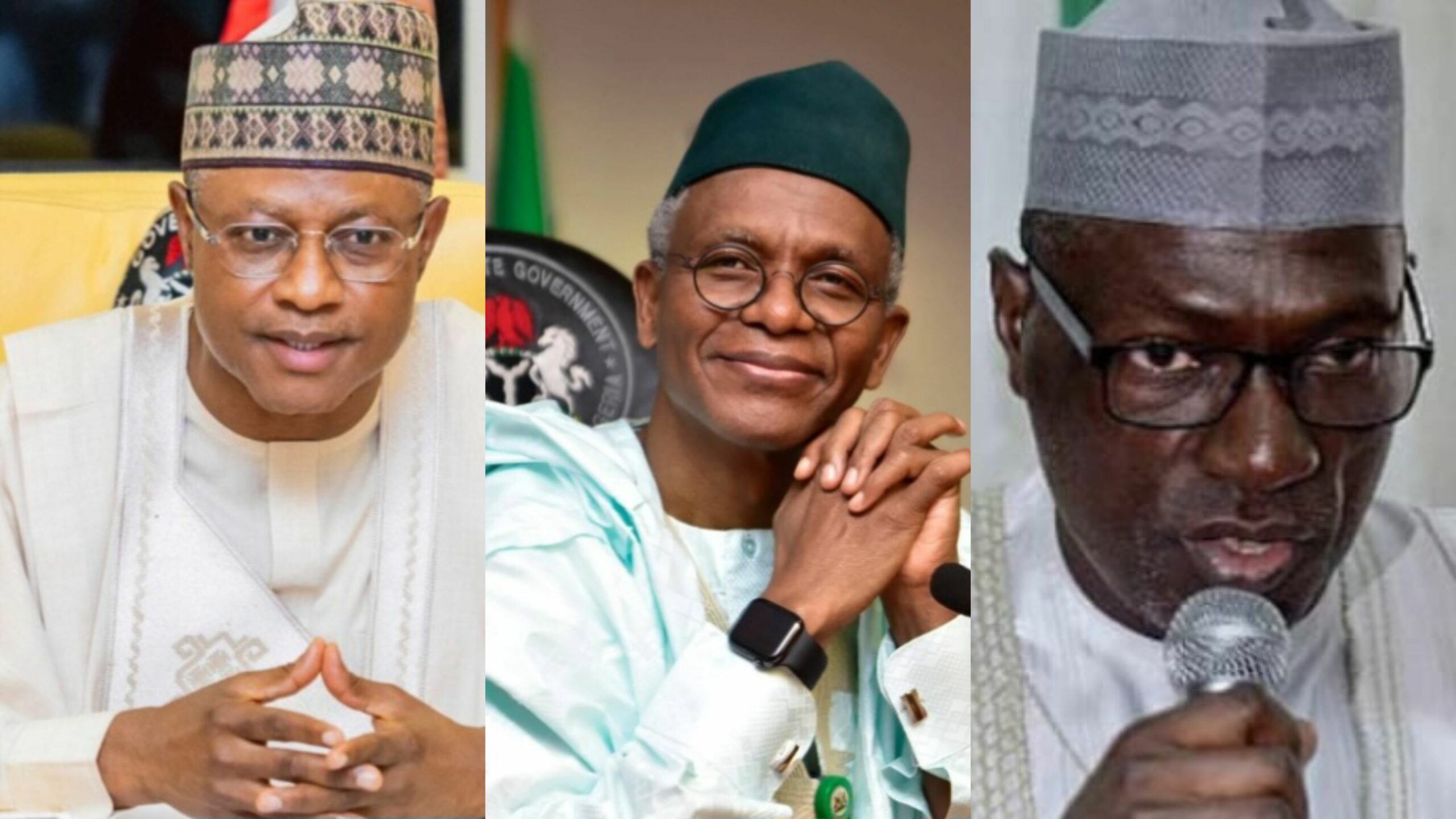
As political activities quietly gather pace ahead of the 2027 general election, Kaduna State is emerging as one of the key battlegrounds likely to test shifting loyalties and entrenched structures.
Even before the Independent National Electoral Commission (INEC) releases the formal Notice of Election, political actors across party lines have intensified consultations, alignments and discreet mobilisation.
The unfolding scenario in Kaduna points to a three-way contest involving the incumbent governor, Uba Sani of the All Progressives Congress, his predecessor and former ally, Nasir el-Rufai, now aligned with the African Democratic Congress, and a former governor, Senator Ahmed Makarfi of the Peoples Democratic Party.
The rivalry reflects not only personal political trajectories but also deeper contests over influence, party control and voter confidence in a state long regarded as politically strategic in the North-West.
Governor Uba Sani currently appears to enjoy structural advantages, drawing strength from incumbency, federal backing and control of the APC machinery within the state.
The governor is widely regarded as a close ally of the president, Bola Tinubu, a relationship that has translated into visible support within the ruling party’s hierarchy.
Sources within the APC say the governor’s path to securing the party’s second-term ticket appears relatively smooth given the current alignment of forces.
Support for the governor is also drawn from segments of the political elite, traditional institutions and religious leaders across different zones of the state.
His administration has placed emphasis on security stabilisation, infrastructure renewal and outreach to previously marginalised communities.
Several political figures, including the former senator, Shehu Sani, former governor Ramalan Yero, Senator Suleiman Hunkuyi and Senator Sunday Katung, have publicly acknowledged aspects of the administration’s approach.
On the other hand, Nasir el-Rufai, the immediate past governor and a leading figure within the ADC, has remained vocal in his criticism of the current administration.
El-Rufai has accused the governor of political disloyalty and described the federal government’s backing of his successor as excessive.
Supporters of the governor have pushed back against these claims, describing them as attempts to destabilise the current administration.
A supporter of the governor, Nasir Dambatta, said, “Nobody undermined his authority when he was in office.”
Findings indicate that the ADC is still grappling with internal organisational challenges within the state.
The party is reportedly divided between factions loyal to El-Rufai and long-standing members resisting changes to the leadership structure.
Investigations show that Tijjani Mustapha and Idris Musa are associated with one faction, while Elder Patrick Ambut is recognised by the national leadership as the state chairman.
This leadership dispute is viewed as a critical obstacle that could shape who eventually emerges as the party’s governorship candidate.
Several party members, including Prof. Muhammad Sani Bello and Ja’afar Sani, are said to be positioning themselves for the ticket.
Despite these challenges, some analysts argue that voter appetite for political change could offer the ADC an opening if internal cohesion improves.
Critics of the current administration have argued that the governor’s performance has not met public expectations.
One such view suggests that “people need change in view of the poor performance of the governor.”
Ahmed Makarfi, a former governor and former national caretaker chairman of the PDP, remains a central figure within the opposition party.
Makarfi is regarded as influential in shaping party decisions both within Kaduna and at the national level.
A PDP youth leader, Mansur Rigasa, said, “He remains the most important figure who picked the gubernatorial candidate since leaving office.”
Although the PDP’s influence in Kaduna has waned, the party maintains pockets of support across several local government areas.
The outcome of the 2023 governorship election, where the APC defeated the PDP by a narrow margin of just over 10,000 votes, is often cited as evidence of the party’s continued relevance.
Recent defections have further strengthened the APC’s position within the state.
Over ten lawmakers from the House of Representatives and the Kaduna State House of Assembly have reportedly defected from the PDP to the APC.
Governor Sani recently stated that the number of APC members in the House of Representatives from the state had risen from four to 14.
“Today in Kaduna, we don’t have any opposition,” the governor said.
He added, “I promised the president some months ago that we were looking at 80 percent of the votes, but today about 95 percent of the total votes in Kaduna State will go to APC in 2027.”
The Kaduna peace model has also been cited by government officials as a major achievement of the administration.
The commissioner of information, Ahmed Maiyaki, said the security improvements had enabled the reopening of over 500 public schools.
He added that more than 300 health centres previously shut due to insecurity had resumed operations.
According to him, over 300,000 out-of-school children have returned to classrooms across the state.
Maiyaki said farming activities had resumed in rural communities, with over 500 hectares currently under cultivation.
“If there were elections today, our principal is ready because of his sterling performance,” he said.
Within the PDP, debates continue over candidate selection and the impact of repeated nominations.
Some party members argue that recycling candidates has weakened the party’s electoral prospects.
As the countdown to 2027 continues, Kaduna’s political landscape remains fluid, shaped by incumbency, party cohesion and voter sentiment.