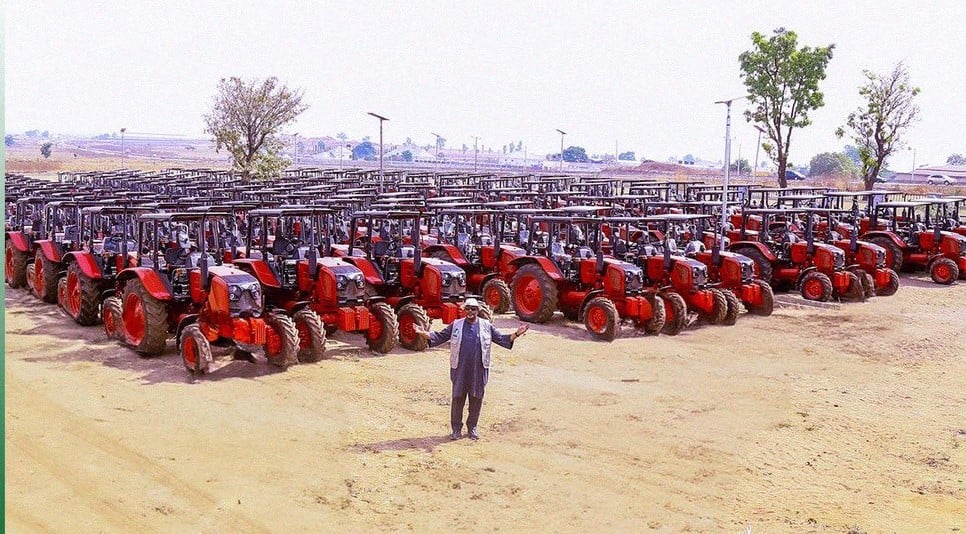
On the outskirts of Gwagwalada in Abuja, within the premises of the National Agricultural Seeds Council, rows of red-and-black tractors, bulldozers and mobile workshops sit idle, coated with dust and shielded from farmers they were procured to serve.
The machines, shipped more than 7,800 kilometres from Belarus, form part of Nigeria’s most ambitious agricultural mechanisation drive in recent years, launched amid high expectations of transforming smallholder farming and easing manual labour.
In June 2025, President Bola Tinubu unveiled the Renewed Hope Agricultural Mechanisation Programme, popularly called the Belarus Project, describing it as a major intervention to modernise agriculture and attract young Nigerians to farming.
The programme, implemented with AfTrade DMCC and backed by the Republic of Belarus, involved the delivery of 2,000 tractors, 10 combine harvesters, 12 mobile workshops, 9,000 farming implements and 9,000 spare parts kits.
At the launch, Tinubu said the equipment would strengthen mechanisation services, create employment and make agriculture “easy and more sexy for our young ones”.
The minister of agriculture and food security, Abubakar Kyari, described the initiative as “the single largest mechanisation drive ever undertaken in our country”.
“Never in Nigeria’s history have we witnessed an agricultural mechanisation initiative of this scale, ambition, and national focus,” Kyari said.
According to projections released by the ministry, the programme was expected to cultivate over 550,000 hectares of farmland, yield more than two million metric tonnes of staple crops, generate over 16,000 jobs and benefit at least 550,000 farming households.
Nearly seven months later, investigations show that a significant number of the machines remain parked in Abuja, unused and undistributed, despite the urgency of Nigeria’s food security challenges.
Officials at the ministry confirmed that the equipment is to be distributed through a leasing model overseen by the Bank of Agriculture.
The assistant director of information at the ministry of agriculture, Ezeaja Ikemefuna, said the tractors are not for outright government operation but are meant to be leased to qualified beneficiaries.
In November 2025, the Bank of Agriculture announced a call for applications, stating that tractors would be leased for three to five years at 15 percent interest, with a mandatory 25 percent down payment.
The guidelines specified that eligible youth agripreneurs must be between 18 and 35 years old.
The timing of the application process, coming months after the arrival of the first batch of tractors, raised questions about whether a clear deployment strategy existed at the point of procurement.
In December, the managing director of the Bank of Agriculture, Ayo Sotinrin, said the bank had received more than 100,000 applications, which were being screened down to 2,000 beneficiaries.
“Yes, it has started already. Tractors have started going out and also other equipment,” Sotinrin said in a WhatsApp response, alongside a video showing a tractor working on farmland.
However, the bank has not publicly disclosed how many tractors have been deployed, where they are operating, or how many beneficiaries have received approval.
The ministry of agriculture, in its National Agricultural Technology and Innovation Policy 2022–2027, states that Nigeria’s mechanisation level stands at 0.027 horsepower per hectare, far below the Food and Agriculture Organisation’s benchmark of 1.5 horsepower per hectare.
The document notes that limited access to tractors and processing equipment has reduced cultivated land, lowered productivity and increased post-harvest losses.
In March 2024, Kyari told the house of representatives that Nigeria requires at least 72,000 tractors to transition meaningfully to mechanised farming.
An agribusiness consultant and managing director of Vestance, Rildwan Bello, said Nigeria has fewer than one tractor per 1,000 hectares of farmland and less than 5,000 functional tractors nationwide.
He estimated that the country needs at least 150,000 tractors to support agriculture at scale.
“That is why you see agricultural students doing practicals with a hoe and a cutlass,” Bello said.
Bello said repeated tractor procurement efforts by successive governments have often failed due to weak deployment systems, poor maintenance and limited technical capacity.
He said the federal government’s role should focus on enabling private operators, supporting leasing models and building skills to service equipment sustainably.
Shortly after assuming office in July 2023, Tinubu declared a state of emergency on food security amid rising food prices, insecurity and declining productivity.
The mechanisation programme was presented as a practical response to those pressures, promising faster land preparation and expanded cultivation.
However, much of the equipment arrived close to the start of the 2025 wet season, yet remained largely unused during critical planting months.
Instead, in June 2025, the ministry declared a three-day fasting and prayer programme for the agricultural sector.
Each missed farming season, analysts note, translates into reduced output, tighter food supply and higher prices for consumers.
Nigeria’s youthful population remains central to the programme’s stated goals, as agriculture continues to struggle to attract young people due to low returns and physical strain.
ActionAid estimates that engaging 40 million youths in agriculture could add ₦60 trillion annually to Nigeria’s economy.
In August, the ministry launched the 2025–2030 revised National Youth Manifesto in Agriculture, describing it as a youth-led roadmap for sector reform.
“This manifesto is proof that the young populace is not just beneficiaries of policy but architects and drivers of the nation’s agricultural future,” Kyari said.
A young farmer, Umar Farouq, said agriculture has become more attractive to youths, but policy gaps continue to limit growth.
He said increased food production requires access to land, finance, inputs and markets, alongside mechanisation.
With hundreds of tractors still idle months after their arrival, questions persist over whether the programme can deliver on its promise to strengthen food security and make farming viable for Nigeria’s youths.