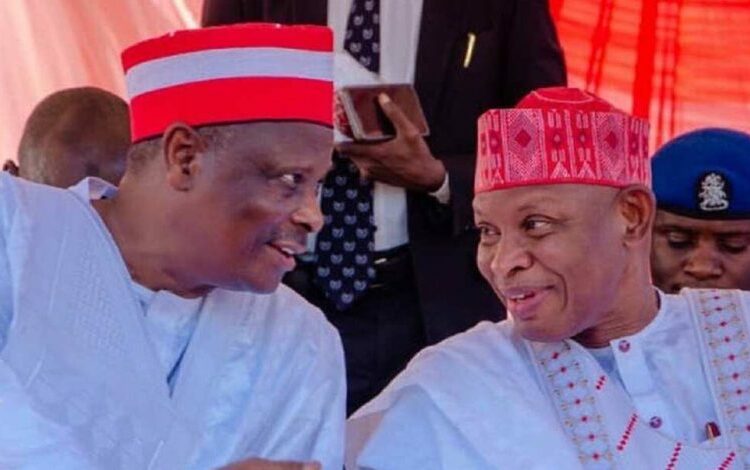
Recent political movements in Kano State have renewed debate among observers over the durability of the political network associated with a former governor of the state and national leader of the New Nigeria Peoples Party, Senator Rabiu Musa Kwankwaso.
The discussion follows the formal defection of Governor Abba Kabir Yusuf from the NNPP to the All Progressives Congress, alongside commissioners, members of the Kano State House of Assembly and federal lawmakers.
For more than two decades, Kwankwaso, through the Kwankwasiyya movement, has been a dominant force in Kano politics, shaping electoral outcomes and influencing party structures across the state.
At the return of democratic rule in 1999, Kwankwaso, who previously served in the House of Representatives during the aborted third republic, was elected governor on the platform of the Peoples Democratic Party, with Dr Umar Ganduje as his deputy.
His first tenure ended in 2003 after defeat by Ibrahim Shekarau of the defunct All Nigeria Peoples Party, but he later returned to public office as the minister of defence under former President Olusegun Obasanjo.
Kwankwaso reclaimed the Kano governorship in 2011 on the PDP platform, again with Ganduje as his deputy, and governed the state until 2015.
Toward the end of that tenure, he defected to the newly formed APC in 2014 alongside Ganduje, positioning himself within a broader national political coalition.
Kwankwaso contested the APC presidential primary in 2014, finishing as first runner-up to the late former President Muhammadu Buhari, before securing the Kano Central senatorial seat in the 2015 general election.
Following his exit from office, political rivalry emerged between Kwankwaso and Ganduje over control of APC structures in Kano, a contest that eventually favoured the then incumbent governor.
As disagreements deepened, Kwankwaso left the APC and later aligned with the NNPP, emerging as its presidential candidate in the 2023 general election.
Although he lost the presidential contest, the NNPP recorded significant success in Kano, winning the governorship, the majority of seats in the State House of Assembly and several positions in the National Assembly.
Governor Yusuf, a long-time associate of Kwankwaso, became a central figure in the party’s hold on Kano following his victory at the polls.
That arrangement shifted following Yusuf’s defection to the APC, which was quickly followed by similar moves from key political office holders within the state.
In response, Kwankwaso described the defections as acts of betrayal, declaring January 23 as the “World Day of Betrayal” while addressing members of Kwankwasiyya groups at his residence in Kano.
Political reactions to the development have varied, with some figures interpreting the defections as evidence of a weakening political structure.
The minister of aviation and aerospace development, Festus Keyamo, argued in a public commentary that Kwankwaso’s refusal to align with the ruling party could limit his future political ambitions.
Some former national leaders of the NNPP have also attributed the crisis to internal instability within the party, describing the developments as a consequence of unresolved structural issues.
In a joint statement, Professor Rufai Ahmed Alkali, former national chairman of the party, Senator Suleiman Othman Hunkuyi, former national organising secretary, and Professor Ben Angure, former national legal adviser, said the defection must be viewed within the context of prolonged internal disagreements.
However, supporters of Kwankwaso have rejected claims of declining influence, pointing to continued grassroots mobilisation across Kano State.
A representative of the Arewa Youth Forum for Peace and Security, Comrade Salihu Dantata, said Kwankwaso’s political relevance remained evident in public support, adding that “there is no way his political dynasty can be described as being under threat.”
He said, “You can see the cheering crowd right in front of his house, and we have to wait until 2027 before anyone can say otherwise.”
A political science lecturer at Nnamdi Azikiwe University, Awka, Dr Christian Okeke, also dismissed suggestions that the defections marked the end of the Kwankwasiyya movement.
“Kwankwassiyya is a strong political movement that remains as strong as ever, and the defection of Governor Yusuf is inconsequential to its strength,” Okeke said.
He added that Kwankwaso’s influence extended beyond individual office holders, noting his long-standing presence in both state and national politics.
Another political analyst, Suleiman Gimba, described the situation as a period of strain rather than collapse, arguing that the governor’s defection highlighted structural features of Nigeria’s political system.
“Kwankwaso’s political empire is not necessarily crumbling, but it is undeniably under pressure,” Gimba said.
He noted that alignment with central power often shapes political outcomes in Nigeria, sometimes overriding constitutional principles of governance and accountability.
An executive director of the Women’s Inclusion, Empowerment and Leadership Development Initiative, Comrade Amarachi Evangel, said the development should be seen as a setback rather than a terminal decline.
She said shifting alliances remain common within Nigeria’s political environment and that influence is not solely defined by party control.
As political alignments continue to evolve ahead of the 2027 elections, Kano State is expected to remain a focal point in discussions about power, loyalty and political endurance.