In February 2026, Nigeria witnessed a significant moment in the interplay between traditional authority and national governance when questions about the Southern Traditional Rulers Council arose publicly. The debate was ignited at a high-profile gathering of traditional leaders and government officials, and it quickly drew the attention of the media and the public.
At the center of this discussion was Adeyeye Enitan Ogunwusi, the Ooni of Ife, who has served as Permanent Chairman of the Southern Traditional Rulers Council. His role as both a custodian of Yoruba traditions and a national figure made his response particularly noteworthy.
The unfolding dialogue highlighted the ongoing tensions between autonomy of regional monarchs, the importance of collaboration, and the perception of legitimacy in traditional structures that operate alongside the formal government system. The setting and participants of this discussion underscore how traditional institutions continue to influence national narratives while also navigating challenges of unity, representation, and public accountability.
Where the Ooni Spoke
The Ooni of Ife delivered his remarks during the National Traditional and Religious Leaders Summit on Health, held at the State House Conference Centre in Abuja, Nigeria. This summit, attended by President Bola Tinubu, senior federal officials, and a wide array of monarchs and faith leaders, served as a formal and ceremonial platform for dialogue on national issues. The presence of both political leaders and traditional rulers made the setting significant because statements made here carry both symbolic and practical implications.
Traditional leaders from various regions gather at such summits not only to discuss governance and health matters but also to negotiate influence and assert the relevance of their councils. This environment, combining ceremonial protocol and practical authority, created the backdrop for the Ooni’s intervention and underscored why clarifications about the council’s structure and legitimacy were essential.
Triggering Event: The Challenge to the Council
During the summit, Lawrence Agubuzu, the Eze Ogbunechendo of Ezema Olo Kingdom in Enugu State, publicly questioned the existence and legitimacy of the Southern Traditional Rulers Council. He claimed, “there is nothing like a Southern Traditional Rulers Council,” and suggested that the federal government should engage directly with recognized regional structures rather than through what he described as an informal council.
This statement challenged both the authority of the council and the credibility of its leadership, implicitly questioning the capacity of the Ooni of Ife as Permanent Chairman. Because this claim came during a formal summit and in front of media coverage, it quickly gained public attention and sparked conversations about traditional councils, regional representation, and the influence of monarchs in national decision-making processes.
Ooni Ogunwusi’s Response
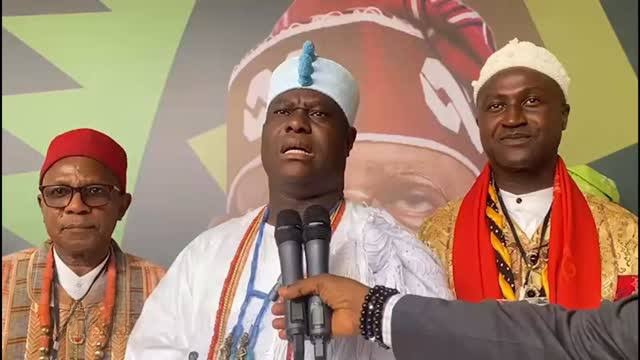
Following the public challenge, the Ooni of Ife addressed journalists and participants at the summit to clarify the situation. His response was measured, authoritative, and designed to reaffirm the council’s legitimacy without creating further conflict among monarchs. He highlighted several key points:
Membership Is Optional: The Ooni emphasized that the Southern Traditional Rulers Council operates on a voluntary basis. Monarchs are free to join or not join, and their autonomy is respected within the structure. He stated, “The Southern Traditional Council is very optional. You do not need to join us if you do not want to, but it is a force, a formidable force among traditional institutions.” This statement reinforced that participation is not coercive, preserving the dignity and independence of individual monarchs.
Council Does Exist and Is Inclusive: The Ooni directly refuted claims of nonexistence by highlighting active participation from monarchs across the southern regions, including the South-East. He noted that several prominent South-Eastern traditional rulers were actively involved in the council’s activities, demonstrating that it is inclusive and represents a wide geographical area rather than being restricted to a single subregion.
Clarifying Purpose and Reducing Division: Beyond asserting existence, the Ooni underscored that the council is intended to foster cooperation and collective advocacy among southern monarchs. He encouraged media and public observers to focus on quality reporting and collaboration rather than spreading impressions of division or conflict. His approach framed the council as a unifying body rather than a contentious one.
Significance of the Intervention
The Ooni’s remarks carried broad implications for Nigeria’s traditional governance landscape. First, his public clarification reinforced the council’s legitimacy in the eyes of both monarchs and federal officials. By addressing the issue during a formal summit, he underscored that the council is not merely symbolic but functions as a platform for coordination among traditional institutions.
Second, his emphasis on optional membership highlighted the balance between collective representation and individual autonomy, a critical aspect of maintaining harmony among monarchs with diverse interests and histories. Third, the intervention helped reduce public and intra-regional speculation about disunity, promoting confidence that the council could serve as a stable forum for southern monarchs to collaborate on national issues.
Historical Context and the Evolution of Traditional Leadership
The Southern Traditional Rulers Council was conceived as a platform to address the evolving role of monarchs in modern Nigeria. Traditional rulers have historically acted as custodians of culture, mediators between communities and government, and arbiters of social and moral norms. Over time, the scope of their influence has expanded to include advisory roles on policy matters, participation in development initiatives, and advocacy for social cohesion. The council represents an institutionalization of this evolving leadership role, providing a structured forum where southern monarchs can coordinate their activities, share insights, and collectively influence regional and national policy.
Challenges to the council’s legitimacy, such as those raised by the Eze Ogbunechendo, are not unprecedented. Southern monarchies have often navigated internal disagreements, questions of hierarchy, and debates over representation. In the early 2000s, there were disputes over regional coordination structures, with some rulers preferring ad hoc meetings while others advocated for formal councils. The formation of the Southern Traditional Rulers Council was a response to these historical tensions, creating an enduring platform for dialogue that respects autonomy while promoting collective influence. By defending the council, the Ooni positioned it as a continuation of centuries of adaptive leadership that allows traditional institutions to remain relevant while responding effectively to contemporary social and political challenges.
The council’s creation also reflected the need for southern monarchs to present unified positions in a federal system where multiple layers of government influence decision-making. From infrastructure development to social welfare initiatives, southern communities often require coordinated advocacy to ensure that their interests are addressed. The council provides a mechanism for this advocacy, allowing rulers to pool resources, align strategies, and engage with the federal government from a position of shared authority. The Ooni’s defense of the council at the 2026 summit was therefore not only about legitimacy but about ensuring that southern monarchs continue to exercise meaningful influence in matters that affect their people.
Broader Context: Traditional Leadership in Modern Nigeria
Nigeria’s traditional leadership system operates alongside modern governance structures, creating a dual authority framework. Monarchs and councils often serve advisory roles, mediate disputes, and provide cultural continuity, while the federal and state governments exercise legal and political authority. The Southern Traditional Rulers Council represents an effort to coordinate the voices of multiple monarchs in regional advocacy and dialogue with the federal government.
Disputes about its legitimacy reflect broader challenges faced by traditional institutions: maintaining influence without overstepping autonomy, navigating regional rivalries, and responding to media scrutiny in an era of rapid information dissemination. The Ooni’s intervention illustrates how prominent monarchs manage these challenges by articulating clear principles, emphasizing inclusivity, and reaffirming institutional purpose.
Implications for the Future of Southern Traditional Councils
The Ooni’s clarification has implications beyond the immediate dispute. It may encourage other councils to clearly define membership, purpose, and mechanisms for resolving disputes. It also sets a precedent for how monarchs communicate with the public and media about internal governance issues.
By affirming that the council is inclusive, optional, and cooperative, the Ooni positioned the Southern Traditional Rulers Council as a model for balancing tradition, regional representation, and national engagement. The intervention may also encourage further dialogue among southern monarchs to strengthen collective decision-making and prevent future public disagreements from undermining credibility.
Closing Thoughts
The dispute over the Southern Traditional Rulers Council in February 2026 highlighted tensions inherent in Nigeria’s traditional leadership system. The Ooni of Ife addressed the controversy with clarity, authority, and emphasis on inclusivity, reinforcing both the council’s legitimacy and the voluntary nature of participation. By framing the council as a cooperative and unifying institution, he mitigated the impact of public criticism and guided the narrative toward collaboration rather than conflict. This episode reflects the ongoing relevance of traditional institutions in Nigeria’s political and cultural life and demonstrates how prominent monarchs navigate challenges of legitimacy, representation, and public perception.
The National Traditional and Religious Leaders Summit on Health in Abuja, attended by President Bola Tinubu, federal officials, and monarchs from across Nigeria, provided the appropriate platform for this clarification, reinforcing the council’s authority and the Ooni’s leadership role. The way this dispute was addressed may serve as a reference for handling future disagreements among monarchs and for enhancing cooperation between traditional institutions and government structures in Nigeria.