
Long before the hit records and bright stage lights, Crayon was just another young Lagos dreamer standing at a crossroads. On one side was the path many Nigerian parents hope their children will follow: university, a stable career, a predictable life. On the other was music, uncertain and unforgiving, where talent alone rarely guarantees success.
The moment of decision came quietly. Sitting for the post-UTME exam that could have secured him admission into the University of Lagos, Crayon reportedly walked out before finishing the test. For him, the lecture halls and campus life would have to wait or perhaps never come. Music, for him, was calling louder than any degree.
That choice would eventually lead him to the doors of Mavin Records, the influential Afropop powerhouse built by legendary producer Don Jazzy. Inside that ecosystem, Crayon would spend years learning the craft, releasing music, and chasing the elusive breakthrough that turns promising talent into a household name.
For a while, it seemed the story was unfolding exactly as planned. Signed through the label’s imprint Blowtime Entertainment in 2019, Crayon quickly emerged as one of the colourful new voices of Afropop, delivering energetic records and dance-ready melodies that fit comfortably within Mavin’s hit-making machinery. But the journey inside a major label is rarely straightforward.
As the years passed, success came in waves. It was sometimes loud, and other times, quiet. Breakout singles brought moments of visibility, yet questions occasionally lingered among fans about where exactly Crayon stood within the Mavin constellation of stars.
Then came the exit.
When Crayon eventually moved on from the label that helped introduce him to the mainstream, the moment reignited curiosity around his time there. Was it simply the natural end of a contract? A strategic step toward independence? Or did the departure hint at deeper tensions within the machinery of one of Africa’s most influential music collectives?
The truth likely sits somewhere between ambition, business and the complex realities of life inside a powerhouse label.
This is the story of Crayon’s years within Mavin…the rise, the records, the difficult seasons and the rumours that followed his departure.
From Trenches to Dreams


Long before the studio sessions and chart ambitions, Crayon was growing up in the crowded margins of Lagos. It was the kind of environment where survival often takes precedence over dreams.
Born Charles Chibueze Chukwu in Orile Iganmu, his early childhood unfolded in one of the city’s densely populated neighbourhoods. When he was seven, his family moved to Ojo on the Lagos mainland, settling into a “face-me-I-face-you” apartment.
Money was scarce. As the eldest child, responsibility came early. School fees were sometimes difficult to pay and there were periods when he was sent home because the family could not meet the costs.
His mother ran a modest fruit stall in Iyana-Iba, where she reportedly sold fruits for nearly two decades to support the household. The stall became a daily lesson in endurance. As a teenager, Crayon often helped his mother and occasionally hawked fruits in traffic. Yet even amid the grind of survival, music quietly took root.
Influenced by Afrobeats, hip-hop and gospel sounds that played around his neighbourhood, Crayon began developing the melodic instincts that would later define his recordings.
Years later, when he titled his debut album Trench to Triumph, the phrase reflected lived experience rather than metaphor.
Eventually, that journey from cramped apartments in Ojo would lead him to one of the most influential music institutions on the continent.
The Mavin Door Opens
By the late 2010s, Lagos had become the epicentre of Africa’s pop music boom. For young artists hoping to break through, few destinations carried as much weight as Mavin Records.
Founded in 2012 by Don Jazzy, the label had built a reputation as one of Afrobeats’ most reliable hit factories.
Crayon’s entry into that ecosystem began through connections with Baby Fresh, a longtime producer within the Mavin structure. Baby Fresh reportedly took interest in the young singer’s melodic instincts and eventually brought him into the creative orbit of the label.
Initially, Crayon spent time around the studio environment, observing sessions and learning the rhythm of professional recording. The exposure offered him a rare glimpse into how major Afropop hits were crafted.
In 2019, the opportunity crystallised. Crayon was officially signed to Blowtime Entertainment, an imprint operating under the Mavin umbrella and run by Baby Fresh.
For the singer who had once helped sell fruit in Lagos traffic, it was a life-changing moment.
The Mavin House Years


Once inside Mavin, Crayon entered an environment that functioned almost like an academy for pop music.
New artists were rarely rushed into the spotlight. Instead, they spent long hours in studios, refining their sound and learning from established professionals within the label’s network.
During this period, Crayon encountered major figures associated with the label, including Tiwa Savage. Another young artist navigating the same environment at the time was Rema, who had also joined the label’s new generation of performers.
The incubation period eventually produced Crayon’s first project.
In 2019, he released his debut EP, Cray Cray. It’s a six-track introduction that showcased his colourful vocal delivery and dance-friendly Afropop sound. Songs like “So Fine,” “Bamiloke” and “Gock Am” reflected the polished production style associated with the Mavin camp.
The project served as his official introduction to the Nigerian music industry.
The Breakout — Finding His Sound


Following the EP, Crayon began steadily building his catalogue.
Singles such as “Kpano,” “On Code,” and “Sometime” continued developing his vibrant Afropop style.
The song that significantly expanded his reach arrived in 2021 with “Ijo (Laba Laba).” The track gained strong radio play and digital traction, becoming one of the most visible records of his career at the time.
Still, his rise unfolded gradually rather than explosively. While some of his songs achieved popularity, his trajectory differed from the viral breakthroughs experienced by some of his peers. In an industry increasingly driven by streaming numbers and social media trends, maintaining attention required constant reinvention.
Inside a label known for producing immediate chart dominance, the pressure to deliver a defining hit remained high.
The Difficult Years
By 2020, Crayon faced one of the most challenging periods of his career.
Despite releasing multiple songs during the year, Crayon said none gained significant traction. In interviews, he later described the period as one of the darkest moments of his professional journey.
Speaking with Korty in 2024, he described how he fell into a deep depression after releasing six consecutive songs that failed to gain the traction he expected.
He also detailed a harrowing mental breakdown where he started acting irrationally, leading to his admission to a psychiatric hospital in Lekki.
Crayon candidly discussed his past struggles with substance abuse like codeine and marijuana, and shared that he reached a point where he felt suicidal, even considering jumping out of a moving car.
The disappointment was amplified by the environment in which he worked. Mavin had built its reputation on launching artists who quickly dominated the charts. For a new signee, expectations were inevitably high.
The global COVID-19 pandemic also disrupted the music economy, shutting down concerts and promotional circuits that many artists relied on for exposure.
For Crayon, the lack of a breakout moment triggered self-doubt and forced him to reassess his artistic direction.
Life Beyond Music — Success Off the Charts


Despite professional uncertainty, Crayon achieved important personal milestones.
As his career progressed, he revealed that he had been able to move his parents out of the cramped living conditions that defined his childhood.
For the singer, the moment symbolised more than financial progress. It represented a form of closure for a chapter defined by hardship and sacrifice.
He also spoke about the emotional cost of pursuing music, noting that he had spent long periods away from home while trying to establish himself in the industry.
The Quiet Questions Around Mavin
As Crayon continued releasing music, conversations about his place within the Mavin roster became increasingly visible among fans.
The label had built a reputation for launching artists whose songs quickly dominated the industry. Within such an environment, comparisons were inevitable.
The rapid global rise of labelmate Rema intensified those comparisons. Online discussions occasionally questioned whether Crayon had received the same promotional push as some of his contemporaries.
Publicly, however, he continued to speak positively about the platform the label provided.
Social Media Storms and Online Speculation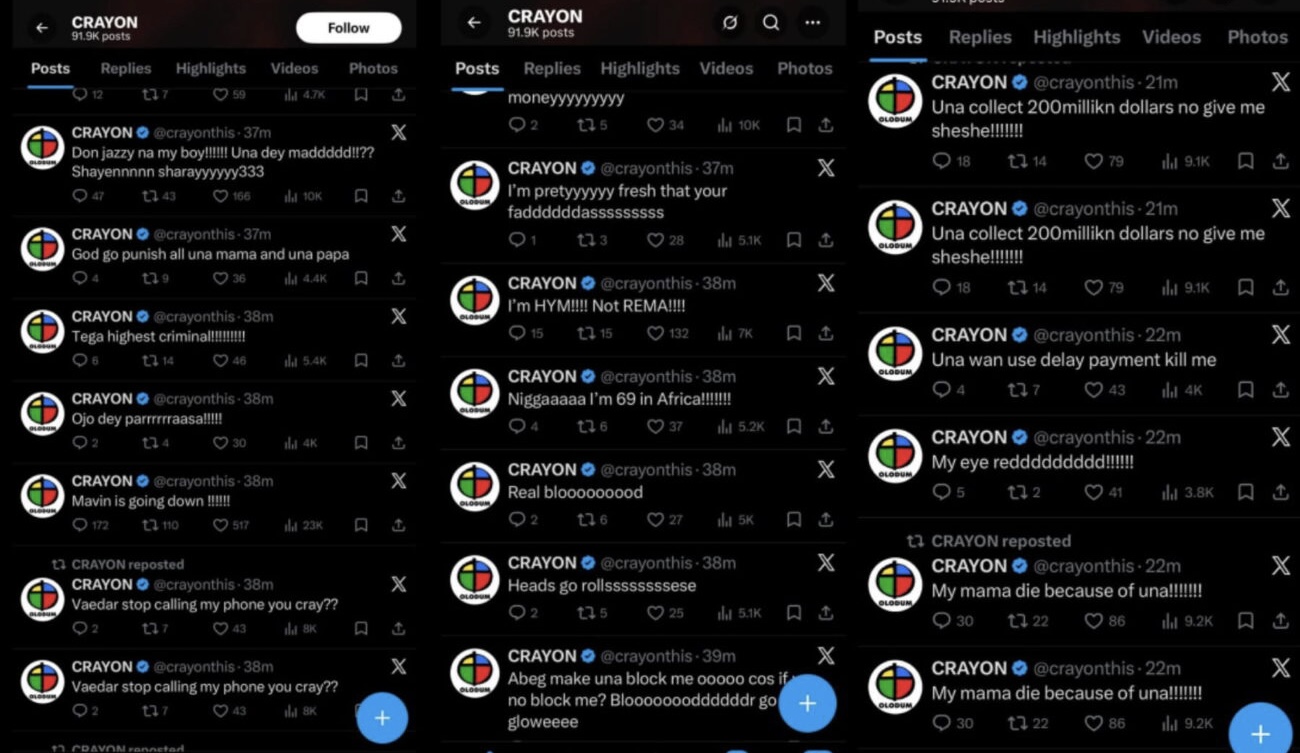

Shortly after reports of his exit from Mavin and launch of his own record label, Olodum entertainment, reports of a fiction with his former label surfaced.
By March 15, 2026, a fresh controversy erupted around Crayon after now-deleted posts attributed to him surfaced on X. In the tweets, he appeared to accuse unnamed figures in the music industry of withholding payments and delaying money owed to him, sparking intense speculation online.
Many social media users quickly connected the alleged complaint to the global hit Calm Down by Rema. The song became one of the biggest Afrobeats records in recent years, achieving massive global streams and reportedly generating hundreds of millions of dollars in revenue. Because of this, some netizens claimed that Crayon may have been referring to royalties or compensation tied to the track, with rumours circulating that he had a role in writing it.
The speculation intensified as people online began suggesting that the tweets were directed at key figures within the Mavin Records camp, including label founder Don Jazzy, Rema himself, and the label’s chief operating officer Tega Oghenejobo.
In one widely circulated outburst, the account posted:
“Una collected 200 million dollars, no give me shishi!!
Una wan use delay payment kill me.
My eye red!!
My mama died because of una!!
Heads go roll!
Don Jazzy na my boy!! Una dey mad!
God go punish all una mama and una papa me.
Tega highest criminal!
Ojo dey para!!
Mavin is going down!!
Vaedar, stop calling my phone, you cray!!”
The posts sparked intense speculation online. Neither Crayon nor representatives of Mavin publicly clarified the situation, and the posts were later deleted.
The Bigger Question
Ultimately, Crayon’s story reflects a larger conversation within the Afrobeats industry.
Major labels like Mavin Records often function as incubators. They discover talent, refine sound and launch artists onto global platforms. But artists frequently transition to new structures as their ambitions evolve.
Crayon’s journey from the crowded streets of Lagos mainland to the studios of Mavin and beyond illustrates that modern Afrobeats careers are defined as much by transition as by triumph.
Whether his next chapter ultimately surpasses the achievements of his Mavin years remains to be seen.
What is clear, however, is that his story follows a familiar rhythm in Nigerian pop: discovery, development, departure and reinvention.