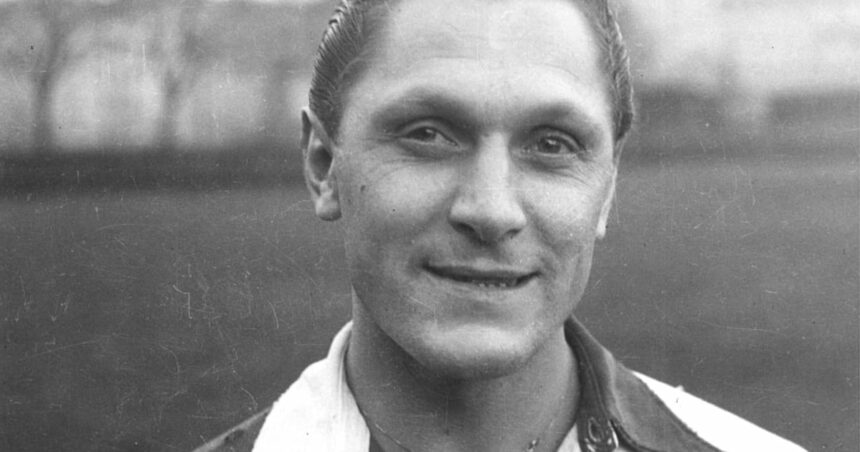
If someone told you a striker once scored over 800 official goals in competitive football, your first instinct would probably be to think of Cristiano Ronaldo, Lionel Messi, or maybe Pelé. But long before modern cameras, social media, and global branding, there was a man who quietly built a goalscoring record that still makes historians argue today, Josef Bican.
Eight hundred and five goals. Some researchers say more. Yet for many fans, his name barely registers in conversations about football’s greatest scorers. That alone feels strange. In an era where every tap-in is archived and every goal is replayed from ten angles, how does a man with that kind of record remain almost invisible in mainstream football memory?
This is not just a story about numbers. It is about timing, history, documentation, and how football decides who deserves to be remembered. It is about how a striker could dominate his generation so completely, yet still be treated as a footnote when modern debates about greatness come up.
My aim in this article is not to hype a forgotten legend or attack modern stars. I want to explain, clearly and honestly, who the striker with 805 goals really was, how those goals were scored, and why his legacy still sits in a strange space between record books and public recognition.
The Striker Who Scored 805 Goals
If you tell most football fans that a striker once scored more than 800 official goals, they will assume you are talking about Ronaldo, Messi, or maybe Pelé. Hardly anyone thinks of Josef Bican. And that is the strange part, because according to FIFA and multiple historical records, Bican’s name sits right there among the most prolific scorers the game has ever produced.
Eight hundred and five goals. Some records even push it higher. Yet when people debate the greatest strikers in history, Bican is usually missing from the conversation. Not because he did not score enough. Not because he was ineffective. But because he played in a time when football was not filmed, not marketed, and not archived the way it is today. So his goals exist in records, not in memory.
This is where the tension starts. On paper, he belongs in the same room as the biggest names the sport has ever produced. In modern football culture, he barely gets a seat. That is what makes his story worth telling.
This is not about saying he was better than today’s stars. It is about understanding why a man who scored that many goals can still feel invisible to an entire generation of fans. It is about how football decides who becomes a legend and who becomes a statistic.
And it is about Josef “Pepi” Bican, the striker who scored 805 goals, and somehow still does not get treated like he did.
Who Is Josef Bican?
Josef Bican grew up long before football was a global spectacle, but even today he remains one of the most remarkable finishers the game has ever known. Born on 25 September 1913 in Vienna, he stepped into professional football at a time when record-keeping was patchy and media coverage almost nonexistent, which is part of why his legacy feels so overlooked now. Despite that, the numbers he put up were staggering and his reputation among historians is undeniable.
Bican’s professional career began in 1931 with SK Rapid Vienna, where he quickly turned heads by scoring prolifically. In his first full season he found the net 51 times in 42 matches across reserve and first-team action, and he continued to rack up goals for Rapid before a contractual dispute stalled his progress for several months. In total for Rapid he appeared 156 times and scored 201 goals, a phenomenal return that highlighted both his natural instincts and finishing ability.
After his time in Austria, Bican moved to Slavia Prague in 1937, where he would cement his reputation as one of the most lethal forwards in European football. Over multiple seasons with Slavia, he consistently led the league in goals, twelve times across his career, and set records that stood for decades. In one of the most extraordinary stretches of his career during the 1939-40 season, he scored at least one goal in 19 consecutive league matches, a European top-division record that went unbroken for more than 70 years until Lionel Messi surpassed it in 2013.
Bican was a rare breed of striker for his era. He was two-footed, meaning he could finish with either foot with remarkable precision, and his pace was extraordinary; some contemporary accounts even suggest he could run 100 metres in around 10.8 seconds, a time that would have been competitive at many athletic meets of the era. This blend of speed, coordination, and finishing made him equally dangerous inside the penalty area and on the break, able to punish defenders in virtually any match situation.
While statistics from those decades can vary, some records credit him with over 948 goals in official matches, while others stick to more conservative figures, the widely accepted and FIFA-acknowledged tally sits at 805 goals in official competition during his career spanning roughly 1931 to 1955. These goals came across league football in Austria and Czechoslovakia and international fixtures, leaving him among the most prolific scorers in the sport’s history.
Beyond the raw numbers, Bican’s style was defined by an uncanny ability to read defenders, find space instinctively, and deliver accurate finishes regardless of pressure or tight marking. His movement off the ball, anticipation of where chances would arise, and sheer consistency made him a nightmare for defenders of his time, traits that measure up with many of the modern greats, even if his name does not always appear alongside theirs in today’s football conversations.
Internationally, Bican also showed his scoring touch. He represented Austria, scoring 14 goals in 19 appearances, and later Czechoslovakia, where he added 12 in 14 matches, demonstrating his ability to find the net at every level he competed.
In all, Josef “Pepi” Bican’s career was a testament to pure goal-scoring instinct at a time when football was far less glamorous, less recorded, and far more chaotic by modern standards. But the legacy of his output, especially for Rapid Vienna and Slavia Prague, still echoes through the numbers and the records that remain part of the sport’s history.
How Bican’s Era Clouds Modern Recognition
When people talk about Josef Bican’s scoring exploits, the figure, 805 goals in official matches is the one that almost always comes up first, and for good reason. That number is widely cited by football historians and has been referenced by high-profile sources that collect career statistics for the sport’s all-time goalscorers. According to multiple records that compile official competitive matches, league games, national cup competitions, and recognised international fixtures, Bican is credited with at least 805 goals in senior matches across his club and international career.
That tally gives Bican a remarkable scoring rate of around 1.52 goals per game, one of the highest in football history across any era. In the context of modern football, where scoring consistently at that rate over hundreds of games is almost unheard of, this figure alone tells you how prolific he was as a striker.
However, as impressive as the 805 figure is, it is only part of the story. The era in which Bican played from 1931 to 1955, lacked the standardised record-keeping we take for granted today. League systems were less unified, many competitions did not maintain complete archives, and not all matches were logged in a way that modern statisticians can easily verify. Because of this, several organisations and historians treat Bican’s official total as an estimate rather than a definitive count.
That’s why the number often gets debated. For example, the History and Statistics Committee of the Czech Football Association, which has gone back through old match reports, league archives, and international records, has publicly stated that Bican’s total in official recognised matches might actually be 821 goals, not just 805. This reassessment includes goals from competitions that may have been overlooked by earlier statisticians, such as second division matches or national cup games that were historically hard to verify. Under that view, Bican’s record would still stand ahead of many modern names in official tallies.
Then there is the matter of counting methodology. The widely used Rec.Sport.Soccer Statistics Foundation (RSSSF), the go-to source for historical goal records across eras, has compiled a much broader tally for Bican when all competitions, regional cups, wartime fixtures, and lesser-documented matches are included.
According to RSSSF’s deep archival work, Bican’s goal total reaches 948 goals in 621 official matches, with dozens more in friendly and unofficial games. That approach is much more expansive than the “official” tally used by FIFA and other organisations, and it underscores just how prolific he was wherever he played.
To add another layer of complexity, different sources have published slightly different figures over time, partially because what counts as an “official” match varies depending on the organisation doing the counting. Some broadcasters and media outlets have even listed totals like 759 goals for Bican based on different interpretations of early football records, which again highlights how murky pre-modern statistics can be.
So when you hear the number 805 attached to Bican’s name, here is what it really means: it is the most commonly accepted official tally of his goals in recognised competitive football, and it places him among the most prolific scorers in the sport’s history. But it is not the only number, and it is not universally agreed upon, partly because the deeper you dig into older competitions, the more evidence there is that the raw total could be higher, possibly into the 820s or even beyond when all credible sources are considered.
In short, Bican’s 805 goals are both a benchmark of historic scoring achievement and a reminder of how football’s early decades resist simple measurement. His legacy is one of extraordinary output, and extraordinary debate, because the numbers that survive tell a remarkable story, even if they are not neatly tied down by modern record-keeping standards.
Comparisons With Other Prolific Scorers
When you talk about prolific goal scorers in football history, Josef Bican’s name sits in the same conversation as modern icons like Cristiano Ronaldo and Lionel Messi, and legendary figures like Pelé and Romário. But the way his record is viewed, and the context around it, highlights just how different eras, record keeping, and visibility shape how we rate goalscorers.
Ronaldo and Messi
Two names dominate modern football scoring charts: Cristiano Ronaldo and Lionel Messi. As of late 2025, Ronaldo has scored well over 930 goals in official competitions across club and international football. His tally continues to grow as he plays for Al Nassr and Portugal, and he has reached milestones like 900+ goals and aims for even more before retirement.
Messi, meanwhile, has also been a scoring force throughout his career, with totals in the high 800s in official play. MessivsRonaldo statistics put Messi’s official totals near 886, combining club and national team goals.
In this modern context, both Ronaldo and Messi benefit from meticulous record-keeping, global media coverage, and a level of documentation that simply did not exist during Bican’s era in the 1930s–1950s. These factors make their numbers easier for fans to absorb and compare year-by-year, which impacts how they are rated relative to earlier greats.
Other Legends
Some of the most famous goal claims in football history come from players whose totals mix eras, informal matches, and varying definitions of “official.” Pelé and Romário, two Brazilian legends, both celebrated personal milestones beyond 1,000 goals. However, much of this tally included friendlies, exhibitions, and non-official competitions, which makes direct comparison with strictly official figures difficult. Sources differ on their official totals; Pelé’s competitive figures, for example, are often listed in the 700s, while Romário’s official competitive total also sits lower than the celebrated 1,000+ figure often cited in media narratives.
Even within the realm of historical scorers, Erwin Helmchen, a German striker active between the 1920s and 1950s, appears at the very top of many raw goal lists. According to deep statistical work by the Rec.Sport.Soccer Statistics Foundation (RSSSF), Helmchen scored at least 989 goals in official matches, and possibly more when counting lesser documented fixtures. While his achievements tend to be overshadowed by the lack of widespread documentation and recognition outside specialist circles, some historians place him ahead of both Bican and modern greats when all official tallies are compiled.
These different figures and lists show just how tricky it can be to compare scorers across generations. Some lists put Ronaldo and Messi at the very top of official goalscoring charts, while others, especially those that include broader categories of matches, place names like Helmchen and Bican ahead. There is no single universally accepted chart once you account for variations in record-keeping standards over nearly a century of football history.
What is clear from these comparisons, though, is that Bican’s record belongs in the same conversation as these legends, not because his goals were “in some forgotten era,” but because his scoring output matches or exceeds the lifetime totals of some of the most celebrated names in football. Yet the way the game evolved and how records were kept during his time means that, for many fans today, his achievements do not automatically register with the same impact as Ronaldo’s or Messi’s, even though the raw numbers and scoring efficiency say he belongs among the all-time great finishers.
Why Bican’s Record Is Still Underrated
Josef Bican’s incredible goalscoring feats, including the widely quoted 805 goals in competitive matches, belong in the annals of football history, yet for many modern fans his name barely registers when discussions turn to the greatest scorers ever. There are a few clear reasons for this gap between achievement and recognition, and understanding them helps explain why his legacy feels quieter than it deserves.
Lack of Visibility and Media Coverage
Bican’s career unfolded long before the age of television and globalised media. During the 1930s to the 1950s, football coverage was limited mainly to newspapers and local radio. There were no live broadcasts, no video archives, and certainly no social media to preserve highlights or build international reputation. Fans today know Cristiano Ronaldo’s goals one minute after they are scored and can pull up Messi’s greatest moments with a quick search. Bican, by contrast, played in an era where even detailed documentation was patchy and footage of his matches is rare or nonexistent.
This lack of visual records means that most fans have never seen Bican play. They know his name from historical lists, not because they watched how he shaped games, exploited space, or punished defenders with his incredible finishing. That absence of visual memory makes it harder for today’s football culture, which thrives on highlights, documentaries, and social media narratives, to fully appreciate his accomplishments.
Record-Keeping Challenges
Another big reason Bican’s goal record remains debated is the difficulty in knowing exactly what to count as “official” goals. Different organisations count goals differently, depending on their criteria. FIFA references a total of around 805 goals, but the Czech Football Association’s History and Statistics Committee, after re-examining archives, claims Bican’s official tally might be 821 goals, including league, cup and national team goals that are now better verified.
Then there are the broader statistical efforts like those by the Rec.Sport.Soccer Statistics Foundation (RSSSF), which attribute even higher numbers when additional competitions and regional fixtures are included. The lack of a singular, universally accepted historical standard means Bican’s official total is fluid rather than fixed. In contrast, modern players like Ronaldo or Messi have every goal tracked digitally and agreed upon by multiple independent data providers, making their numbers feel more concrete and easier for fans to relate to.
Era and Historical Context
Bican’s career was also shaped by forces outside football’s control. His prime coincided with World War II, a period when many international competitions were suspended, leagues were reorganised and documentation was disrupted. Some seasons were shorter, some leagues were regionalised, and some matches from those years are harder to verify, all contributing to debate over how many goals should count in official records.
Because of this, even among historians there is disagreement over which competitions and goals should be included. This ambiguity weakens the clarity of Bican’s record in the eyes of many fans, especially younger ones who have grown up with the clear, well-documented statistics of the modern era.
Modern Fans and Global Exposure
Football today is a global broadcast industry. Cristiano Ronaldo and Lionel Messi have played in front of millions of viewers on live television, built international brands, and had every goal analysed in real time. Bican’s era did not have that infrastructure. His goals were reported in local newspapers, not shown in highlight reels watched around the world. That difference in exposure plays a huge role in how legacies are formed.
Modern fans often learn about historical players through the lens of comparison to current stars. When Bican comes up, his era’s conditions, different leagues, wartime contexts, incomplete match records, lead some supporters to question how directly his achievements compare to those of players in fully professional, globally televised competitions. This skepticism, whether entirely fair or not, contributes to him being underrated in general football conversation.
So when you put these factors together, limited media exposure, disputed record-keeping, and the historical context of his era, it becomes clear why Bican’s record, as remarkable as it is, feels less celebrated than those of later generations. His goals are in the record books, but his presence in the footballing imagination is far more muted.
This dynamic reveals not just something about Bican himself, but about how football builds its legends: visibility and narrative matter just as much as numbers, and in that arena Bican’s era simply could not compete with the broadcast age we live in today.
Football History and Statistics — What Truly Defines Greatness
When debates around scoring greatness turn serious, it quickly becomes clear that numbers alone never tell the whole story. Josef Bican’s remarkable tally, widely reported as 805 goals in official competitive matches over his career, only scratches the surface of what makes a player’s impact truly historic. To understand why his achievements must be seen in context, you have to look at how the game itself has changed over time, and how those changes affect the way goals and records are perceived.
Different Standards Across Eras
Football in Bican’s era was nothing like the highly regulated, globally connected sport we know today. During the 1930s to 1950s, leagues were regional, national competitions varied wildly in format, and consistent record-keeping was far from universal. When Bican was scoring record numbers of goals, including leading Europe’s scoring charts for five consecutive seasons in the late 1930s and early 1940s, much of Europe was engulfed in political turmoil and then war, which disrupted competitions and documentation.
Record keeping in those days was often a patchwork of club documents, newspaper reports, and regional archives, not the unified statistical frameworks that modern analysts rely on. Some matches from that period are missing from historical databases altogether, and others are counted differently depending on the source. Even today’s major archives, from FIFA to RSSSF to national federation records, show slightly different totals for Bican, with some recognising 805 official goals, others suggesting 821, and broader tallies that consider additional competitions pushing even higher.
Contrast that with football since the 1950s: national leagues have stabilised, international competitions are meticulously catalogued, and organisations like FIFA, UEFA, and independent statistical bodies maintain detailed match logs. Modern stars such as Cristiano Ronaldo and Lionel Messi benefit from modern record-keeping that tracks every goal in club and international fixtures with precision, meaning there is little ambiguity in their tallies and little room for debate about what counts or does not count.
This difference in standards makes direct comparison tricky. Ronaldo and Messi might have more officially counted goals, but they have also played in far more matches across highly documented leagues under consistent rules. Bican’s era, by contrast, was defined by fluctuating league formats, cross-border competition interruptions, and periods where international fixtures were limited or completely suspended.
Balancing Legacy and Records
When you look at greatness through a purely statistical lens, it is easy to fall into traps created by inconsistent historical data. But defining a player’s legacy, especially one like Bican’s, requires a more nuanced approach. It’s not just the number next to a player’s name that matters; it’s the conditions under which those goals were scored, the role the player had in shaping team success, and how consistent that performance was over time and circumstance.
For Bican, much of this complexity lies in the era he played in. Wartime disruptions, variations in league competitiveness, and limited international play all influenced how his career unfolded. Yet those same challenges make his scoring consistency all the more remarkable. Scoring at a rate many modern strikers can only dream of, and doing so across unstable and under-documented conditions, suggests a level of instinct and finishing ability that goes beyond spreadsheets and tally lists.
Modern football benefits from contextual data, advanced analytics, defensive metrics, and video evidence that help evaluate whether a goal was scored against a top defence in a tight tactical contest or against a flailing backline in a one-sided match. In Bican’s day, most of this context is lost or incomplete, which means statisticians and historians have to rely on fragmented sources. That uncertainty does not diminish his skill; it simply changes how his statistics are framed compared to those of later generations.
In essence, truly understanding a goalscoring legacy like Bican’s means looking beyond raw numbers and appreciating how the game’s structure, competitive landscape, and documentation standards have evolved. His career invites us to think about greatness not just in terms of GDP-like totals, but in terms of efficiency, adaptability, and consistency across different football contexts, qualities that resonate deeply in any era.
Bican’s Influence on Goal Scoring Culture
Josef Bican may not be a household name among casual football fans today, but among historians, statisticians and many old-school pundits he has quietly become a benchmark for pure goal-scoring efficiency, a standard against which many great forwards are still measured. In an era where most strikers are discussed through the lens of fame and media visibility, Bican’s influence lives on in the way scorers are evaluated and compared across generations.
Impact on Future Strikers and Historians’ View of Scoring
For players who study the history of the game closely, Bican’s scoring output is not just a number, it is a reference point for what clinical finishing looks like. Over his professional career, Bican demonstrated an uncanny ability to convert chances whenever they came his way.
Many of his contemporaries and those who wrote about him later pointed to his consistency and natural instinct in front of goal as something that should be recognised alongside more famous records. When questioned about scoring being “easier” in his day, Bican himself pushed back on the notion, arguing that whether there were few or many opportunities, a chance remained a chance, and finishing it was always difficult. That attitude reflects a core principle of elite goal-scoring: the pressure and decision-making involved in finishing are the same no matter the era.
This perspective has influenced later generations of strikers and analysts to think differently about scoring records. Instead of looking only at totals, a striker’s efficiency, goals per game, and contextual understanding of chances have come to matter more in debates about who qualifies as truly great. Bican’s incredible goals-per-game ratio, often estimated around 1.52 goals per match at club level, remains one of the highest on record, and it is frequently referenced by statisticians comparing scoring across eras.
How Scoring Has Evolved Tactically and Physically
The way goals are scored has changed dramatically since Bican’s day. In the 1930s to 1950s, football tactics were generally simpler and less structured than modern systems. Defences were not organised into the sophisticated zonal or pressing frameworks seen today, and fitness standards varied widely between teams.
Despite these differences, the essence of scoring, creating space, anticipating play, controlling the ball and finishing, remains constant. Bican’s success across multiple leagues and his adaptability in different tactical contexts demonstrate how timeless certain striker attributes are, and how they continue to inform how coaches and analysts evaluate attacking players.
Over the decades, football’s tactical evolution has introduced formations and styles that either open up space for strikers or tighten defensive structures to make scoring more difficult. From the WM formation of the mid-20th century to the modern emphasis on pressing and compact defence, the game has continuously adapted.
In this environment, the idea of a “pure finisher”, a player whose main quality is the ability to convert chances with almost mechanical efficiency, has had to compete with forwards who also bring playmaking, pace, dribbling and tactical versatility to their role. Bican’s legacy reminds fans and analysts alike that even as roles shift, the ability to score goals reliably remains at the very heart of what it means to be a great striker.
Perhaps most importantly, Bican’s story highlights how goal-scoring is shaped not just by talent but by context: wartime disruptions, league structures, and the absence of global media meant his feats were recorded differently than those of players in later generations. Yet despite these challenges, his numbers continue to serve as a hard benchmark in historical rankings and debates, and his approach to finishing, instinctive, relentless and centered around the basics of good positioning and sharp decision-making, influences how we think about scoring excellence even in 2025.
In the end, Bican’s influence on goal-scoring culture is not about how famous he became, but about how his achievements have shaped what we value and how we measure effectiveness in the striker’s role. His legacy persists in the way prolific scorers are analysed, remembered and compared, a fitting tribute to a player whose feet did most of his talking long before football had the language of global broadcast to match them.
Conclusion
Josef Bican’s story is not just about 805 goals. It is about what happens when greatness is born too early for the world to properly remember it. His record matters because it represents a level of finishing consistency that few players in any era have ever touched. Season after season, in unstable leagues, through wartime disruption, and without the benefit of modern structure or visibility, he kept scoring. Relentlessly.
But his legacy also exposes something uncomfortable about football history. The game does not only reward achievement. It rewards timing, exposure, documentation, and narrative. Bican had the achievement. He did not have the machinery that later generations enjoyed to turn achievement into global memory.
That is why debates around his record still feel unresolved. Not because his goals were imaginary, but because football never learned how to properly archive his dominance in a way that modern fans can emotionally connect with. His career reminds us that statistics without context can mislead, and context without visibility can erase.
If we are honest about football history, we have to accept that greatness does not exist in a single format. Some legends are built on video. Some on trophies. Some on moments. And some, like Bican, are built almost entirely on numbers and testimony. None of those paths is less valid than the other.
So remembering Josef Bican properly means doing something football does not always do well: judging players by the reality of their era, not the comfort of ours. It means recognising that a man who scored over 800 goals did not fail to become a legend, football simply failed to preserve him as one.
And maybe that is the real lesson in his story. Not that Bican needs defending. But that football history itself still needs to learn how to remember.