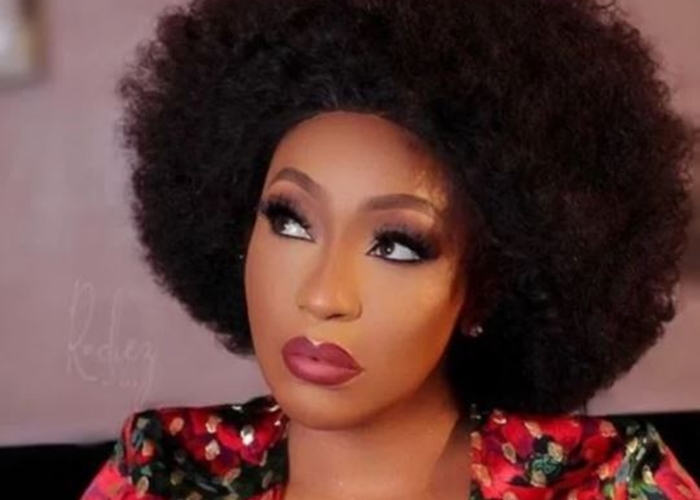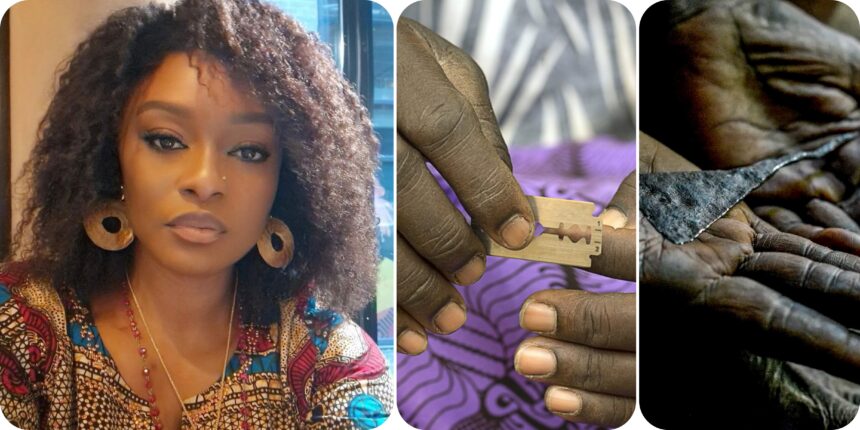
On a recent Instagram Live session with media personality Daddy Freeze, Nollywood actress Victoria Inyama revisited a deeply personal childhood experience where she underwent circumcision. She spoke of being given local alcohol, restrained, and overwhelmed by pain she says may have made her faint. But it was not the account of trauma that drew the most attention, it was her conclusion.
In a country where the practice remains a sensitive and contested issue, her remarks have reopened difficult questions about culture, memory and the line between personal belief and public health.
Here are five key things she said and why they have raised eyebrows.

1. She Was Circumcised at a Very Young Age
Speaking during the Instagram Live with Daddy Freeze, Victoria Inyama said she underwent circumcision as a child. She revealed the decision was made within her family while she was growing up in the village with her grandmother.
According to her, she was about five or six years old at the time, an age where she had no real understanding of what was happening or the ability to consent. She suggested it’s how it’s usually done in many traditional communities, where elders decide as part of raising a child. She said:
“Yes I was [circumcised] because I grew up in the in the village with my grandmother but that is what is helping me oh Ife that is what is helping me.”
2. She Clearly Remembers the Pain and Trauma
Beyond stating that it happened, Victoria Inyama gave a vivid account of what the experience felt like, adding that it has stayed with her over the years.
She recalled being given kai kai (local alcohol) beforehand, suggesting it was used to dull the pain. Even at that, she said the procedure was overwhelming.
According to her, she was physically held down while it was carried out. The pain, she explained, was so intense that she believes she may have passed out at some point.
Despite being very young at the time, Inyama said she can still remember the moment. This detail underscores the lasting psychological impact such experiences can have, even when they happen in early childhood. She recalled:
“I think I probably was like five, six so that’s what I remember. I can remember the pain, the trauma… they will give you kai kai and that kai kai is the original akpete. So you would drink it…then I remember they held me down… the pain, I think I fainted. I just think I fainted… it’s a specialist that does it and it’s just one swipe.”

3. She Says the Experience “Helped” Her as a Woman
After recounting the pain and fear surrounding the procedure, Victoria Inyama took a position that many found unexpected.
According to her, the experience has, in her view, had a positive impact on her life. She suggested that it shaped her sense of self as a woman and gave her a certain level of control, particularly in how she navigates relationships and intimacy.
Inyama also implied that, unlike some others who struggle after undergoing the procedure, she sees her own outcome differently. For her, it is not something she views purely through the lens of trauma, but as something that, in her words, “helped” her.
It is this contrast of acknowledging the pain, yet assigning it a positive outcome, that marks a turning point in her remarks. It literally set the stage for the wider debate her comments have sparked online. In her words:
“That’s the best thing. I swear to God because if I say I no dey do, I no dey do. And that is the power that I have as a woman, that is why anybody wey try me, no no I will give you.
That is why you cannot say, ‘Oh, I saw you in this hotel.’ Mba, you cannot say that. That is the best thing my grandmother did for me..”
4. Her Position Contradicts Established Medical and Human Rights Views
While Victoria Inyama framed her experience in a positive light, her position stands in clear contrast to widely accepted medical and human rights perspectives on female genital mutilation.
Global health authorities, including the World Health Organization, classify the practice as harmful, with no medical benefit and significant physical and psychological risks. These include complications such as infections, long-term pain, and emotional trauma.
In Nigeria, the practice is also legally prohibited under the Violence Against Persons (Prohibition) Act, reflecting growing efforts to end it.
Against this backdrop, Inyama’s remarks stand out. Not because she shared her experience, but because she presented a view that challenges the dominant narrative around a practice widely condemned by health experts and advocacy groups.
5. She Revealed Her Daughter Is Not Circumcised And Why
In the course of the conversation, Victoria Inyama also spoke about her own children, drawing a clear line between her experience and the choices she has made as a parent.
She disclosed that her daughter has not been circumcised, explaining that the child was raised in the United Kingdom, where the practice is not only uncommon but also illegal.
However, Inyama added a remark that further stirred conversation. She suggested that circumstances might have been different if her children were raised in Nigeria, noting that cultural expectations and family decisions often play a strong role. In her words, she indicated that if a father insists on such a decision within that setting, it may be difficult to oppose. In her words:
“But nobody owns the children alone, the father has a say. So Yes, even though I had the trauma… but now, I think that’s the best thing that happened to me.”
FGM: Why It Raised Eyebrows

Beyond the deeply personal nature of Victoria Inyama’s story, her comments drew strong reactions because they touch on an issue that remains highly sensitive, widely condemned, and still practiced in Nigeria.
A Practice Still Happening in Nigeria
Female Genital Mutilation (FGM) comprises all procedures involving partial or total removal of external female genitalia or other injury to female genital organs for non-medical reasons. Sadly, it has not disappeared despite increasing awareness. According to UNICEF Nigeria, about 19.9 million Nigerian women and girls have undergone the practice, placing the country among those with the highest numbers globally.
What makes this even more troubling is how early it often happens. Many girls are subjected to it before the age of five, which closely reflects the age Inyama said she experienced it.
Health Risks: Physical and Psychological
Medical experts are clear that FGM has no health benefits. The World Health Organization states that it can cause severe bleeding, infections, long-term pain, and complications with urination. It can also lead to serious problems during childbirth and increase the risk of newborn deaths.
The effects are not only physical. Survivors may also experience anxiety, depression, trauma, pain during intimacy, and reduced sexual wellbeing.
A Human Rights Issue

FGM is widely recognised globally as a violation of human rights. It reflects deep-rooted gender inequality and is often carried out on minors who cannot give consent. It also violates the rights to health, safety, and bodily integrity.
In Nigeria, the practice is banned under federal law, although enforcement is still inconsistent across different states.
Why Her Comments Are Controversial
This is where the debate becomes complicated. Inyama acknowledged the pain and trauma she went through but still described the outcome as positive. That position conflicts with strong medical evidence that clearly shows the practice is harmful.
While some women may attach cultural or personal meaning to their experience, often because of societal acceptance, this does not change the documented risks or the global stance against FGM.
Conclusion
Victoria Inyama’s experience is hers to tell, for reasons she understands best. She believes it shaped her, kept her in check, and influenced how she lives her life as a woman.
But her comments also suggest something more… that while she sees it as discipline, others may struggle with it differently, especially when it affects their ability to find sexual satisfaction.
That contrast is what makes the conversation difficult. What feels right to one person may not reflect the reality for many others and that is where the questions begin.
In the end, the push by governments and health authorities against female genital mutilation is based on one key point: the risks and harm far outweigh any perceived benefits, and the practice is considered unnecessary for girls and women.