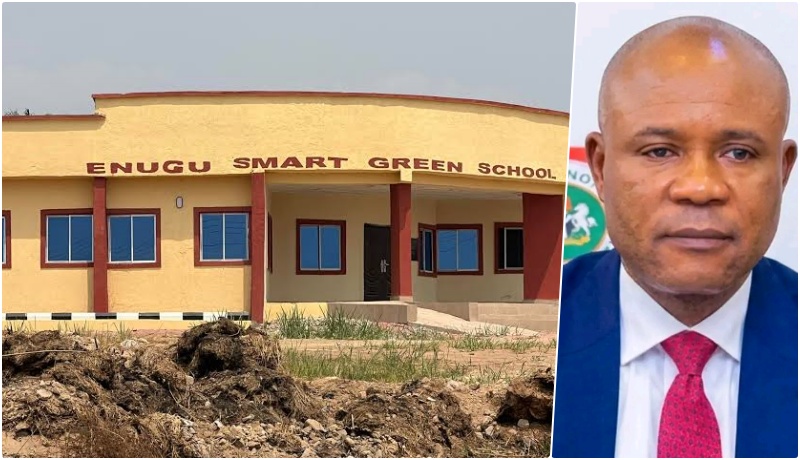
On September 22, 2025 Enugu State government ushered in any education system as it officially began the transition from existing primary and junior secondary schools to Smart Green Schools.
In his speech during a state wide broadcast, Governor Peter Mbah said the shift from old school structures and learning by memorisation to world-class infrastructure and experiential learning had become imperative to equip Enugu children with knowledge and skills to compete in the global economy, stressing that “we are no longer a state waiting to be saved – we are a state shaping the future on our own terms.”
According to him “Africa today is the youngest continent in the world. More than 60% of our people are under the age of 25. By 2050, our population will reach 2.5 billion, and one in every three young people on earth will be an African. This is a stark reminder that our future will be built by young hands.
“This is not just a statistic; it is a summons. It means that the destiny of African nations rests on what we nurture in the minds and hearts of our children.
“If we raise them well and leave them opportunity, when they inherit tomorrow; when they own it; they will shape it and defend it. If we fail them, no amount of slogans will save us,” he stated.
The governor further stated that his administration’s slogan, “Tomorrow is here,” was not just a catchphrase for Enugu, but “a covenant with that future,” adding that Africa’s sovereignty rests on the quality of its human capital.

“It is the recognition that the sovereignty of our state, of Nigeria, and indeed of Africa, will be determined by the strength of our young people – their ability to think critically, to innovate, and to act with integrity.
“Our sovereignty begins in the classroom. It begins with how we choose to welcome the child into the world. And this takes time, care – and investment,” he said.
He cited his personal experience where he had to journey from “the slums of Port Harcourt, where every day was a struggle and nothing was guaranteed,” Mbah said education and resilience were his “passport to a life of possibility.”
“At home and at school, when a community receives and educates each child as a whole human being, it is akin to public service at the deepest level.
“The habits a child rehearses – attention, curiosity, patience, empathy, self-belief – become the civic habits of our culture. A school day shaped by rhythm, responsibility, and care quietly trains the nervous system for self-regulation and the social muscle for cooperation.
“Those capacities later show up as lower violence, stronger communities, and a public square that can tolerate disagreement without tearing itself apart.
“The school, then, is not just a service; it is a commons where the human village renews itself,” he added.
He noted that the Smart Green Schools represent the most personal and transformative project of his leadership.
“They are not only schools – they are my promise of a new society; my covenant with the Enugu child. In them, Tomorrow Is Here finds its truest form.
“Each of the 260 schools is designed as a complete ecosystem for learning. ‘Smart’ means integrating technology, critical thinking, and problem-solving into every subject. Each has about 25 digitally-connected modern classrooms, ICT centres, robotics and AI labs, e-libraries, and spaces for experiential learning.
“They are ‘green’ because they have renewable energy sources and smart farms where children plant, grow, and harvest, learning agriculture not as theory but as practice.
“And they are inclusive. Every child is provided with free uniforms, books, meals, and tablets. Each school has its own medical clinic, reliable water systems, and community halls that anchor the school in village life. Housing for teachers is on-site so that the best educators live within the communities they serve, ensuring continuity of care and commitment.
“Smart Green Schools are not just an investment in classrooms, but in the soul of our people. The habits a child rehearses, of curiosity and collaboration, become the civic habits of the culture. A generation raised in schools of innovation will build an economy of innovation. A generation raised in classrooms of fairness will create a politic of justice.
“So, those buildings are beyond mere bricks; we see in them children eagerly looking forward to the future.”
Gov. Mbah said “in the new model, the classroom is a creativity hub; learning becomes experiential; theory meets practice, and knowledge is translated into tangible skills; children are able to put into practice what they have learnt.”
According to him, “this journey has not been easy. We know that every Smart Green School is not yet complete. There have been setbacks, delays, and challenges to overcome.
“While some schools will open today, some will open next week, and yet some more in a fortnight.
“We do not claim perfection. What we do claim is resolve.
“We set out with a bold vision, and boldness sometimes requires a little more time. But by all means, every school shall be open this term. No school’s academic calendar will be interrupted. We have planned for every contingency.
“Make no mistake: we will deliver. Because attending a Smart Green School – even if it means waiting a few more weeks – is worth it. It is the transformation of a lifetime for our children, and we ask for your patience as we finish the work. We’re doubling down on our commitment,” he assured.
He urged the communities to protect the schools as if they were their own children.
“These schools are a once-in-a-lifetime opportunity to bring world-class education home to Enugu. Cherish them. Defend them. Guard them as a community. Take shared responsibility for our future, which is walking in on two small feet every time a child enters these gates.
“Support the teachers – the custodians and guardians of our future farmers, entrepreneurs, nurses, artists, engineers, lawyers, and leaders.
“They are the cornerstone of this transformation. Equipment and buildings matter, but machines do not teach; people do,” he stated.
However, few days to the resumption of schools across the state, there has been growing concern that this lofty dream may go down the drain as more than one hundred thousand public school pupils are in the risk of unwittingly dropping out of school.
WITHIN NIGERIA gathered that this ugly situation is engineered by transition to Smart Green School by the state government.
Findings showed that the said Smart Green Schools would be built across the 260 wards of the state; a project that will gulp N420b, according to the state governor.
However, with the completion of some of these new schools, both the teachers and pupils are to move out of the old school structures to the Smart Green Schools, some located about ten kilometres away from their homes or previous schools.
WITHIN NIGERIA reporter gathered that the teachers have been posted to these various smart schools since closure of second term in March.
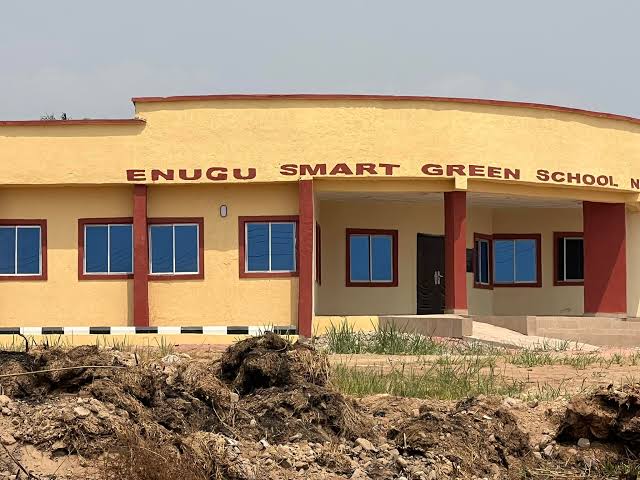
By and large, some of the smart schools visited by our reporter showed a sign of abandonment.
At Eha-Etiti ward, Eha-Alumona, Nsukka local government area, the Smart school has been overrun by weeds.
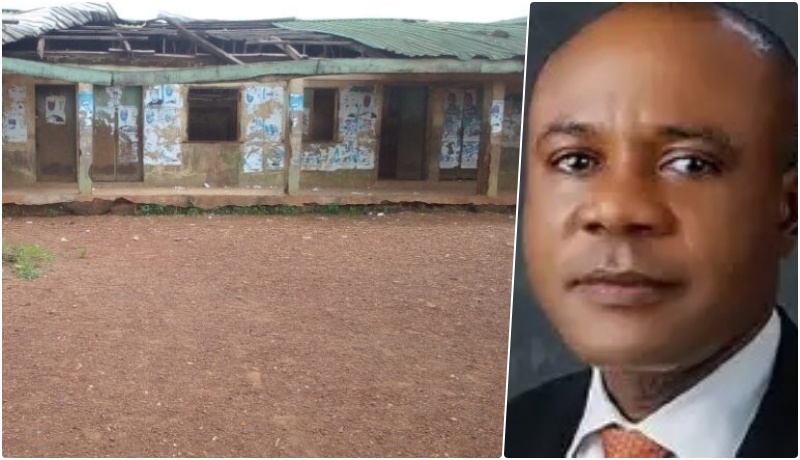
The situation is the same in many of the wards even as some of the new schools have been destroyed by rainstorm.
In any case, with the resumption of school on April 27, there is growing concern over the accessibility of these new schools by the pupils as the distance between some communities and the schools are far.
Lamenting the situation, Gregory Akubue, a native of Aku community, Igbo-Etiti local government area of the state told our reporter that the situation will certainly throw some pupils out of school.
According to him, “eight community schools in Mgboo, Aninri LGA will be closed down for the children of these schools to go to one smart school. What does the governor really want to achieve? To satisfy his ego or to provide qualitative and quantitative education for the people of Enugu State? If the latter is the answer, then his approach is opposite of his intention.”
Narrating further, Mr. Akubue stressed that “let me give you some names of primary schools in Aku town. Amogu Primary School, located in Amogwu Aku. The people feel a sense of ownership. We have Ugwunani Primary located in Ugwunani Aku, etc. The distance between these two communities is far, but the governor is saying that they must attend the same school.”
He stressed that ” you can imagine that when officials of ENSUBEB went to Isuawa in Awgu local government area to share uniforms to pupils, no pupil was seen because the smart school was built across Enugu Port Harcourt Express Road. For a small child in Isuawa to go to school in the morning, they have to cross Port Harcourt Express Road to access education. For now, that crisis isn’t resolved.
“How possible and convenient is that? How can a pupil of six, eight years whose parents are living from hand to mouth trekk a distance of about eight to kilometres every day in the name of going to Smart Green School? I still don’t understand why the governor is wasting scarce resources on these smart schools.”
A teacher at a public school in Udenu local government area who spoke to our reporter under anonymity lamented that the state government will surely lose a lot of public school pupils to substandard private schools as a result of smart schools.
“Currently, Enugu State has about 1,216 public schools. In their minds and from what’s going on so far, Enugu State is closing down 1,216 public schools for 260 schools. This means all the teachers in the current public schools are being moved to the smart schools. Most of the old public schools, as I speak, do not have teachers again. They will just be there, probably taken over by hoodlums and other criminal elements.
“But, another bad side of it is that most of these public school pupils who will not be able to make it to Smart Green Schools due to convenience and cost of transportation to and fro school will just end up getting enrolled in all these substandard private schools. No doubt, many will surely drop out of school completely.”


Zion Ebuka is a social critic in Enugu, he told our reporter that the management of the smart schools by the state government is like pouring old wine in new bottle.
“I begin to wonder what is wrong with our governments in the first place. How can the governor build tech schools across the state, youths are there who are gurus in technology and Internet, but the government chose to push 1980 teachers, old women and old men who cannot even operate an android phone, into the new Smart Schools. This is a typical example of putting old wine into a new keg.
“For crying out loud, our kids in the Smart Schools will continue to receive the same ancient model of education that is outdated already. Even, most of these old teachers don’t want to join the Smart Schools but the government is forcing them into it.”
Narrating further Ebuka said “two years ago, in August 2024, youths of Enugu participated in the Smart School recruitment exams, wrote computer based exam. Many of them passed it, but the government doesn’t see the need to employ these tech savvy youths into the Smart Schools. They are forcing old women and old men who started teaching since 1980s to go and teach in the Smart Schools.
“My good people of Enugu State, I don’t understand what the government is doing in our education sector. In the end, one can boldly say that there’s no need for Smart School initiative at all since it’s the same archaic education that will be delivered to our pupils by these ancient teachers they just forced into the Smart Schools.”
Nevertheless, all efforts to get the reaction of state commissioner for Education, Prof. Ndubueze Mbah proved abortive as he was not picking his calls.