Debate over whether former President Goodluck Jonathan can legally contest another presidential election has again returned to public attention ahead of the 2027 political season.
The renewed conversation followed a fresh suit filed before the Federal High Court in Abuja seeking a declaration that Jonathan is constitutionally barred from seeking the presidency again.
In the case marked FHC/ABJ/CS/2102/2025, a lawyer, Johnmary Jideobi, argued that Jonathan had already taken the presidential oath twice and should therefore be disqualified from future contests.
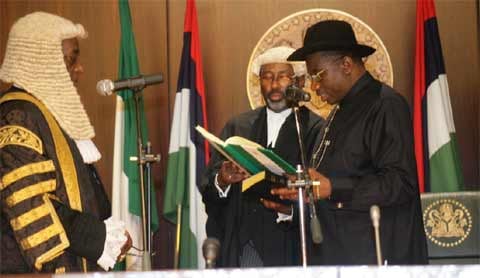
Jonathan first became president in May 2010 after the death of former President Umaru Musa Yar’Adua.
He later secured victory in the 2011 presidential election and remained in office until 2015 after losing his re-election bid to former President Muhammadu Buhari.
However, legal arguments surrounding Jonathan’s eligibility did not begin with the latest court action.
THE 2012 CASE
The earliest major legal challenge surfaced before the 2015 election cycle.
In a suit marked FCT/HC/CV/2449/2012, Cyriacus Njoku approached an FCT High Court in Abuja to stop Jonathan from contesting the 2015 presidential election.
Njoku argued that Jonathan’s assumption of office in 2010 after Yar’Adua’s death should count as a completed presidential term.
According to the plaintiff, Jonathan’s inauguration after winning the 2011 election meant he had exhausted the constitutional limit allowed under the law.
The suit asked the court to restrain Jonathan, the Peoples Democratic Party and the Independent National Electoral Commission from recognising or presenting him for the election.
Jonathan’s lawyers, however, maintained that he had only been elected president once.
The defence argued that his emergence in 2010 followed constitutional succession and not an electoral process contemplated under section 137(1)(b) of the constitution.
Although the court ruled that the plaintiff lacked the legal standing to institute the case, it still proceeded to consider the constitutional issues raised.
In the judgement delivered on March 1, 2013, the court held that Jonathan could not be disqualified because he had only won one presidential election.
The Presiding Judge, Mudashiru Oniyangi, stated that Jonathan was not elected president in 2007 and only assumed office through constitutional succession in 2010.
The court further ruled that the oath taken in 2010 did not amount to a separate electoral mandate.
APPEAL COURT AFFIRMATION
Dissatisfied with the judgement, Njoku challenged the ruling before the Court of Appeal.
On March 3, 2015, a five-member panel of the appellate court upheld the decision of the lower court.
The appellate court held that the constitutional reference to a person “elected” president twice could only apply where an actual electoral process had taken place.
“The process of primaries, nomination, voting, collating and announcement of results must of necessity be involved. These did not take place when the 1st respondent stepped into the shoes of President Yar’adua on the 6th of May 2010,” the court held.
“Again, the succession of a Vice-President to the office of a President who died, in accordance with section 146(1) of the 1999 Constitution, cannot be ‘deemed an election’, especially for the purpose of taking away a right that has been vested.”
The appeal was subsequently dismissed.
THE 2018 CONSTITUTIONAL AMENDMENT
Nigeria’s constitutional framework later changed following the fourth alteration to the 1999 Constitution introduced in 2018.
The amendment inserted section 137(3), which states that a person who completes the tenure of another elected president cannot be elected to the office more than once afterwards.
The new provision directly addressed constitutional succession scenarios similar to Jonathan’s rise to office in 2010.
THE 2022 SUIT
The legal debate resurfaced ahead of the 2023 election.
In 2022, Andy Solomon and another plaintiff filed a suit before the Federal High Court in Yenagoa seeking to stop Jonathan from contesting under the All Progressives Congress.
The plaintiffs relied heavily on section 137(3) of the amended constitution.
They argued that Jonathan’s completion of Yar’Adua’s tenure in 2010, combined with his election in 2011, prevented him from seeking another term.
Jonathan’s legal team opposed the suit, insisting that the constitutional amendment could not be applied retrospectively.
His lawyers argued that the amendment came into effect years after the events being challenged.
The Federal High Court agreed with Jonathan’s submissions.
The court held that section 137(3) became operational in June 2018 and could not invalidate actions or rights that predated the amendment.
The judge also reaffirmed earlier judicial decisions which distinguished constitutional succession from election through voting.
FRESH ARGUMENTS EMERGE
The latest case before the Federal High Court in Abuja has once again revived the constitutional argument.
Jonathan’s legal team, led by Chris Uche, has argued that courts of competent jurisdiction had already determined the issue in earlier cases.
The defence also contended that the present suit amounts to an attempt to reopen matters previously settled by existing judicial decisions.