Every year, Nigerians lose money, time, and sometimes property itself because they bought land, signed a Deed of Assignment, paid in full, and thought the job was done. Some hold on to documents for years before someone tells them the truth: their ownership is not legally complete. The seller might have already sold the same property to someone else. The bank will not accept their title as collateral. And if the matter ever goes to court, they have very little standing because the most important government stamp is missing from their documents.
- Who Actually Needs Governor’s Consent
- Governor’s Consent Nigeria: What It Is & How to Get It
- The Documents You Must Gather Before You Apply
- How the Application Process Works, Step by Step
- What It Will Cost You in 2026
- How Long the Process Takes and Why It Drags
- What Happens If You Skip It
- How It Works Outside Lagos: Abuja and Other States
- The System’s Flaws and What Reform Could Look Like
- Getting This Right Is Part of Owning Property in Nigeria
That stamp is the Governor’s Consent. It is not a formality. Under Nigerian law, it is the thing that actually completes a land transaction. Without it, you may be in possession of a property, but you do not legally own it. That gap between physical possession and legal ownership is exactly where fraudsters operate, where disputes are born, and where buyers find out the hard way that a Deed of Assignment is only as strong as the title perfection process behind it.
The Land Use Act of 1978 is the legal backbone of land ownership in Nigeria, and it makes the Governor the statutory custodian of all land in each state. That single provision is why no one in Nigeria, not even a C of O holder, can sell or transfer land without the state’s explicit approval. Understanding how that approval works is something every property buyer in this country needs.
Why the Governor’s Signature Is on Your Land Deal

Before 1978, land in Nigeria could be owned outright. People held freehold interests, meaning the land was theirs permanently with no government head sitting above it. The Land Use Act changed all of that in one fell swoop. It vested all land in each state in the hands of the state Governor, to be held in trust for the benefit of all Nigerians. What that means for individuals is that you do not actually own land in the absolute sense anymore. What you hold is a right of occupancy, typically for a maximum of 99 years, granted by the Governor.
Because the Governor is technically the landlord of all land in the state, his approval is required every time that land changes hands. Section 22 of the Land Use Act spells it out plainly: it is unlawful for the holder of a statutory right of occupancy to transfer, assign, mortgage, or sublease their interest in land without first obtaining the consent of the Governor. That is not a recommendation or a best practice. It is the law, and ignoring it carries real consequences.
In practice, the Governor does not personally review each transaction. That power is delegated to the Commissioner of Justice or the relevant land bureau, which processes applications, assesses fees, and eventually issues the endorsed consent. But the legal authority behind the stamp is the Governor’s, and that is what makes the document a recognized title in the eyes of the state, banks, and the courts.
This setup applies uniformly across Nigeria’s 36 states and the Federal Capital Territory. Whether you are buying a duplex in Lekki, a plot in Enugu, or a commercial property in Kano, the rule is the same. The only difference is the specific processing requirements and fee structures, which vary by state.
Who Actually Needs Governor’s Consent
There is a common misconception that only first-time land buyers need to worry about Governor’s Consent. The reality is the opposite. The first person to occupy a piece of land gets a Certificate of Occupancy (C of O) from the government. That is the original title. From that point forward, every time the land changes hands, the new owner must get Governor’s Consent. There is no upper limit on how many times this can happen. A property that has been sold five times will have four Consents issued on it, each one tracing back to the original C of O.
So if you buy a property from someone who already has a C of O, you do not get another C of O. You get Governor’s Consent. That is your title. And when you sell the property in the future, the person buying from you will need their own Governor’s Consent. It goes on like that for as long as the land exists within its 99-year occupancy term.
Governor’s Consent is also required for transactions beyond outright sales. If you are taking a mortgage on a property, the lender needs the consent to secure the loan against the title. If you are subletting a property for a term, consent may be required depending on the length. Commercial lease arrangements on C of O land typically require it as well. The law covers assignment, mortgage, transfer of possession, sublease, and any other form of alienation of interest. The word ‘otherwise howsoever’ in Section 22 of the Land Use Act is intentionally broad.
One group that often gets caught out is buyers of apartments in multi-unit buildings. Many people assume that once a developer has a C of O on the land, their individual apartment purchase is fully covered. It is not. Each unit sale is still a transfer of interest in land and, strictly speaking, requires consent. This is an area where legal practice in Nigeria has not always been consistent, but the statutory position is clear: the transfer is incomplete without it.
Governor’s Consent Nigeria: What It Is & How to Get It
Governor’s Consent Nigeria is one of those terms people hear in property conversations without fully understanding what it means in practice or what happens without it. The requirement flows directly from Section 22 of the Land Use Act, and it applies to every land transaction in every state, from Lagos Island to Kaduna to Port Harcourt. This article breaks down what it is, exactly who needs it, how to process it, what it costs, and why so many Nigerians still skip it to their detriment.
The Documents You Must Gather Before You Apply
The application for Governor’s Consent is submitted to the state’s land bureau or Ministry of Lands. Different states have slightly different requirements, but Lagos is the most documented and serves as the closest thing to a national reference point for the process.
For Lagos, the core documents required are: a completed Land Form 1C, which is the official application form that must be dated, signed by both the seller and buyer, and sworn before a Magistrate or Notary Public; a Certified True Copy (CTC) of the root title, which is usually the original C of O or a previously registered Governor’s Consent; three copies of the Deed of Assignment or instrument of transfer, each with a clear, approved survey plan attached; and four passport photographs of the vendor, measuring 5×5, on white background.
If the property involves a company on either side of the transaction, you will also need a Certificate of Incorporation and a form showing the particulars of directors. There is also an administrative fee for charting and endorsement, and a cover letter from the solicitor filing the application. That letter should state the nature of the transaction, identify the parties, describe the property, and confirm the root of title.
One thing that trips up a lot of applicants is the quality of the survey plan. The land bureau requires a plan that clearly shows the property boundaries, reference numbers, and approved survey marks. A rough sketch or an old plan that does not match the current plot dimensions will cause the application to be queried, which adds weeks or months to the process. Get a licensed surveyor to prepare or verify the plan before you submit anything.
The Deed of Assignment itself also needs to be properly drafted. This is not something to leave to a non-lawyer or an agent who dabbles in documentation. The deed must correctly identify the parties, describe the property, state the consideration, and include the necessary covenants. A poorly drafted deed is another common reason for queries at the land bureau.
How the Application Process Works, Step by Step
Once you have assembled all your documents, the application is submitted to the Directorate of Land Services (in Lagos) or the equivalent in your state. The file goes through an administrative workflow that typically involves verification of the root title, a search to confirm there are no existing encumbrances or disputes on the property, charting of the survey plan against official land records, and an assessment to determine the fair market value of the property, which is used to calculate the fees due.
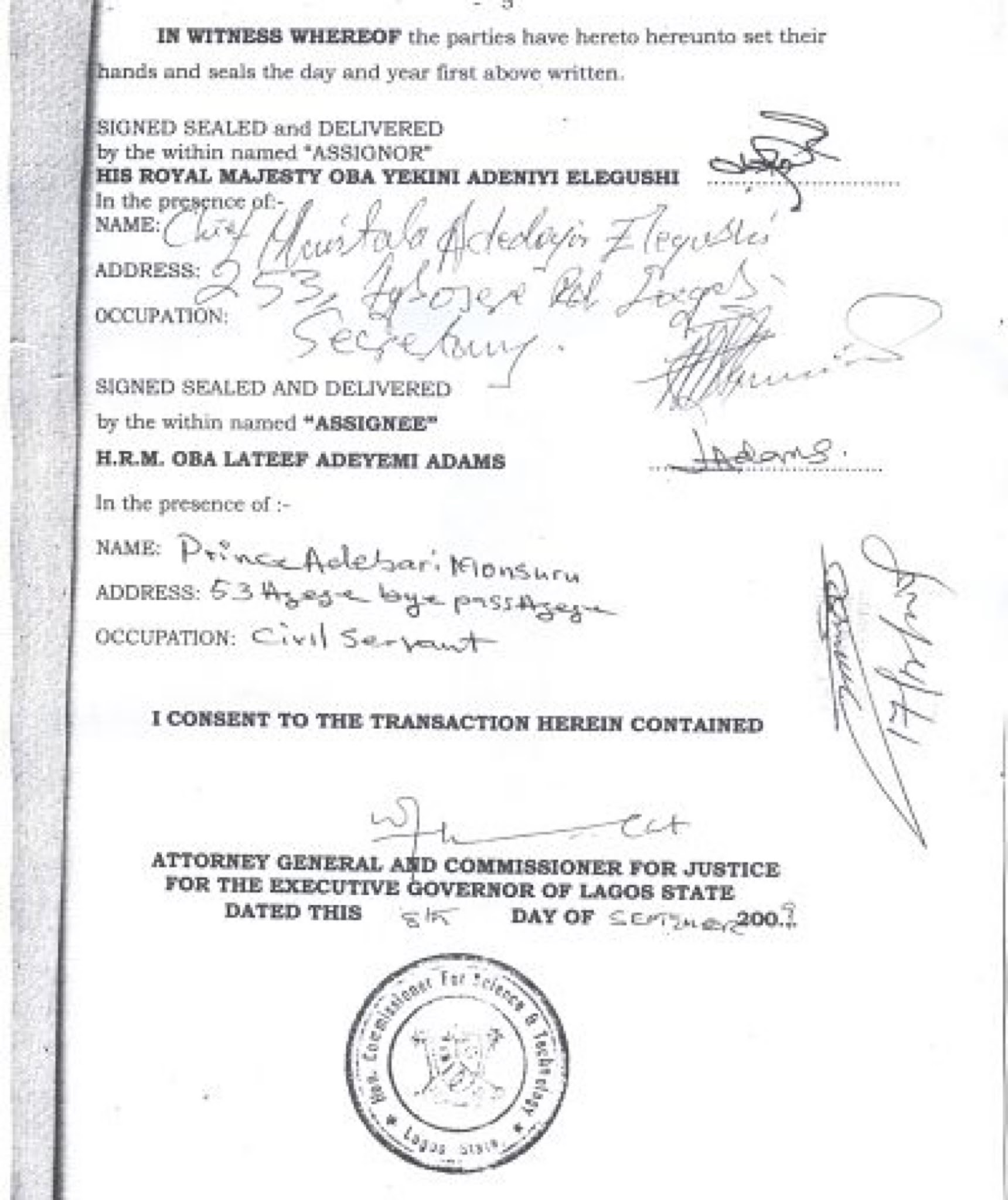
After the assessment is complete, the land bureau issues a Demand Notice. This is a formal letter telling you exactly how much you owe in fees and taxes. It is only after you pay those fees and submit the payment receipts that the process moves forward. The file then goes through further reviews before the endorsed consent is issued, with the Consent number stamped on your documents and recorded in the land registry archives. That Consent number is what makes your title official and traceable.
It is also worth knowing that although the law technically requires consent to be obtained before the transaction is concluded, this almost never happens in practice. In the real world, the sale is completed first, money changes hands, the Deed of Assignment is signed, and only then does the buyer begin the consent process. The consent is processed after the fact. This is standard practice across Nigeria and the land bureaus are set up to accommodate it.
If there are any issues with your documents, including inconsistencies in the survey plan, discrepancies in the description of the property, a defective root title, or missing information in the deed, the bureau will raise a formal query. Resolving a query can take additional months, which is why having an experienced property lawyer on the application from the start is genuinely important, not just a recommendation to ignore.
What It Will Cost You in 2026
The cost of Governor’s Consent is calculated based on the assessed fair market value (FMV) of the property, not the price you paid for it. The land bureau uses official gazette rates that assign values per square metre to different areas of the state. In Lagos, which is the most detailed example, these rates vary significantly by location. Upscale areas attract much higher per-square-metre assessments than off-plan estates on the fringes of the state.
According to data from Estate Intel and corroborated by The Africanvestor’s early 2026 review, the fee breakdown for Lagos looks like this: the consent fee itself sits at approximately 1.5% of assessed value; Capital Gains Tax at 0.5%; stamp duty at 0.5%; and registration fee at 0.5%. That puts the aggregate government-facing charge at around 3% of assessed value for a straightforward sale transaction. Mortgage transactions use a different calculation basis, set at a flat rate per million.
There are also Neighbourhood Improvement Charges (NIC) for private and excised land. These are calculated based on the size of the land multiplied by a prescribed rate per square metre, then multiplied by the number of years since the relevant title was issued. In older estates, this figure can be surprisingly large, so it is worth getting a lawyer to calculate it before you commit to a budget.
When you factor in professional fees, things add up quickly. Legal fees for a conveyancing lawyer typically run at around 5% to 10% of the transaction value on the lower end, though this is negotiable depending on the property value and the firm. Combined with stamp duty, consent fees, registration, and administrative charges, The Africanvestor’s analysis of Lagos transactions found that the total cost of buying and perfecting property in Lagos runs between 10% and 15% of the purchase price. That is one of the higher transaction cost environments in West Africa, and it catches buyers who budget only for the land price.
Outside Lagos, fees are generally lower, but the process is no less mandatory. In Abuja, the Federal Capital Development Authority (FCDA) and the Ministry of FCT Lands Administration handle the equivalent process. Other states have their own fee schedules, and some are less transparent than Lagos about publishing them, which creates room for arbitrary charges at the bureau level. Always demand a formal Demand Notice in writing before paying anything.
How Long the Process Takes and Why It Drags
The Lagos State Government’s stated target is 30 days from application to issuance. The lived reality, across the board, is a minimum of three months. That is if everything goes smoothly: all your documents are in order, there are no queries, and you pay the assessment fees immediately upon receiving the Demand Notice. Three months is the optimistic end.
When there are queries, or when the queue at the land bureau is particularly backed up, or when assessors are slow to schedule site visits, the timeline stretches to six months or more. Stories of people waiting a year or longer are not uncommon on forums like Nairaland, particularly in cases involving older properties with complicated title histories.
The delays come from multiple pressure points. The volume of applications at the Lagos Directorate of Land Services is enormous. Physical files still move through the system in ways that create bottlenecks. Assessors sometimes need to physically inspect properties before finalising valuations, and scheduling those visits takes time. Some bureaus also still operate on systems that require applicants to physically chase their files across offices to track progress.
Several state governments, including Lagos, have in recent years announced moves toward digital land administration. Proposals exist as of early 2026 for more digitized filing and tracking systems. However, the transition remains incomplete in most states, and applicants still largely navigate a process that depends heavily on having someone physically present at the bureau to follow up.
What Happens If You Skip It
The consequences of not processing Governor’s Consent are not theoretical. Under Section 22 of the Land Use Act, any land transaction carried out without the Governor’s prior consent is null and void. That language is unambiguous. You can have a perfectly drafted Deed of Assignment, you can have paid full price, and you can have physical possession of the property. None of that creates legal ownership in the eyes of Nigerian law if the consent is absent.
The most immediate practical consequence is that no Nigerian bank will accept the property as collateral for a loan. Financial institutions are well aware of the legal status of unperfected titles, and a deed without registered Governor’s Consent is simply not bankable. For anyone who wants to use property as an asset to access credit, this matters enormously.
The more dangerous consequence is exposure to double sale. Because your ownership is not registered, the seller’s name remains in the official records. Nothing technically prevents a dishonest seller from going back to the land bureau with a different buyer and processing the consent in that buyer’s name. The original buyer, with their unregistered deed, will have an uphill legal battle. This is not a rare scenario in Nigeria. Property lawyers document it regularly as one of the most common forms of real estate fraud in the country.
There is also the problem of inheritance and estate planning. When an owner dies without having perfected title, the property becomes significantly harder to administer as part of their estate. Family members may find themselves fighting over a property whose legal ownership was never properly established, compounding personal grief with property disputes that can drag through the courts for years.
Even if none of the above happens during your ownership, the problem passes to your buyer when you eventually sell. A buyer who does their due diligence will discover the gap in the title history. Either they will walk away, or you will have to renegotiate the price downward, or the deal will stall while the historical consents are processed retroactively. It is a problem that compounds over time, not one that quietly goes away.
How It Works Outside Lagos: Abuja and Other States
Lagos gets the most documentation and legal discussion, partly because of the volume of real estate transactions there and partly because the state government has published more material about its process than most. But the requirement for Governor’s Consent applies in every state of the federation, including the FCT Abuja.
In Abuja, land administration is handled by the Federal Capital Territory Administration (FCTA) through the Department of Development Control and the Land Administration secretariat. The equivalent of Governor’s Consent in Abuja is the FCT Minister’s Consent, since there is no state governor for the territory. The process involves similar documentation requirements: the Deed of Assignment, survey plans, root title, and payment of assessed fees. Abuja has its own fee schedule, and the zones within the FCT carry different assessed values, with prime areas like Maitama and Asokoro commanding significantly higher assessments.
In states like Rivers, Ogun, Oyo, and Kaduna, the same general framework applies under the Land Use Act, but each state’s land bureau has its own specific procedures and documentation requirements. Some states are more efficient than others. Some have clearer published fee schedules. A number of states in the South-West have benefited from Lagos’s relatively more organized land administration culture, with clearer records and more predictable processes. In parts of the North, particularly in states where customary land tenure was historically stronger, the interaction between the statutory consent process and traditional landholding can be more complex, requiring additional steps to establish clear root title before an application can succeed.
What does not change across any state is the legal requirement itself. Section 22 of the Land Use Act has no geographic exceptions. If the land is in Nigeria and it is being transferred, Governor’s Consent is required.
The System’s Flaws and What Reform Could Look Like
The Governor’s Consent requirement was designed to protect land ownership, ensure orderly record-keeping, and give the state visibility over property transactions within its borders. In theory, those are reasonable goals. In practice, the system has created a bureaucratic bottleneck that encourages non-compliance, fuels corruption, and adds significant costs to property ownership for ordinary Nigerians.
One of the most frequently cited problems in legal and real estate circles is the cost. For a middle-class Nigerian buying a modest property in a mid-tier area of Lagos, the 3% aggregate government charge on the assessed fair market value, on top of legal fees, stamp duties, and agent commissions, is a substantial financial burden. Many buyers, particularly those who have already stretched to fund the purchase price, simply cannot afford to perfect the title immediately. They file the deed away and plan to do it later. Later often never comes.
The opacity of the fee assessment process is another genuine grievance. In theory, the Fair Market Value used to calculate fees is published in official gazettes. In practice, many applicants only learn the actual figure when the Demand Notice arrives, and the gap between what they estimated and what they are asked to pay can be significant. This unpredictability makes financial planning around the consent process difficult.
Experts in property law and urban planning have for years argued that the Land Use Act needs reform. Academic papers and legal commentary consistently point to the over-centralisation of land authority in the Governor’s office as the root cause of the system’s inefficiencies. Some proposals advocate for a more decentralised administrative approach, with the Land Registry handling more of the consent process at a lower bureaucratic tier. Others point to full digitization of title records and applications as the most practical near-term fix, one that would reduce the scope for delays, file loss, and corrupt demands.
The proposals exist. As of 2026, legislative proposals have floated the idea of a unified digital National Land Registry. Whether that materialises depends on political will at both federal and state levels, and Nigeria’s history with land reform suggests patience is required. In the meantime, the practical advice for any property buyer remains the same: factor Governor’s Consent into your budget from day one, hire a qualified property lawyer, and do not put the process off.
Getting This Right Is Part of Owning Property in Nigeria
Governor’s Consent is not a technicality. It is the legal act that converts a private agreement between two people into a state-recognized change of ownership. Without it, the transaction exists only on paper between the parties, and paper between private parties does not protect you against fraud, does not give you access to credit, and does not hold up well in court.
For most Nigerians, property is the largest single financial commitment they will ever make. The cost of perfecting that title, which typically runs somewhere between 3% and 5% of the assessed property value in government charges alone, is real money. But it is a fraction of what can be lost to a double sale, a contested estate, or a failed loan application years down the line. The cost of not doing it almost always exceeds the cost of doing it.
The process is slow, it can be expensive, and it requires patience and professional help. None of that makes it optional. Whatever state you are buying in, whatever type of property it is, the moment you take on land in Nigeria, Governor’s Consent is part of the deal.