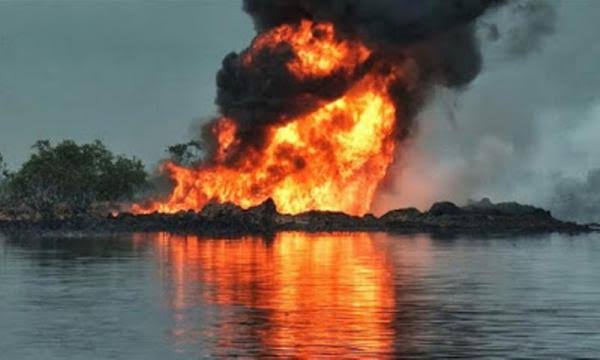
On July 8, 2008, the Movement for the Emancipation of the Niger Delta, MEND blown up two major oil pipelines in a pre-dawn attack in Bayelsa State, marking a sharp escalation of violence following President Umaru Yar’Adua’s amnesty offer to militants.
MEND in a statement released to the media claimed responsibility for sabotaging pipelines operated by Anglo-Dutch oil giant Shell and Italian firm Agip.
According to the group, the Agip pipeline which connects the Agip Brass terminal was sabotaged at Nembe creek while the Shell Nembe creek line was done at Asawo village, all in Bayelsa state.
A Shell spokesperson confirmed it was investigating reports of an attack on its joint venture’s Nembe Creek facility.
MEND, while claiming responsibility for at least seven attacks since the amnesty offer, dismissed the amnesty as a “charade” that fails to address under-development and injustice in the Niger Delta.
MEND also alleged that some youths who responded to the amnesty have been arrested by a joint military and police unit deployed to quell violence.
The militants say they are on a campaign to cripple the oil industry until grievances over inequitable distribution of oil wealth are addressed.
July 8: 150 Protesters from Arutan, Igborodo Hold 700 Workers, Including Foreign Nationals
On July 8, 2002, no fewer than 150 unarmed women occupied ChevronTexaco’s Escravos export terminal in Nigeria’s oil-rich Niger Delta, blocking all exits and preventing some 700 workers from leaving the facility.
The protesters, from the neighboring Arutan and Igborodo communities, forced their way into the multimillion-dollar pipeline terminal.
According to ChevronTexaco Nigeria spokesman Wole Agunbiade, they demanded for jobs for their sons and electricity for their villages.
The Escravos facility, surrounded by miles of delta rivers and swamps, relies on docks and airstrips as its only entry and exit points. The protesters have barricaded both.
About 700 employees were working on rotational shifts at the terminal when the occupation began. Those trapped inside include Americans, Britons, Canadians and Nigerians, a worker at the site confirmed.
“This is not a hostage situation, this is an occupation,” Agunbiade said, adding that workers were not in danger but “cannot do their normal jobs”. The terminal produces an estimated 500,000 barrels of oil a day.
Community leaders say the action follows decades of unmet promises.
“For about 38 years since Chevron has been taking oil from Escravos, nothing to show for it. No development,” said Mrs. Queen Uwawa, Deputy Chairperson of the Escravos Women Coalition.
“Chevron has polluted the rivers and creeks. We used to catch fish and crayfish for food, but that is not possible,” Uwawa added.
Another protester, Christiana Mene, said farms have been lost to pollution: “We cannot farm. We cannot kill fishes and crayfish. That is why we told Chevron that Escravos women and Chevron are at war”.
ChevronTexaco said it had called in security forces and was in talks with the communities to end the demonstration. The women say they will remain until senior executives meet them directly.
The protest marks a shift in Niger Delta resistance. Unlike past actions led by armed men, the Escravos sit-in has been entirely nonviolent. Many of the women are elderly, some with infants strapped to their backs.