Several underprivileged Nigerian women, each running a business with less than ₦40,000 in capital, recently spoke with the online newspaper WITHIN NIGERIA. Despite grappling with the harsh economic realities of the fuel subsidy removal, they shared a striking sentiment: a single ₦50,000 grant or soft loan would be enough to save and sustain their livelihoods.
Recall that Nigeria’s First Lady, Senator Oluremi Tinubu, in June, 2026, told wives of state governors at a Renewed Hope Initiative meeting in Abuja that Nigerian women should consider low-capital businesses such as frying akara, roasting corn, and producing kulikuli.
According to Oluremi, these kinds of low-capital businesses can be sustained or supported with grants rather than loans. The comments drew widespread criticism online, with many Nigerians accusing her of downplaying economic hardship.
Responding to the backlash, Tinubu clarified that the program was not limited to akara sellers, claiming that it also covers tomato, pepper, and vegetable traders in the market. She added that the Federal Government had released N100 million to the Jigawa State Government to support 2,000 petty traders. Under the scheme, each beneficiary will receive a N50,000 grant to recapitalize their business.
This report spotlights Nigerian women operating businesses with less than N40,000 in capital. It documents the challenges of low-capital businesses in Nigeria and assesses whether a N50,000 grant or less could be enough to sustain and boost business outcomes.
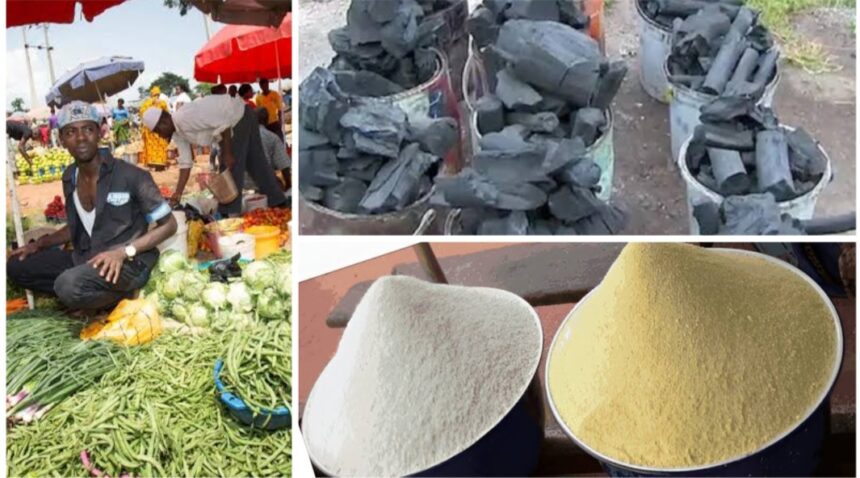
Kemisola, 34, sells garri and charcoal in Ijoka, a neighborhood in Ilesa. She has no store or shop.
“Where do you sell your goods?” I asked.
“I created a space in my one-room apartment,” she said. “Most of my customers are neighbors. They come to my room to buy.”
“Why not get a shop?”
She gave a small laugh. “Shops are very expensive here. The cheapest one, with a caretaker commission included, is N40,000.”
I suggested that having a shop could help her expand and stock other items.
“My whole business capital is N35,000,” Kemisola told WITHIN NIGERIA. “How can I use N40,000 to rent a shop for a business worth N35,000?”
“What if I gave you N50,000 as a loan? Would that help?”
“I can’t take any loan right now,” she replied. “I’m already servicing one with interest. The profit from this business isn’t even enough to take care of my family.”
When I asked about her husband, she said, “He’s alive. He is an Okada rider. We live together. He is not the owner of the motorcycle.”
I asked what impact ₦50,000 would have on her business.
Her eyes lit up. “Do you want to give me the money?”
“Not really,” I said. “I just want to know.”
“It will do a lot,” she replied. “A sack of charcoal is ₦7,500. A bag of garri is ₦18,500. I will buy two sacks of charcoal and two bags of garri. It will boost my gains. Right now, I sell to customers from just one bag of garri and one sack of charcoal.”
Labake (not her real name), 29, sells ponmo and hawks fufu in the evenings. She lives in Imo, a neighborhood in Ilesa, but she has no shop.
Every morning she leaves early for Isua, a rural settlement at the outskirts of Ilesa, to buy cow skin at a cheaper rate. She washes it, cuts it into pieces, and displays it in a covered plastic bucket in front of the house where she lives. While she’s at the back of the house preparing fufu, her fellow tenants and sometimes relatives help sell the ponmo for her.
When WITHIN NIGERIA met her, Labake was arranging firewood to cook fufu. She declined help with the wood but was eager to talk.
“Is this business profitable?” I asked.
“It is decent,” she said. “Better than running after men. It helps my husband provide for our family, even if it’s in a little way. It’s the most important thing for me, though I want it to grow bigger.”
“How much do you need to start your business?” I asked.
Labake smiled. “I started my ponmo business with ₦5,000 back in 2021. I started the fufu business with less than ₦10,000.
Now I buy ₦10,000 worth of ponmo and cut it into smaller pieces. From ₦15,000 worth of ponmo, I make at least ₦3,000 profit.
For fufu, I make at least ₦2,500 profit per batch, sometimes more, depending on the market. I supply most of my fufu to a local canteen, and I hawk the rest.”
“Do you have any loans at the moment?”
“Yes,” she said. “I took ₦20,000 from LAPO. I used part of it for pressing needs at home and put the rest into the business.
I’m a single mother of two. Managing both ponmo and fufu is very demanding.”
I asked her what ₦50,000 would mean to her.
“It’s a lot of money,” she replied. “I would clear my debt first, then use the rest to keep both businesses running.
I really want to start my own small canteen. I can cook. I just need a spot and some capital. I’m also willing to hawk.”
Saudat, 31, is a single mother of one. She sells fruits and vegetables during the day, and fries akara at night. She lives in Oke-Ayepe, Osogbo.
When I arrived, she was pulling a table closer to where she sat. A young boy, about 6, stepped off an okada. I assumed he was hers. She hugged him, checked his lunch box and school bag, took off his uniform, and playfully fed him the biscuits he didn’t finish at school.
I watched for a few minutes before speaking.
“Can I ask you a personal question?”
“What’s that?” she asked.
“How were you able to send your child to a private school?”
“I also run market errands,” she told _WITHIN NIGERIA_. “And I take care of two elderly men. I wash their clothes, clean their houses, and cook for them. They don’t have close relatives in the country, so their children pay me. That’s why I don’t fry beans or sell nylon bags on weekends — I use that time to clean their houses.”
I asked if she had heard about the ₦50,000 grant for low-capital businesses linked to President Tinubu’s wife.
“Yes, I heard it on the radio,” she said.
“What do you think about it?”
“It was grossly misunderstood,” Saudat said confidently. “But people like us who run low-capital businesses know what ₦50,000 can do. The capital for my fruit business isn’t even up to ₦30,000. If I add ₦50,000 to it, the business will grow.”
“What about your akara business?”
“I get beans and vegetable oil on credit from an aunty,” she explained. “After sales, I calculate everything, remove her money, and keep the profit.
If I get ₦50,000, I won’t need to collect anything on credit anymore. It’s really tough times, but we are surviving.”
Seyi Olujide, an economic and financial development expert, told _WITHIN NIGERIA_ that the grant provides much-needed working capital to traders who are often shut out of bank credit.
According to the policy expert, the money puts cash directly in the hands of beneficiaries within days.
“For many, that’s the difference between closing shop and staying open this month,” Olujide said.
However, he warned that ₦50,000 per person only offers short-term relief amid rising inflation and operating costs.
“Most beneficiaries will use it for basic restocking. It helps, but it isn’t enough for real business expansion or to lift households out of poverty on its own,” he said.
Olujide added that the long-term impact of the programme will depend on three things: monitoring, transparency in beneficiary selection, and linking recipients to training, markets, and financial literacy support.
“For now, the grant is being received as immediate support. Whether it becomes a pathway to growth will depend on how well it is scaled and tied to broader economic interventions,” he noted.