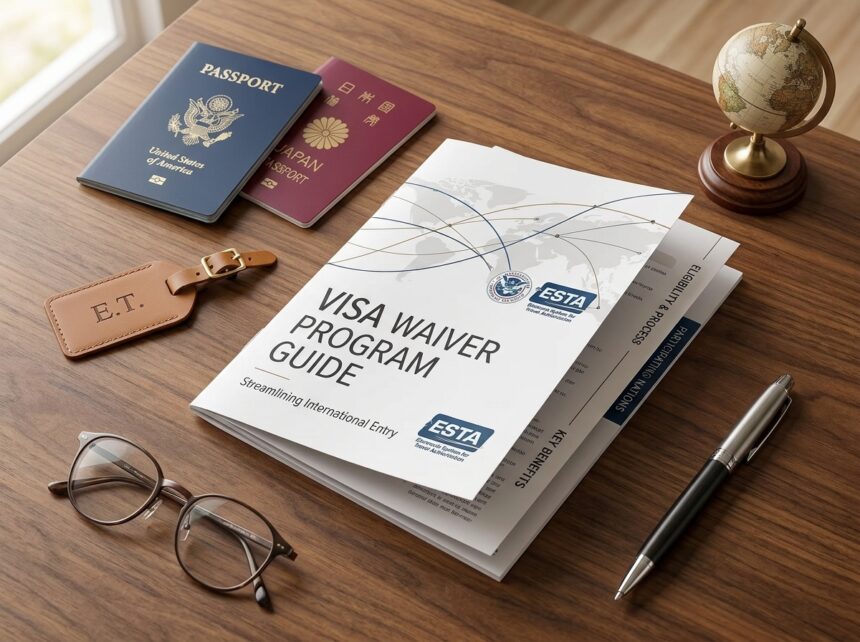
Millions of travelers still skip the visa line every year, and the reason is the U.S. Visa Waiver Program. Under this arrangement, citizens of 42 countries can enter the United States for tourism or business without ever stepping into an embassy, provided they clear a quick online screening called ESTA. Here’s what the program looks like in 2026, who qualifies, and what’s changed.
What the Visa Waiver Program Actually Does
The VWP lets eligible travelers stay in the U.S. for up to 90 days per visit for tourism, business meetings, conferences, or short training, all without a traditional visa stamped in their passport. In exchange, each participating country has to extend the same courtesy to American citizens and nationals visiting for a similar length of time.
It’s a reciprocal deal, not a one-way gift, and that reciprocity requirement is part of why the list of member countries hasn’t grown as fast as some travelers assume.
Rather than a visa, VWP travelers apply for an Electronic System for Travel Authorization, better known as ESTA, before they ever board a plane. It’s a pre-screening tool, not a guarantee of entry. A Customs and Border Protection officer still makes the final call at the port of entry.
The Full 2026 List of Eligible Countries
As of mid-2026, the U.S. Department of State and the Department of Homeland Security recognize 42 countries under the VWP:
Andorra, Australia, Austria, Belgium, Brunei, Chile, Croatia, Czech Republic, Denmark, Estonia, Finland, France, Germany, Greece, Hungary, Iceland, Ireland, Israel, Italy, Japan, Latvia, Liechtenstein, Lithuania, Luxembourg, Malta, Monaco, Netherlands, New Zealand, Norway, Poland, Portugal, Qatar, San Marino, Singapore, Slovakia, Slovenia, South Korea, Spain, Sweden, Switzerland, Taiwan, and the United Kingdom.
Qatar is the newest name on that roster, admitted in 2025 after meeting the program’s security and data-sharing benchmarks. It was the first Gulf nation to join, a milestone that surprised few observers given how closely Doha had aligned its counterterrorism and border-security cooperation with Washington in the years leading up to admission.
There’s been plenty of online chatter suggesting Romania has already joined the club for 2026, and some lower-quality aggregator sites have run with that claim. It hasn’t happened. Romania, along with Bulgaria, Cyprus, and Uruguay, remains in the “aspiring country” category that Washington reviews periodically, not the confirmed member list. If you’re planning travel based on a country’s supposed VWP status, check the official State Department or CBP pages directly rather than trusting a secondhand list.
Who Actually Qualifies
Membership on the list isn’t the only box a traveler needs to tick. To use the VWP, you need to be a citizen or national of one of those 42 countries, not merely a permanent resident. Someone holding a Croatian green card but carrying a different passport, for instance, doesn’t qualify just because Croatia is on the list.
British citizens face an extra wrinkle worth knowing: they must hold the unrestricted right of permanent abode in England, Scotland, Wales, Northern Ireland, the Channel Islands, or the Isle of Man. Not every UK passport holder automatically clears that bar.
Every traveler also needs a biometric e-passport, the kind with an embedded electronic chip that stores identity data and can be scanned at the border. Older, non-chip passports don’t cut it. And in most cases that passport needs to be valid for at least six months beyond the planned departure date from the U.S., though CBP maintains agreements with many VWP countries that soften this requirement somewhat.
How ESTA Works in Practice
Getting an ESTA approval is meant to be simple. Travelers apply online through the official portal at esta.cbp.dhs.gov, submit passport details and answer a handful of eligibility questions, and pay the application fee. Most people get a decision within minutes, though CBP advises applying at least 72 hours before departure in case additional review is needed.
Once approved, an ESTA is generally valid for two years or until the passport expires, whichever comes first, and it covers multiple entries during that window. Each individual stay is still capped at 90 days.
Travelers should be wary of third-party websites that mimic the look of the official ESTA portal while charging inflated “processing fees.” The only legitimate place to apply is the government’s own site.
Who Gets Disqualified
The VWP comes with built-in restrictions that trip up more travelers than you’d expect. Anyone who has traveled to or been present in Iran, Iraq, North Korea, Libya, Somalia, Sudan, Syria, or Yemen since March 1, 2011, generally loses VWP eligibility, even if they hold a passport from a member country. The same applies to anyone who has visited Cuba since January 12, 2021, and to dual nationals of Cuba, Iran, Iraq, North Korea, Sudan, or Syria.
These restrictions date back to the Visa Waiver Program Improvement and Terrorist Travel Prevention Act of 2015, passed in response to concerns about foreign fighters traveling through VWP countries. Travelers who fall into one of these categories aren’t barred from the U.S. altogether; they simply need to apply for a regular B1/B2 visitor visa through a U.S. embassy or consulate instead of relying on ESTA.
A recent visa refusal, a past immigration violation, or a criminal record can also sink an ESTA application, even for citizens of countries firmly on the list.
Recent Program Developments Worth Knowing
Hungary’s participation offers a useful case study in how quickly the U.S. government can tighten or loosen the rules. In 2023, Washington cut the ESTA validity period for Hungarian passport holders from two years down to one, and limited each approved ESTA to a single entry, citing security concerns tied to how Budapest issued citizenship and passports. Hungary addressed those concerns, and the U.S. lifted the restrictions entirely at the end of September 2025, restoring standard two-year, multiple-entry ESTA privileges for Hungarian travelers.
It’s a reminder that VWP status isn’t necessarily permanent. The Secretary of Homeland Security retains the authority to suspend or terminate a country’s designation without advance notice if a credible security threat emerges, and DHS says it continuously monitors every member country rather than waiting for a scheduled review.
Planning a Trip Under the VWP
For anyone from an eligible country weighing a U.S. trip, the practical checklist is short: confirm you hold a valid biometric passport, apply for ESTA well ahead of your travel dates through the official government site, and make sure your travel history doesn’t fall into one of the disqualifying categories above.
Given how often unofficial “2026 VWP country list” articles circulate with outdated or simply wrong information, the safest move is always to cross-check against travel.state.gov or cbp.gov before booking flights or making other firm plans.