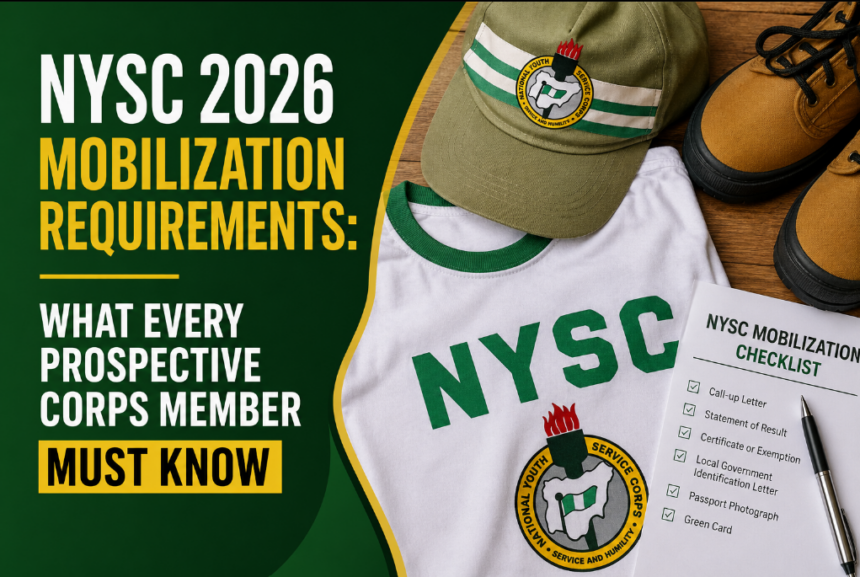
Every year, tens of thousands of Nigerian graduates go through a ritual that is as bureaucratic as it is significant: the mobilization process for the National Youth Service Corps. For many, it begins in the final weeks of their degree programme, with a school clearance and a form signed at the Student Affairs office. For others, it starts with a rude awakening at the orientation camp gate when a missing document sends them back home without registering. The difference, almost always, comes down to preparation.
- What the Mobilization Process Actually Involves
- Who Qualifies for Service and Who Does Not
- The NERD Clearance Requirement That Changed Everything in 2026
- Senate List Verification: The Gate That Opens Before Registration
- Online Registration on the NYSC Portal: Documents and What Each One Requires
- Documents You Must Carry to the Orientation Camp
- The 2026 Batch Structure and What It Means for Your Timeline
- After Camp: Deployment, PPA, and What the Service Year Looks Like
- Why Getting Mobilization Right Is Worth the Effort
The 2026 service year has introduced changes that make thorough preparation more critical than ever. The most consequential is the mandatory NERD compliance requirement, a federal directive that took effect from October 6, 2025, which now requires every prospective corps member to have their final-year project verified in a national academic database before they can complete camp registration. Alongside this, the familiar requirements around National Identification Number accuracy, senate list verification, and biometric data capture remain firmly in place. For graduates preparing to mobilize in 2026, the margin for error is thinner than in previous years.
NYSC 2026 Mobilization Requirements


Understanding the NYSC 2026 mobilization requirements in full, and in the correct order, is the most important thing a prospective corps member can do before the portal opens. The process is structured and sequential: each stage unlocks the next, and a failure at any point creates delays that can push a graduate into a later batch. This guide covers every stage from institutional clearance to orientation camp, drawing on the official NYSC timetable and the federal government’s latest policy updates.
What the Mobilization Process Actually Involves
Mobilization is the term NYSC uses for the formal process of identifying, verifying, and deploying eligible graduates for national service. It is not simply about logging onto a portal and filling in your details. The process begins at the institutional level, moves through a federal verification layer, and concludes only when a prospective corps member physically reports to an orientation camp in their assigned state. Every stage must be completed correctly for the next one to proceed.
The sequence begins with a graduate clearing all academic and administrative obligations at their institution: library returns, bursary payments, departmental sign-offs. Only after these are complete can a school upload a graduate’s details onto the NYSC portal through the senate list submission process. NYSC does not recognize a graduate’s existence for registration purposes until their institution has performed this upload. This means that if a graduate owes a late library fee, or if their faculty was slow to process results, their name may not appear on the portal when registration opens.
From the institutional upload, the process moves to the national level. The NYSC management processes deployment data, assigns states, and generates call-up letters. Prospective corps members can then log into the portal, complete their personal registration, upload required documents, capture biometric data, and ultimately print their call-up letter and green card. The green card, which is the signed online registration summary, is one of the documents that must physically accompany a prospective corps member to camp. Missing it is not a minor inconvenience; it is grounds for being turned away at the gate.
Who Qualifies for Service and Who Does Not
The eligibility framework for NYSC is set by the NYSC Decree 1993, specifically Section 2, Subsection 1, which states that a person shall not be called to serve if they were above the age of thirty years at the date of graduation. The calculation uses two official figures: the date of graduation as recorded on the NYSC senate list, and the date of birth as recorded in the JAMB database for locally trained graduates. For those who did not sit JAMB, the date of birth on their international passport is used instead.
What matters under this rule is age at graduation, not current age. A graduate who completed their degree at 28 but is now 33 due to delays in mobilization remains eligible, because the clock stopped at graduation. Conversely, a graduate who turned 30 even one day before their graduation date is automatically exempted from service. This is not discretionary; the NYSC portal calculates it automatically. Those who are exempted receive a Certificate of Exemption, which carries the same legal weight as a discharge certificate for employment and government documentation purposes.
Beyond the age rule, NYSC service is restricted to full-time graduates of accredited institutions. Part-time and correspondence graduates receive exclusion letters, not exemption certificates, and do not proceed through the same mobilization process. Graduates of foreign institutions must present their certificates for physical verification at NYSC headquarters in Abuja, and those from non-English speaking countries are required to provide certified English translations of their academic credentials. A foreign institution must also be accredited by the relevant regulatory body in the country of study before NYSC will recognize the qualification.
The NERD Clearance Requirement That Changed Everything in 2026
The single most significant change to the mobilization process in 2026 is the mandatory compliance with the National Education Repository and Databank, commonly referred to as NERD. This requirement was formally enforced through a circular issued by the Secretary to the Government of the Federation, Senator George Akume, conveying an approval by President Bola Ahmed Tinubu that invoked Sections 2(4)(4) and 16(1)(C) of the NYSC Act. The enforcement date was October 6, 2025, and no graduate mobilizing from January/February 2026 onwards is exempt from it.
NERD is a centralized national database managed by the Federal Ministry of Education, designed to store and verify the academic outputs of Nigerian graduates. Every prospective corps member must ensure their final-year project, thesis, or equivalent academic work is uploaded, verified, and assigned a unique National Credential Number before reporting to camp. The NERD clearance slip, which is generated once verification is complete, must be printed and physically presented at camp registration. Without it, a prospective corps member will be sent home.
The clearance process involves the graduate uploading their project through an accredited agent, after which the work goes through an automated plagiarism assessment on the NERD platform before supervisor approval and final institutional sign-off. The slip that emerges from this process carries the student’s full name, matric number, project title, deposit reference number, and the names of approving supervisors. NYSC cross-checks this slip during camp registration. Minister of Education Maruf Tunji Alausa confirmed the policy’s scope, stating that NERD compliance is now a prerequisite not only for NYSC participation but for exemption processing as well, with the directive extending to agencies including the National Universities Commission and the National Board for Technical Education.
Haula Galadima, the spokesperson for NERD, explained the policy’s broader intention. In public statements, she described the national database as a mechanism that would publicly link supervisors’ names to the work they oversee, with the expectation that visibility on a global platform would motivate higher academic standards. Whether or not the quality incentive materializes, the practical consequence for 2026 corps members is immediate: a missing NERD clearance slip means no camp registration, regardless of every other document being in order.
Senate List Verification: The Gate That Opens Before Registration
Before a prospective corps member can create an account or attempt any registration on the NYSC portal, their name must appear on the senate-approved list uploaded by their institution. This is not an optional confirmation step; it is the condition that allows the portal to recognize a graduate as eligible to register. NYSC has stated clearly that only graduates whose names appear on Senate or Academic Board approved lists uploaded by their institutions will be eligible to proceed.
The senate list check is performed through the official NYSC portal at portal.nysc.org.ng. A graduate who finds their name absent should not panic immediately. Institutions upload names in batches, and a name that is absent on Monday may appear by Friday, depending on the institution’s internal processing timeline. The practical advice is to maintain contact with the Student Affairs office and Directorate of Students’ Affairs at the institution, as these are the units responsible for coordinating the senate list upload. Following up directly is more reliable than waiting.
JAMB list verification is a parallel check that affects registration. For locally trained graduates, the NYSC portal validates registration details against the JAMB matriculation list. If a graduate’s name is not on the JAMB list, the portal blocks registration outright. This typically affects graduates who had admission regularization issues or whose JAMB admission records were not properly updated. Addressing this requires contact with both JAMB and the institution’s admissions office before the registration window opens.
Online Registration on the NYSC Portal: Documents and What Each One Requires
Once a name appears on the senate list, the prospective corps member can begin personal registration on the portal. For 2026 Batch A Stream II, the online registration window ran from March 12 to March 18, 2026, a one-week window that is typical of NYSC’s registration schedule. The portal is at portal.nysc.org.ng, and the NYSC has consistently warned against using third-party websites or agents who claim to facilitate registration on behalf of applicants.
A valid National Identification Number is non-negotiable for registration. NYSC requires that the name on the NIN exactly match the name on the prospective corps member’s Statement of Result. Discrepancies in dates of birth between NIN and JAMB records are consistently cited as the most common cause of registration delays. Before sitting down to register, every prospective corps member should verify that their name and date of birth are consistent across their JAMB record, Statement of Result, and NIN slip. Where there are discrepancies, they must be resolved with the relevant agency before registration opens.
The documents needed for portal registration are distinct from those required at the orientation camp, and the two lists are often confused. For the online registration specifically, prospective corps members need a functional email address and a Nigerian GSM number, their JAMB registration and matriculation numbers, a valid NIN, and their institutional details. Registration by proxy is categorically prohibited. NYSC conducts biometric verification at designated registration centers and orientation camps, and this step must be completed in person. A registration submitted without biometric capture will trigger disqualification.
Married female prospective corps members have additional documentation obligations during online registration. They must upload copies of their marriage certificate, evidence of a change of name, and their husband’s place of domicile. This documentation is required to process potential requests for relocation to the state where their husband resides. Pregnant and nursing mothers should note that NYSC’s orientation camp structure does not accommodate them, and the scheme has stated this explicitly.
Documents You Must Carry to the Orientation Camp
The distinction between online registration documents and camp registration documents is one that catches many prospective corps members unprepared. A graduate who successfully registers online has cleared only one stage. Showing up at the orientation camp with the correct physical documents is a separate requirement, and the camp gate is not forgiving of gaps.
The mandatory documents for camp registration include the printed call-up letter, the NYSC green card (the signed printout from online registration), a Statement of Result endorsed by the institution, the institutional identity card from final year, a Medical Certificate of Fitness from a government or military hospital, and the NERD clearance slip. The medical certificate requirement is specific: private clinic certificates are now rejected. Only government hospitals or military hospitals are accepted, and the certificate must be both signed and stamped. Passport photographs with a white background are required in multiple copies, with at least eight prints standard practice.
Polytechnic graduates carry an additional burden: they must present their Ordinary National Diploma certificate for clearance at the camp gate. Without it, they face the same outcome as anyone with a missing primary document. Graduates with professional qualifications, including doctors, nurses, and pharmacists, must bring the relevant professional license or registration certificate in original copy along with photocopies.
For foreign-trained graduates, the document requirements at camp are more extensive. They must carry their international passport, including the data page and evidence of entry and exit stamps, along with accreditation evidence confirming that their foreign institution was recognized by the relevant regulatory body. Where certificates are not in English, certified translations are compulsory. Foreign graduates who have previously undergone physical verification of credentials at NYSC headquarters will have a separate paper trail to present.
The 2026 Batch Structure and What It Means for Your Timeline
NYSC mobilizes graduates in three batches each year, designated A, B, and C, each of which is further split into two streams. This structure exists to manage the logistical scale of deploying hundreds of thousands of graduates across 36 states simultaneously. Batch A typically covers early-year graduates, Batch B those completing degrees mid-year, and Batch C those finishing in the final quarter. Understanding which batch applies to a particular graduate depends on when their institution uploaded their senate list.
For 2026 Batch A Stream II, the official mobilization timetable published by NYSC outlines the key pre-camp dates. Briefing activities for prospective corps members ran from February 23 to March 27, 2026. Physical verification of credentials for foreign-trained graduates took place between March 24 and 28, 2026. Data processing and deployment finalization is ongoing from April 9 to 17, 2026. Call-up letter printing is scheduled for April 19 to 21, 2026, and the orientation camp for Stream II will commence on April 22, 2026, with the closing date set for May 12, 2026.
Prospective corps members who missed Batch A Stream II or were not yet mobilized at the time of this batch are expected to be accommodated in Batch B Stream I, which based on historical patterns would open for registration around May or June 2026. As of April 2026, NYSC had not released an official date for Batch B registration, and the scheme had confirmed that no fresh registrations would be processed until the current backlog from previous batches was cleared. Graduates in this position were advised to monitor the official NYSC portal and verified social media handles regularly rather than rely on broadcasts from unofficial channels.
After Camp: Deployment, PPA, and What the Service Year Looks Like
The orientation camp marks the formal entry into the service year, not its conclusion. The three-week camp exercise, held across all 36 states and the Federal Capital Territory, combines physical drills, skill acquisition sessions, and administrative processing. During the first week, prospective corps members are sworn in and officially become corps members. At the end of the three weeks, a passing-out parade marks their transition into the main phase of service.
Following camp, corps members are posted to their Place of Primary Assignment, or PPA, which can be a school, government ministry, private company, or non-governmental organization depending on the state and the corps member’s field of study. While NYSC’s official position is that deployment is random, the reality is that the state of posting has significant implications for the quality of the service year, from the PPA stipend to security conditions and living costs.
The federal monthly allowance for corps members stands at 77,000 naira, a figure that came into effect from March 2025 following the implementation of the new national minimum wage. This allowance is paid directly by the federal government and is uniform across all states and PPAs. Some state governments pay an additional state allowance, though the amounts vary considerably and are not always reliable. As of early 2026, states including Lagos and Rivers were among those with a track record of paying state allowances, while many others either paid inconsistently or not at all. Corps members are advised to treat the 77,000 naira federal figure as their planning baseline and treat any state allowance as supplementary. Medical corps members, including doctors, pharmacists, and nurses, often receive higher PPA stipends due to the demanding nature and scarcity of their roles.
At the end of the 12-month service year, corps members who have fulfilled their obligations receive the NYSC discharge certificate, the document that certifies completion of national service. Its importance to graduates cannot be overstated: most federal and state government jobs require it for employment processing, as do many private sector positions. The discharge certificate and the exemption certificate, for those who qualify under the age or other criteria, carry equivalent legal weight.
Why Getting Mobilization Right Is Worth the Effort
The paperwork, the portal logins, the institutional follow-ups, the NERD clearance agents, the government hospital queues for a fitness certificate: the NYSC mobilization process is, by any honest accounting, a test of endurance before service even formally begins. But the consequences of getting it wrong sit at the far end of the process, where a missing document at the camp gate adds months to a graduate’s timeline, and a name mismatch on NIN records can stall everything before it starts.
The 2026 service year has raised the compliance bar. The NERD requirement alone demands engagement with a system that many institutions are still integrating into their processes, which means prospective corps members cannot leave it to their schools alone. Following up with the institution’s NERD coordinator or student affairs office to confirm that the project upload has been completed and the clearance slip generated is now as important as confirming senate list placement.
For Nigerian graduates, the discharge certificate and the network of connections built during service remain genuinely useful. The national unity rationale that inspired NYSC’s establishment in 1973 still operates, however imperfectly, in the lived experience of corps members posted far from home. Getting through mobilization without delays, with every document in order, means more time for the year itself to be productive. That begins with understanding, early and in detail, exactly what is required.