Every week, thousands of Nigerians type their knowledge into WhatsApp voice notes, Facebook captions, and Twitter threads that disappear within hours. The insight is real, the audience is real, and the demand is real, but the infrastructure is not. A blog changes that equation. It turns what you know into a permanent, searchable, monetisable asset that keeps working while you sleep, charge your phone, or wait out NEPA.
- How to Start a Blog in Nigeria 2026
- Choose Your Niche Before You Touch WordPress
- Domain Names and Hosting: What Nigerians Need to Know
- Installing WordPress and Configuring Your Site
- Choosing a Theme and the Plugins That Actually Matter
- Writing Content That Nigerian Readers Search For
- Monetising Your Blog: AdSense, Affiliates, and Beyond
- Building a Blog That Lasts in the Nigerian Digital Landscape
The numbers behind Nigerian blogging have never been more compelling. According to the Nigerian Communications Commission, internet subscribers reached 151.6 million in January 2026, a 2.3 percent increase in a single month. DataReportal’s Digital 2026 report puts the number of active internet users at 109 million, with mobile devices accounting for the overwhelming majority of traffic. The person reading your blog is almost certainly on a phone, not a laptop, which shapes every decision you will make about how to build and write it.
None of this means it is easy. Plenty of Nigerian blogs have launched with enthusiasm and gone quiet within six months because the founder did not understand what they were actually building. A blog is not a social media page. It requires hosting, configuration, a consistent publishing discipline, and a strategy for the way Google surfaces content to readers. This guide walks through each of those stages, practically and in the Nigerian context, without skipping the parts that usually get glossed over.
Why Starting a Blog in Nigeria Still Makes Sense
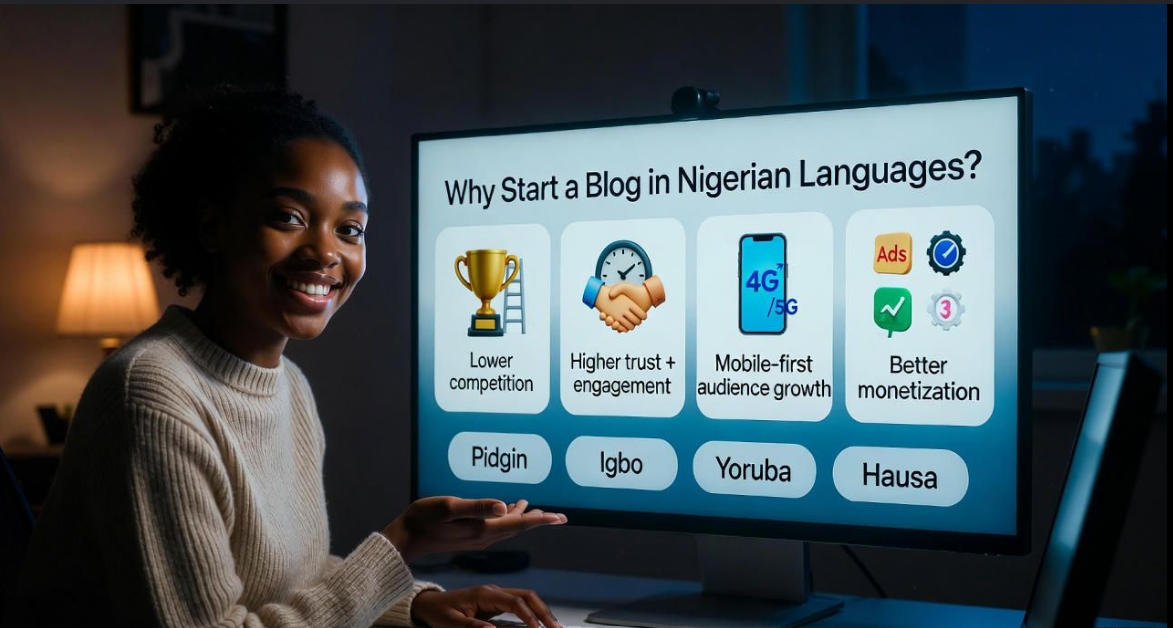

The case for Nigerian blogging is not sentimental, it is structural. Nigeria has one of the youngest, fastest-growing internet populations on the continent. The NCC’s January 2026 data showed nearly 151 million of the country’s internet subscribers connecting via mobile (GSM), while fixed connections account for just over 555,000. This is a country that skipped the desktop era almost entirely and went straight to mobile browsing, which means the audience for well-optimised mobile content is enormous and still expanding.
What that audience is searching for is overwhelmingly practical. Nigerians search in English, Pidgin, Yoruba, Hausa, and Igbo, often for answers that foreign blogs either ignore or get wrong. The NYSC posting schedule, how to get a police clearance certificate, which fintech apps actually work in 2026, what JAMB cut-off marks mean for your preferred university, this is the terrain where a Nigerian blogger with genuine local knowledge has a structural advantage over any international publication trying to parachute in. Google’s own quality evaluation systems, updated repeatedly over recent years, increasingly reward what the company calls E-E-A-T: experience, expertise, authoritativeness, and trustworthiness. A Nigerian blogger writing from lived knowledge about Nigerian realities is better positioned to demonstrate those qualities for a Nigerian audience than a foreign writer researching the same topic at a distance.
The monetisation routes have also matured. Google AdSense remains viable for blogs with significant organic traffic. Jumia’s affiliate programme (Jumia KOL), Konga’s affiliate platform, and direct brand sponsorships from companies targeting Nigerian consumers have all expanded. Nigerian content creators are also increasingly selling digital products, ebooks, templates, courses, consultation slots, through their blogs, creating income that does not depend on ad impressions at all. None of these routes produce results quickly; three to six months of consistent, quality publishing is the realistic baseline before meaningful traffic begins. But for someone building a long-term digital income, that is not a long timeline.
The cost of entry is also low enough that it is not a genuine barrier for most people with the discipline to persist. A domain name typically runs between ten and fifteen dollars per year. Shared hosting on a reliable provider ranges from roughly forty to two hundred dollars annually, with Nigerian-facing providers offering naira-based billing. The entire first-year investment can be under fifty thousand naira on a budget plan, and the asset you are building compounds in value with every published article.
How to Start a Blog in Nigeria 2026
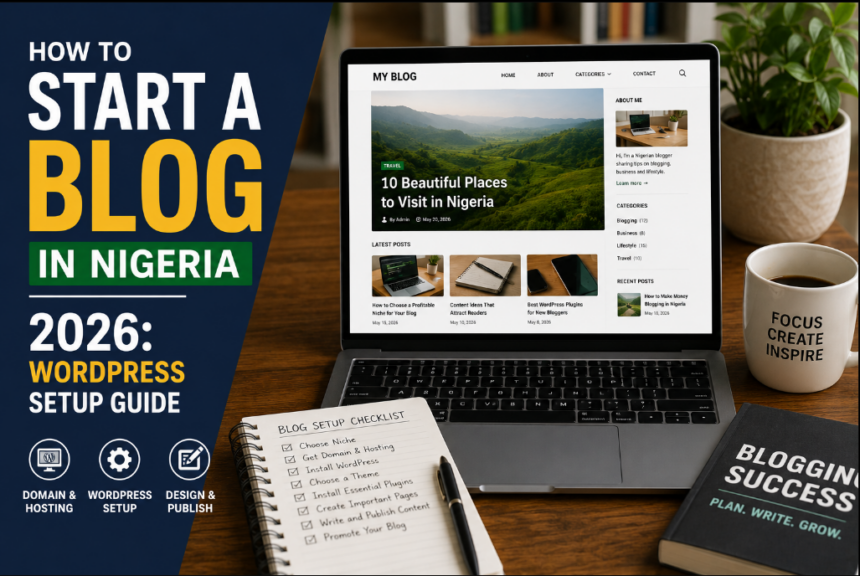
Starting a blog in Nigeria in 2026 is more accessible than it has ever been, but accessibility does not mean effortless. The technical barrier is genuinely low, WordPress is free, hosting in naira is available, and you do not need to write a single line of code. The real work is strategic: choosing the right niche, finding a hosting provider that does not buckle under load-shedding pressure, and understanding how Google decides which Nigerian blogs to trust. What follows is a setup guide that takes you from a blank idea to a live, monetisation-ready site.
Choose Your Niche Before You Touch WordPress
The most consequential decision in blogging happens before any technical setup begins. Your niche determines your audience, your content calendar, your monetisation options, and your long-term patience. Getting it wrong costs months. Getting it right creates momentum that compounds.
A niche that works in Nigeria satisfies two conditions simultaneously: you have genuine knowledge or sustained interest in it, and Nigerians are actively searching for content about it. The first condition protects you from burning out after twenty posts. The second condition determines whether Google sends you any traffic at all. A niche where you have passion but nobody is searching is a personal diary. A niche where there is demand but you have no real knowledge produces thin content that ranks poorly and earns even less.
Profitable Nigerian blog niches that consistently generate organic traffic include personal finance (budgeting on naira salaries, fintech reviews, investment options for Nigerians), health and wellness (medical symptoms, hospital and drug costs in Nigeria, mental health), education and scholarship opportunities (JAMB, WAEC preparation, studying abroad on Nigerian scholarship funding), technology (phone reviews at Nigerian price points, data-saving tips, app comparisons), food and recipes (Nigerian cuisine, affordable meal planning), and careers (CV writing, job search strategy, remote work for Nigerians). Each of these has a Nigerian-specific dimension that foreign content misses, and that gap is where a local blogger has real leverage.
Before committing, validate the niche. Search your proposed topics on Google and look at who ranks, if the top results are all generic international sites, that is actually a signal of opportunity, not saturation. Use Google Trends with Nigeria as the region filter to see whether interest is stable or declining. Browse Nairaland’s relevant sections to understand how Nigerians actually discuss the topic, what terms they use, what questions come up repeatedly. Those questions are your first content ideas.
Domain Names and Hosting: What Nigerians Need to Know
Your domain name is your blog’s permanent address. The choice between extensions matters more in Nigeria than in many markets because the local domain landscape has specific rules attached to it. A .com domain is the most globally recognised and can be registered through any major registrar, Namecheap and Google Domains are commonly used internationally and accept dollar-denominated payments. Nigerian providers like Whogohost (founded in 2007 and serving over 50,000 customers across West Africa) and QServers (operating since 2004 with servers in Lagos) also offer .com registration with naira billing and bank transfer payment options, which matters in an environment where international card payments are frequently declined or subject to the CBN’s foreign spending limits.
The .ng and .com.ng domains require registration through a NiRA-accredited registrar. NiRA is the Nigeria Internet Registration Association, the body that manages the country’s country-code top-level domain. If you want a .ng extension, which signals Nigerian relevance and is sometimes preferred for local government, legal, or institutional content, you must use an accredited registrar and cannot simply purchase it through an international provider. QServers and Whogohost are both NiRA-accredited and include a free .com.ng domain with annual hosting plans.
For most bloggers, a .com domain is the practical choice. It costs less, works with any registrar, and carries no disadvantage in Google’s Nigerian search results. Keep the name short, pronounceable, and niche-adjacent without being too narrow to expand later. A name like ‘NigeriaHealthGuide’ is fine today, but if you later want to write about finance, it becomes a constraint.
On hosting, there are two broad paths: Nigerian providers and international providers. Nigerian providers, principally QServers, Whogohost, Truehost Nigeria, and SmartWeb, bill in naira, offer local customer support (including phone), accept bank transfers, and have servers in Lagos or Johannesburg, which reduces latency for Nigerian visitors. The trade-off is that their infrastructure and uptime performance has historically lagged behind large international providers, though this gap has narrowed in recent years. International providers like Hostinger are consistently ranked for speed in server tests, accept naira cards through virtual card workarounds, and offer strong technical documentation, but their dollar pricing fluctuates with the exchange rate and their support operates in time zones that may not align with Nigerian business hours.
The minimum specifications to look for in any hosting plan: NVMe or SSD storage (not older HDD), a 99.9 percent uptime guarantee, free SSL certificate, one-click WordPress installation via Softaculous or a similar installer, and cPanel or an equivalent control panel for management. Plans with LiteSpeed web server technology load WordPress sites faster than traditional Apache-based setups, which is worth prioritising given that Nigerian mobile connections, though improving, with median mobile download speeds reaching 44.96 Mbps in late 2025 according to Ookla, are still variable in many areas.
Installing WordPress and Configuring Your Site
Once your hosting account is active and your domain is pointed at it (through nameserver records, a process your hosting provider’s support team can walk you through), the installation itself is the simplest part of the entire setup. Every reputable hosting provider includes WordPress in its one-click installer suite, usually Softaculous or Installatron, accessible from the cPanel dashboard.
Log into cPanel and look for the WordPress icon under the Applications or Auto Installers section. Click it, then click Install. The setup form will ask you to choose the domain to install on (select yours), set a site title and description (these can be changed later, so do not overthink them now), and create your administrator username and password. Choose a strong password, a guessable admin password is the most common way Nigerian blogs get hacked. Enter your email address for notifications and click Install. The process completes in under two minutes.
After installation, access your WordPress dashboard by visiting yourdomain.com/wp-admin and logging in with the credentials you just created. The first configuration priorities are not visual. Go to Settings > General and confirm your site title and tagline reflect your niche. Under Settings > Permalinks, change the URL structure to Post Name, this produces clean, SEO-friendly URLs like yourdomain.com/article-title rather than yourdomain.com/?p=123. Save it and do not change it again once you start publishing, because changing permalink structure after articles are live breaks all your existing URLs.
Next, force HTTPS across the site. Your SSL certificate should have been activated automatically by your hosting provider; if it has not, locate the SSL/TLS section in cPanel and install the free Let’s Encrypt certificate. Once SSL is active, go to Settings > General in WordPress and change both the WordPress Address and Site Address from http:// to https://. Then install a redirect plugin like Really Simple SSL to push all non-secure traffic to the secured version. A site without SSL ranks lower in Google and displays a browser security warning that drives visitors away immediately.
Choosing a Theme and the Plugins That Actually Matter
The theme determines how your blog looks and, more consequentially, how fast it loads. Speed is not an aesthetic preference in the Nigerian context, it is a functional requirement. According to Statcounter data cited by multiple Nigerian tech sources, mobile devices account for approximately 87 percent of web traffic in Nigeria. Your blog’s primary visitor is on a smartphone, possibly with a fluctuating 4G connection, and a theme that loads slowly will lose that visitor before they read a word.
Two themes dominate the performance-first WordPress space: Astra and OceanWP. Both are free at their base tier, both clock in at well under 100KB at their lightest configuration, and both are designed to pair with page builders and customise without requiring any coding. Astra in particular has a starter template library that includes niche-specific blog layouts ready to import in a few clicks. Avoid the common beginner mistake of choosing a theme based on visual complexity, the themes that look most impressive in screenshots are often the slowest to load in practice because they carry large image carousels, custom fonts, and JavaScript animations that do nothing for the reader’s experience but add seconds to load time.
The plugin stack should be kept minimal and purposeful. Four plugins cover the essential functions of a serious Nigerian blog. Rank Math SEO is the current consensus pick for search optimisation: it handles meta titles and descriptions, schema markup, sitemap generation, and provides per-article guidance on keyword use and readability. Site Kit by Google connects your blog directly to Google Search Console and Google Analytics from inside your WordPress dashboard, giving you traffic data, search query reports, and Core Web Vitals performance without needing to toggle between platforms. WP Super Cache or LiteSpeed Cache (use LiteSpeed Cache if your host runs LiteSpeed servers) generates static HTML versions of your pages so returning visitors load a cached version rather than triggering a full database query each time. UpdraftPlus handles automated backups, configure it to back up your site weekly and store the backup files to Google Drive or Dropbox, not just on the hosting server. A hosting account going down or being hacked without a recent backup is a recoverable problem; without a backup, it may mean starting from zero.
Two administrative additions that are not technically plugins but are equally non-negotiable: an About page that explains who runs the blog and why (this is a trust signal both for readers and for Google’s quality evaluators), and a Privacy Policy page that explains what data the site collects and how it is used. Without these pages, your application for Google AdSense will be declined, and Google’s own guidelines flag sites that lack them as lower-quality properties.
Writing Content That Nigerian Readers Search For
The blog is live, the theme is configured, the plugins are installed. Every subsequent decision about content determines whether the site grows or stagnates. This is where most Nigerian blogs fail, not at setup, but at the content strategy that follows it.
Search intent is the principle to internalise before writing anything. When someone types a query into Google, they want a specific type of answer: a direct fact (informational intent), a comparison to help them decide (commercial intent), or a page to complete a transaction (transactional intent). An article mismatched to its keyword’s intent ranks poorly regardless of how well written it is. A keyword like ‘best Nigerian fintech apps 2026’ signals commercial intent, the reader wants a comparison, not a history of fintech in Nigeria. An article that spends two thousand words on context and buries the list at the bottom will lose that reader in thirty seconds.
Nigerian search intent has specific patterns worth understanding. Searches involving prices, locations, application processes, and eligibility requirements tend to be high-intent and underserved by generic international content. ‘How to apply for a Nigerian passport renewal’ is better served by a Nigerian blogger who knows the VIO process, the current fees, and the practical reality of appointment slots than by any overseas publication. That specificity is your competitive asset. Mine it deliberately.
For content research, the tools are not expensive. Google’s autocomplete function shows you what phrases Nigerians complete after your seed keyword, start typing ‘how to send money’ and notice that Nigerian-specific completions appear. Nairaland’s section headers and most active threads reveal what topics generate sustained discussion. Google Search Console, once your site has been live for a few weeks, shows you exactly which search queries your pages are already appearing for, even if you are not yet ranking on the first page, those queries tell you what Google thinks your site is about and where to double down.
On article length: the practical minimum for a piece that stands a realistic chance of ranking on a competitive Nigerian keyword is around 1,500 to 2,000 words of substantive, structured content. The 1,000-word figure cited by some sources as an AdSense content minimum is a technical threshold, not a quality benchmark. The articles that rank are the ones that answer the question most completely. That usually takes more than 1,000 words when done properly. Consistency of publishing matters more than any single article’s word count, a blog with two new posts per week for six months will outperform one with ten posts published in the first week and nothing after.
Monetising Your Blog: AdSense, Affiliates, and Beyond
Google AdSense is the starting point for most Nigerian bloggers because it requires no prior relationship with brands and pays out based on traffic alone. Getting approved, however, requires more preparation than many first-time applicants expect. Google does not publish a precise content minimum, but the practical consensus from bloggers who have gone through the process recently is that 20 to 30 well-written, substantive articles on a coherent niche gives an application a reasonable foundation. Each article should be at least 800 to 1,000 words of original content with no plagiarism. The site must have an About page, a Privacy Policy page, and a Contact page in place before submitting the application. A custom domain (not a free WordPress.com subdomain) is effectively required for credibility. The review process typically takes one to two weeks.
Critically, AdSense payments to Nigerian publishers require a valid Nigerian bank account linked to a verified AdSense account. Payments are made monthly once the account balance reaches the payment threshold, which is currently set at $100. At current exchange rates, that translates to a meaningful naira amount, but it also means that low-traffic blogs may wait many months between payments in the early stages.
Affiliate marketing offers faster monetisation potential for blogs in specific niches. Jumia’s affiliate programme (Jumia KOL) is the most direct Nigerian option, it pays commission on purchases made through your tracked links, which means a blog about technology, fashion, or household products can earn directly from product recommendations without needing ad impressions. Konga runs a comparable programme. For blogs with audiences interested in software, international affiliate programmes from companies like Bluehost, Hostinger, or any SaaS product your audience uses are viable and often pay higher commission rates than local options.
Sponsored content and direct brand partnerships become available once a blog establishes visible authority in its niche, typically at 10,000 to 30,000 monthly visitors, though this varies by niche and how targeted the audience is. Nigerian brands in sectors like fintech, food and beverage, education, and telecoms are increasingly buying placement on niche blogs rather than relying solely on social media influencers, because blog content persists and accumulates search traffic over time in a way that Instagram posts do not.
Digital products are the highest-margin monetisation route for a blog with a specific, solution-oriented audience. An ebook, a downloadable template, a video course, or a paid consultation service attached to a blog that has built genuine authority in its niche can generate income that dwarfs what AdSense pays at comparable traffic levels. The barrier is the effort required to create the product, but for a blogger who has already published fifty articles on a topic, the raw material is already there.
Building a Blog That Lasts in the Nigerian Digital Landscape
A Nigerian blog set up correctly today is a compounding asset. Every article that ranks on Google drives traffic tomorrow, next month, and next year without requiring any additional effort. The hosting fee is paid once annually. The domain renews for a modest sum. The content, once published, keeps earning.
What separates the Nigerian bloggers who build sustainable income from those who abandon the project after a few months is not technical skill, it is operational clarity. They chose a niche with genuine audience demand and stayed in it long enough for authority to accumulate. They treated publishing consistency as non-negotiable, even at two posts per week, even during power outages, even when traffic was still thin. They did not mistake early analytics silence for failure.
The digital audience Nigeria is developing, 109 million internet users and growing, predominantly on mobile, increasingly searching for practical, local-language answers to real-life problems, is one of the most compelling content opportunities on the continent. A well-structured WordPress blog, hosted on reliable infrastructure, publishing specific and accurate content for that audience, is positioned to benefit from every year of that growth. The setup takes an afternoon. The results accumulate over years.