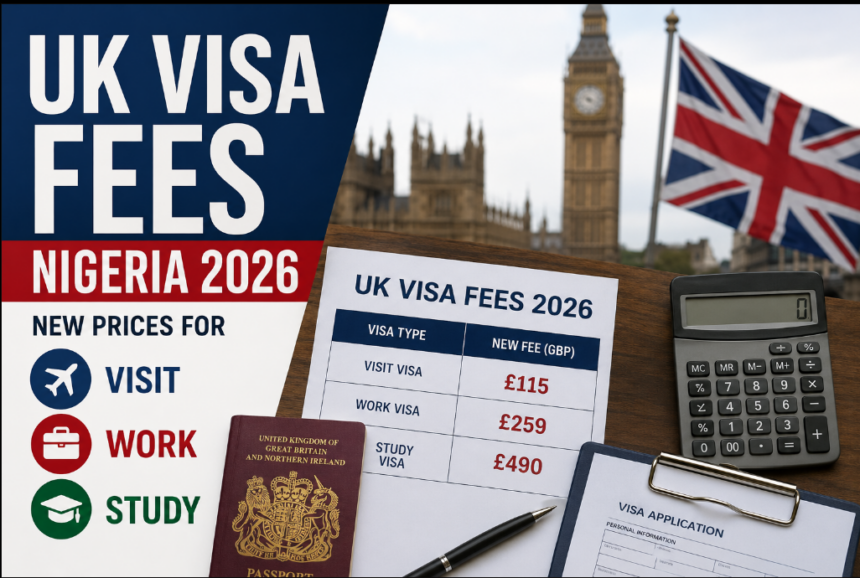
Every year, tens of thousands of Nigerians gather documents, save money, book appointments at the VFS Global centres in Lagos or Abuja, and sit in those waiting rooms hoping for a stamp that changes their trajectory. For students chasing a British degree, nurses and doctors heading for NHS placements, professionals on Skilled Worker visas, and families trying to reunite in the UK, the visa application process is already stressful enough. From April 8, 2026, the cost of that process went up again.
- UK Visa Fees Nigeria 2026: What the New Prices Actually Are
- The New Visit Visa Prices: What Changed on April 8
- Student Visa Costs and What Nigerian Applicants Must Budget For
- Work Visa Fees: From Skilled Worker to the Health and Care Route
- Settlement, ILR, and the Cost of Staying for Good
- The Immigration Health Surcharge: The Bill Most Nigerians Don’t Anticipate
- How Much This Costs in Naira: The Real Numbers
- What the Fee Increases Mean for Nigerians Specifically
- The Price of Getting In
The UK Home Office announced the latest round of fee increases in late March 2026, confirming that most visa, immigration, and nationality application fees would rise by between 6 and 7 percent. On the surface, that sounds modest. But stacked on top of previous increases in 2023 and 2024, plus the sharp jump in the Immigration Health Surcharge two years ago, the cumulative cost of applying to enter or stay in the UK has grown dramatically. For Nigerians applying with naira that has lost significant value against the pound sterling in recent years, the numbers hit harder than the percentages suggest.
Nigeria is not a peripheral market in UK immigration. According to Home Office statistics for the year ending September 2025, Nigerian nationals submitted over 247,000 visa applications across all categories, placing the country among the top sources of UK visa applications worldwide. Nigerians ranked fourth in study visa grants, with 30,009 student visas issued in that period, a 56 percent increase from the previous year. That recovery came after a steep fall in 2024, when the UK’s dependant ban and tighter scrutiny hit Nigerian applicants hard. The point is that these fee changes are not abstract policy. They land on real people in Surulere, Wuse, and Port Harcourt who are already working out what a UK application will cost them.
Why the UK Keeps Raising Its Visa Fees

The UK government’s position on immigration fees is consistent and has not changed under the current Labour administration. The official line is that those who benefit from the immigration system should pay for it, with the goal being what officials call a user-funded immigration model. Translation: the government wants to stop subsidising immigration processing through general taxation, and wants applicants and their sponsors to cover the full cost of running the system.
This logic has driven fee policy for over two decades. When the Blair government began charging above the processing cost in the early 2000s, a student visa cost just 36 pounds. What started as modest cost recovery has grown into a significant revenue stream. By 2024, the UK government was collecting around 3 billion pounds annually from immigration and nationality fees alone, with an additional 2.6 billion pounds from the Immigration Health Surcharge and roughly 600 million pounds from employer levies on work visas. The Home Office’s UK Visas and Immigration arm is structured to recover more than twice what it spends on processing applications.
The April 2026 increases are projected to generate an additional 47 million pounds per year, according to Treasury figures cited in British media reports. The Home Office has indicated that this money will be ring-fenced specifically for border security technology and to help fund the UK’s humanitarian immigration programmes for people from Ukraine, Hong Kong, and Afghanistan. Whether that accountability actually holds in practice is a different matter, but it is the stated justification.
Critics of the system argue that the UK is now priced out of reach compared to other major destination countries. A 2025 report by the Royal Society confirmed that UK immigration costs are significantly higher than those in Canada, Germany, France, and the United States. The Confederation of British Industry, which represents large employers, has argued that the UK is already the most expensive G7 destination for a typical five-year work permit. For applicants coming from countries with weaker currencies, like Nigeria, the gap between the UK and other destinations is not just about the fee in pounds. It is about how many naira it takes to produce that pound.
The April 2026 increases follow a pattern of rapid escalation since 2023. In October of that year, the Sunak government raised work and visit visa fees by 15 percent, family visas and settlement fees by 20 percent, and student visa fees by a sharp 35 percent. Then in February 2024, the Immigration Health Surcharge was increased by 66 percent, from 624 pounds to 1,035 pounds per year. So when the Home Office describes this latest 6-7 percent increase as modest, that modesty sits on top of a base that was already substantially inflated.
UK Visa Fees Nigeria 2026: What the New Prices Actually Are
The UK visa fees Nigeria 2026 schedule covers every major immigration route, from a simple six-month tourist visa to the long road to British citizenship. The increases came into effect on April 8 and apply to applications submitted both inside and outside the UK. This article breaks down the new charges category by category, converts the key figures into naira, and explains what the pattern of repeated hikes actually means for Nigerians planning to apply in the months ahead.
The New Visit Visa Prices: What Changed on April 8
The standard visitor visa, the one most Nigerians apply for when travelling to the UK for tourism, family visits, or short business trips, rose from 127 pounds to 135 pounds for a stay of up to six months. This is a single-entry or multiple-entry visa valid for that six-month window. The 8-pound increase looks small in isolation. Across 247,000 Nigerian visa applications, including the many thousands who apply for visit visas each year, it adds up.
Long-term visit visas are where the increases become more consequential. The two-year multiple-entry visit visa now costs 506 pounds, up from 475. The five-year version moved from 848 to 903 pounds. The ten-year visa, which is popular with frequent business travellers and Nigerians with family connections in the UK who find themselves returning multiple times, went from 1,059 to 1,128 pounds, crossing the four-figure mark for the first time. That ten-year visa, when you break it down, costs around 113 pounds per year, which is still cheaper than three separate short-term visas. But the upfront outlay is now 1,128 pounds before a single flight is booked.
A few specialist visitor categories also saw changes. Visiting academic visas for stays between six and twelve months rose to 234 pounds, and private medical treatment visas for the same duration moved to the same amount. These categories matter for specific groups: Nigerian academics on short research attachments to UK universities, and a smaller but real cohort of Nigerians who travel to the UK for medical treatment. Transit visas, used by Nigerians passing through UK airports, also increased, with the Direct Airside Transit Visa moving to 41.50 pounds and the landside transit visa rising to 74.50 pounds.
The Electronic Travel Authorisation, which is a pre-travel screening system rather than a full visa, saw the sharpest proportional increase. It moved from 16 to 20 pounds, a 25 percent jump. The ETA is required for nationals of certain visa-exempt countries and is a separate fee from the visa application itself for those categories. Nigerian passport holders still require a full visa for UK entry and are not eligible for the ETA route.
Student Visa Costs and What Nigerian Applicants Must Budget For
The student visa, which is the route used by Nigerians pursuing degree programmes, postgraduate study, and professional qualifications at UK universities and licensed education providers, rose from 524 to 558 pounds. The child student visa, for Nigerian children enrolled in independent UK schools, moved to the same fee. A short-term student visa specifically for English language courses lasting between six and eleven months increased from 214 to 228 pounds.
The 558-pound visa fee is, however, only the starting point of what a Nigerian student actually pays to study in the UK. The Immigration Health Surcharge must be paid upfront at the time of application, and for students it is charged at a discounted rate of 776 pounds per year of study. A student on a one-year master’s programme pays 776 pounds in IHS. A student on a three-year undergraduate degree pays 2,328 pounds. That IHS payment comes before they have paid tuition, bought a flight, or rented a room in any UK city.
Nigerian students are also required to undertake a tuberculosis test at approved IOM clinics in Nigeria before submitting their visa application. That test costs approximately 95 US dollars for applicants aged eleven and above. On top of that, most Nigerian applicants will need to book their biometrics appointment at VFS Global in Lagos or Abuja. There are currently three VFS Global Visa Application Centres serving Nigerian applicants: Lagos Ikeja on Opebi Road, Lagos Victoria Island at Churchgate Tower 2, and Abuja at Churchgate Plaza on Constitution Avenue.
For students who need a faster decision, priority services are available at additional cost: priority processing is 500 pounds for a decision within approximately five working days, and super priority is 1,000 pounds for a decision by the next working day. These are optional but frequently used by Nigerian students working against university enrollment deadlines.
The Graduate Route visa, which allows international students to remain in the UK to work after completing their degree, also increased from 880 to 937 pounds. This is a significant route for Nigerian graduates who want to convert their UK degree into UK work experience before deciding on their next step. It is worth noting that the student visa grant rate for Nigerian applicants in 2025 was 92 percent, slightly below the Home Office’s target threshold of 95 percent, which has implications for which universities remain able to recruit Nigerian students going forward.
Work Visa Fees: From Skilled Worker to the Health and Care Route


The Skilled Worker visa, the primary route for Nigerians with a UK job offer to work in professional, technical, and managerial roles, rose from 769 to 819 pounds for visas of up to three years. For visas exceeding three years, the fee increased from 1,519 to 1,618 pounds. These fees apply to the visa application itself. Employers who sponsor a Skilled Worker are also now paying more for the Certificate of Sponsorship, which increased sharply from 239 to 525 pounds, a 120 percent jump introduced as part of the same package of changes.
For Nigerian nurses, doctors, pharmacists, and care workers, there is a separate and cheaper route: the Health and Care Visa. This visa carries a reduced fee because the UK government recognises the particular contribution health and care workers make to the NHS. Under the new schedule, the Health and Care Visa for a period of up to three years costs 324 pounds, up from 304. For over three years it is 628 pounds, up from 590. Critically, Health and Care Visa holders and their dependants are also exempt from the Immigration Health Surcharge entirely, which represents a substantial saving compared to the standard Skilled Worker route.
This distinction matters greatly for Nigerians in the healthcare pipeline. Nigeria has long been one of the significant source countries for the UK’s Health and Care Worker visa, alongside India, Zimbabwe, and the Philippines. For a Nigerian nurse applying for a three-year Health and Care Visa rather than a standard Skilled Worker visa, the difference in total upfront cost once the IHS exemption is factored in runs into thousands of pounds.
Other work categories also increased. The Innovator Founder visa, which targets entrepreneurs setting up businesses in the UK, moved from 1,274 to 1,357 pounds. The Scale-up visa, designed for fast-growth companies, went from 880 to 937. Temporary worker categories including Seasonal Worker, Charity Worker, and Creative Worker visas rose from 319 to 340 pounds. The Minister of Religion visa and the International Sportsperson route for periods over twelve months both went to 819 pounds. Nigerians in the sports and religious ministry sectors who pursue UK opportunities through these routes face the same upward pressure as everyone else.
Settlement, ILR, and the Cost of Staying for Good
Indefinite Leave to Remain, the status that gives a person the right to live and work in the UK without time restrictions, is now the most expensive single immigration application in the system. The fee rose from 3,029 to 3,226 pounds per person. For a couple applying together, that is 6,452 pounds in ILR fees alone before any of the associated documentation costs. Route to Settlement, which is the category covering various pathways to permanent residency, increased from 1,938 to 2,064 pounds.
For families on reunification routes, the costs are even more significant. Settlement applications for other adult dependent relatives of British citizens or settled persons moved to 3,635 pounds per person. A dependent relative who is a refugee pays a reduced fee of 452 pounds. In-country extension of visitor stay, for those seeking to extend their time in the UK on a visitor visa, costs 1,172 pounds. General leave to remain for other categories rose to 1,407 pounds.
British citizenship through naturalisation is now 1,709 pounds, up from 1,605. Registration as a British citizen for an adult costs 1,540 pounds. There is one genuine exception in the entire fee schedule: the registration of a child as a British citizen was reduced from 1,214 to 1,000 pounds, a cut of 214 pounds. This is the only category where fees came down. The government has framed this as addressing affordability concerns for families with children who are British citizens by birth but require formal registration of that status.
Immigration advisers cited in British media have pointed out the cumulative burden for a family of four on a five-year route to settlement. Once visa fees, IHS payments for each family member, and the eventual ILR applications are factored in, total immigration costs can exceed 30,000 pounds. For Nigerian families navigating this system on salaries earned in naira, the financial planning required is substantial.
The Immigration Health Surcharge: The Bill Most Nigerians Don’t Anticipate
The Immigration Health Surcharge is the cost that catches many Nigerian visa applicants off guard, partly because it is separate from the visa fee itself and must be paid at the same time. This is not a payment plan or a deduction from salary. It is paid in full, upfront, before a decision is even made on the application. If the visa is refused, a refund process exists but can take time and is subject to conditions.
The IHS is charged per year of the visa at 1,035 pounds annually for most adult applicants in work and family categories. Students and those on the Youth Mobility Scheme pay a discounted rate of 776 pounds per year. Each dependant pays their own IHS separately at the applicable rate. So a Skilled Worker applicant with a spouse and one child applying for a three-year visa would pay IHS of: 1,035 pounds multiplied by three years for themselves (3,105 pounds), 1,035 pounds multiplied by three for the spouse (3,105 pounds), and 776 pounds multiplied by three for the child if the child qualifies for the reduced rate (2,328 pounds). That is 8,538 pounds in IHS alone for three people, paid before they have boarded a flight.
The IHS does not apply to visitor visas of six months or less. It also does not apply to ILR applications. But it applies to virtually everything else: student visas, Skilled Worker visas, family visas, and their renewals and extensions. Each time a person applies for further leave, they pay the IHS again for the new period being applied for. Someone who has been in the UK on a student visa for three years and then switches to a Skilled Worker visa pays the IHS again from scratch for the Skilled Worker period.
The House of Commons Library, which publishes independent research for the British parliament, confirmed in a briefing in early 2026 that the IHS has not changed from 1,035 pounds for adults and 776 for students in the current round of increases. But it sits at a level that was itself the product of a 66 percent increase in February 2024. Anyone budgeting for a UK visa application in 2026 needs to think about the IHS as the main cost, not the visa application fee.
How Much This Costs in Naira: The Real Numbers
UK visa fees from Nigeria are charged by the Home Office in US dollars, not in naira. This creates an additional layer of currency exposure for Nigerian applicants, who are dealing with both the pound-dollar rate and the dollar-naira rate. Using a reference exchange rate of approximately 1,900 naira to the pound, which reflects the mid-market rate in April 2026, the figures translate as follows.
A standard six-month visit visa at 135 pounds costs approximately 256,500 naira. The two-year visit visa at 506 pounds is roughly 961,400 naira. The ten-year visit visa at 1,128 pounds works out to around 2,143,200 naira. The student visa at 558 pounds is approximately 1,060,200 naira for the application fee alone, before the IHS of 776 pounds per year (roughly 1,474,400 naira per year of study) is added. A Skilled Worker visa for up to three years at 819 pounds is approximately 1,556,100 naira. ILR at 3,226 pounds converts to approximately 6,129,400 naira per applicant. British citizenship at 1,709 pounds is around 3,247,100 naira.
These conversions fluctuate with the exchange rate, which has been volatile. The naira ranged between approximately 1,550 and 1,950 to the pound in the months leading into April 2026, meaning the naira cost of any application can shift meaningfully depending on when exactly the payment is processed. Applicants who pay through VFS Global will find that the platform applies the rate in effect on the day of payment, not the rate they budgeted against weeks earlier. This unpredictability is itself a cost that Nigerian applicants absorb in ways that applicants from stronger-currency countries do not.
Beyond the visa fees and IHS, Nigerian applicants typically absorb other costs that do not appear on the Home Office fee schedule: the TB test at approved clinics (around 95 US dollars), document translation and notarisation where required, IELTS or other English language tests for work and study routes (which can cost between 80,000 and 120,000 naira depending on the centre), and the cost of sourcing and certifying financial documents. A realistic budget for a student visa application, including application fee, IHS for a one-year master’s, and ancillary costs, runs well above 1.5 million naira before flights and accommodation are considered.
What the Fee Increases Mean for Nigerians Specifically
There is a specific Nigerian context to these fee increases that gets lost when the conversation stays at the level of pounds and percentages. Nigeria’s economy has been through a difficult period. The naira devaluation of 2023, which saw the currency lose well over half its value against the dollar in a matter of months after the Tinubu government removed the fuel subsidy and liberalised the exchange rate, meant that the cost of a UK visa in naira roughly doubled even before the Home Office raised fees at all. The combination of a weaker naira and upward fee movement in sterling has made UK visa applications substantially more expensive for the average Nigerian applicant in real terms than the official percentage increases suggest.
The UK remains one of the most popular destinations among Nigerians for education, work, and family reunification. Official Home Office statistics for the year ending September 2025 showed 30,009 Nigerian students receiving study visas, a 56 percent increase from the previous year, suggesting that demand is resilient despite the cost pressures. Nigeria was the fourth largest source country for UK study visas globally in that period, behind India, China, and Pakistan. But the structural question is whether this resilience holds as fees continue to climb, and whether the additional cost signals push some Nigerian students toward alternative destinations like Canada, Australia, or increasingly competitive universities in continental Europe that charge no or nominal tuition for international students.
For Nigerians on work routes, the picture is mixed. The Health and Care Visa remains relatively affordable and carries the significant benefit of IHS exemption, which is a meaningful incentive for Nigerian healthcare workers. But the Skilled Worker route, used by Nigerians in technology, finance, engineering, and other professional fields, now carries a heavier combined cost once sponsorship fees, visa application fees, and IHS are stacked together. The University of Oxford’s Migration Observatory noted in its 2025 reporting that visa refusal rates for Nigerian work route applicants were noticeably higher than for applicants from some other countries, often because of documentation issues or salary mismatches. Paying more in fees while facing the same refusal risk is a particularly difficult position.
Immigration lawyers and consultants advising Nigerian clients have consistently stressed one practical recommendation in the wake of the April 8 announcement: if a Nigerian applicant is at or near eligibility for any stage of their immigration journey, submitting before the new fee takes effect saves money. For ILR applicants, the difference between the old and new fee is 197 pounds per person. For a family of four submitting ILR applications, that is nearly 800 pounds. The same logic applies at every stage, from the initial visa application through renewals to citizenship. Getting the timing right on an immigration application is not just a legal matter but a financial one.
The Price of Getting In
The UK’s approach to visa fees is deliberate. The government has made no secret of wanting immigration to be financially self-sustaining, and each successive round of increases moves that goal closer to reality for the Home Office, even if it moves it further from reach for individual applicants. The April 2026 increases are not the last. The House of Commons Library confirmed in early April 2026 that the Home Office is already preparing further increases later in 2026, specifically for naturalisation and related nationality fees.
For Nigerians, the practical takeaway is clear. The cost of a UK visa in 2026 is not just the fee on the Home Office table. It is that fee converted at whatever the naira-pound rate is on the day you pay, plus the Immigration Health Surcharge paid upfront in full, plus the TB test, language test, legal or consultancy costs, VFS Global service charges, and the supporting documentation that the Home Office expects you to have in order. A visit visa might start at 135 pounds, but a realistic total budget for a Nigerian applicant who wants to maximise their chances of approval includes considerably more than that.
The resilience of Nigerian demand for UK visas, despite the cost, says something about the pull of British education and employment for many families. But resilience has a ceiling. If fees continue rising at the pace of the past three years while the naira remains under pressure, the calculation will shift for a greater number of potential applicants. Some will find other routes. Others will find the door too expensive to knock on. The UK is making a choice about who can afford to apply, and that choice lands differently on applicants from Lagos than it does on those from London.