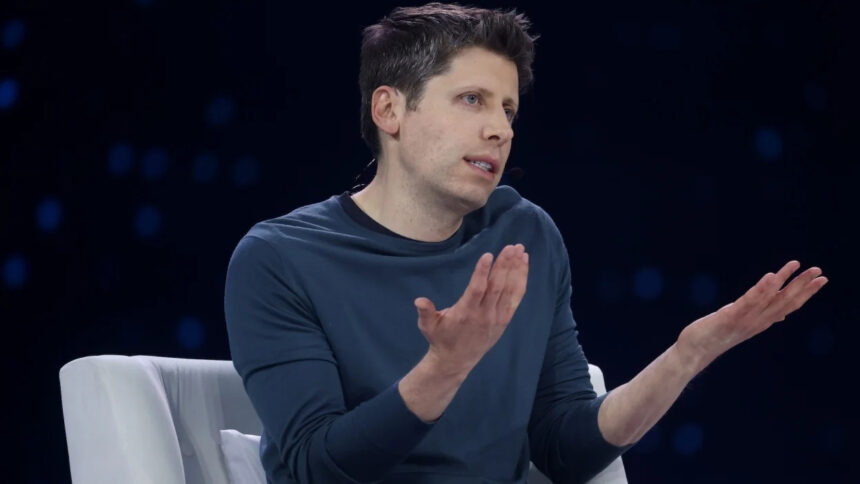
Sam Altman has stopped hedging. For years, the OpenAI CEO talked about the singularity the way most tech executives do: as a horizon somewhere out there, a thing that might happen if the scaling curves hold. That changed this week. On the YouTube podcast “How to Start a Startup,” hosted by Ti Morse, Altman said the quiet part out loud: humanity isn’t approaching the singularity anymore. We’re in it.
“We are now in the singularity. This is the moment,” Altman told Morse. He described it as something that felt like a fantasy at “the lunch table” a decade ago, and now sits at the center of his working life.
It’s not a throwaway line. Altman has been building toward this claim for more than a year, and the timing of this latest remark, dropped the same week OpenAI’s AI-in-science ambitions and Meta’s superintelligence lab are both making headlines, has reignited a debate that never really cooled down: is the singularity actually here, or is this just very effective marketing from the man running one of the world’s most valuable AI companies?
What Altman Actually Said
Altman’s framing on the podcast echoes his June 2025 essay, “The Gentle Singularity,” where he first declared that humanity had crossed the “event horizon” of AI development. In that post, he argued the singularity wouldn’t arrive as a single dramatic event, no Hollywood moment where machines suddenly wake up, but as a gradual acceleration so smooth that people barely notice it happening.
On the podcast, he leaned into the same idea, but with more urgency. Rather than a single tipping point, he said, AI has been climbing an exponential curve, and the world has now reached another decisive stage in that climb, one where the direction AI takes will shape what comes next for everyone, not just the people building it.
He’s also been specific about dates, which is unusual for a technology this hard to pin down. In “The Gentle Singularity,” Altman laid out a rough timeline: 2025 as the year AI agents started doing real cognitive work, 2026 as the year systems begin producing genuinely novel scientific insights rather than just summarizing what’s already known, and 2027 as the point when robots doing physical tasks in the real world stop being a novelty. As evidence the shift is already under way, he’s pointed to researchers who say AI tools have made them two to three times more productive in their work.
Why This Time Feels Different
Altman has flirted with singularity talk before. Back in 2017, in an essay called “The Merge,” he predicted humans and machines would blend together, whether through brain-computer interfaces or simply spending so much time talking to AI that the line stops mattering. He guessed this would happen somewhere between 2025 and 2075. Even then, he wrote that he believed the process had already begun.
What’s changed since is the company around him. OpenAI is no longer a research lab making bold predictions from the sidelines, it’s a central player in Stargate, the massive AI infrastructure venture backed by SoftBank, Oracle, and Trump-aligned investment group MGX. Meta, meanwhile, has stood up its own dedicated superintelligence lab, effectively confirming that Altman’s rivals take the same trajectory seriously enough to bet billions on it. When the CEO of a company with that kind of infrastructure and that kind of competition says the singularity has already started, it lands differently than a blog post from an outsider.
The Pushback
Not everyone is buying it, and the skepticism isn’t limited to online commentary. Critics point out that “gentle” is doing a lot of work in Altman’s framing. One widely shared rebuttal put it plainly: slow isn’t the same as easy, and workers who lose their jobs to automation are unlikely to experience that transition as smoothly as Altman’s essay suggests.
There’s also a harder, more technical objection. AI systems still hallucinate. They still fail at reasoning tasks that seem trivial to a person, sometimes even after being told the correct answer outright. A widely cited Apple research paper found that leading AI models tend to collapse when problems get sufficiently complex, essentially giving up rather than reasoning their way through. That’s not exactly the profile of a system on the verge of generating Nobel-calibre scientific insight within the year, which is part of why Altman’s 2026 prediction has drawn so much scrutiny from scientists who’d actually have to validate that kind of claim.
Then there’s the economics angle. Yale economist William Nordhaus went looking for signs of a productivity singularity in national economic data and didn’t find one, a reminder that intelligence isn’t a single dial that, once turned up, automatically translates into GDP growth, factories, or cures for disease. Surveyed AI researchers, when asked when machines might reach human-level intelligence, land on a median estimate closer to 2047, with plenty of disagreement about whether current methods get there at all.
Some critics go further, framing Altman’s essay less as a forecast and more as a deliberate attempt to manage public anxiety. A commentary from the American Enterprise Institute described the “Gentle Singularity” post as a message aimed at reassuring a nervous public, shaping how people feel about AI’s trajectory as much as predicting it. Reaction on social media has split along similar lines, some users say they’re excited to be living through the moment, others have accused Altman of overhyping a technology that’s already causing real harm, pointing to OpenAI’s ongoing wrongful-death lawsuits tied to chatbot interactions as evidence the “gentle” framing glosses over genuine costs.
What It Means for Ordinary People
Strip away the philosophical debate about event horizons, and Altman’s argument boils down to something more concrete: AI is already changing how work gets done, and that change is going to keep compounding whether or not anyone agrees on what to call it.
For workers, that means the tools showing up in daily workflows now- coding assistants, research agents, customer service bots- aren’t the ceiling. They’re the early, unimpressive version of what Altman expects to be routine by the end of the decade. His own words capture the pattern: people get amazed by what AI can do, then quickly start expecting more, and the previous “wonder” becomes just another baseline.
For governments and institutions, the stakes are less about the technology itself and more about who controls it. Altman has been fairly consistent on this point, both in his essay and in recent interviews: he’s argued against a future where a single company or model dominates AI, saying society needs a real say in how the technology gets used, even while acknowledging the risks that come with spreading it widely.
For everyone else, the honest answer is that nobody, including Altman, actually knows how this plays out. What’s verifiable is narrower than the headlines suggest: OpenAI’s timeline for 2026 and 2027 makes specific, testable claims that will either hold up or they won’t. Scientists will either be citing AI-generated discoveries in journals next year, or they won’t be. Robots will either be doing useful physical work in the world by 2027, or that prediction will join a long list of AI forecasts that arrived late.
The Bottom Line
Whether or not “the singularity” is the right word for what’s happening, something real is going on. AI systems are getting woven into research, coding, and daily productivity faster than most institutions know how to respond to. Altman’s claim that we’re already inside the singularity might be premature, or it might be remembered as an obvious statement of fact a few years from now. Either way, the more useful question isn’t whether Altman is right to use that word; it’s whether the people affected by this shift, workers, regulators, and the public, are moving anywhere near as fast as the technology he’s describing.