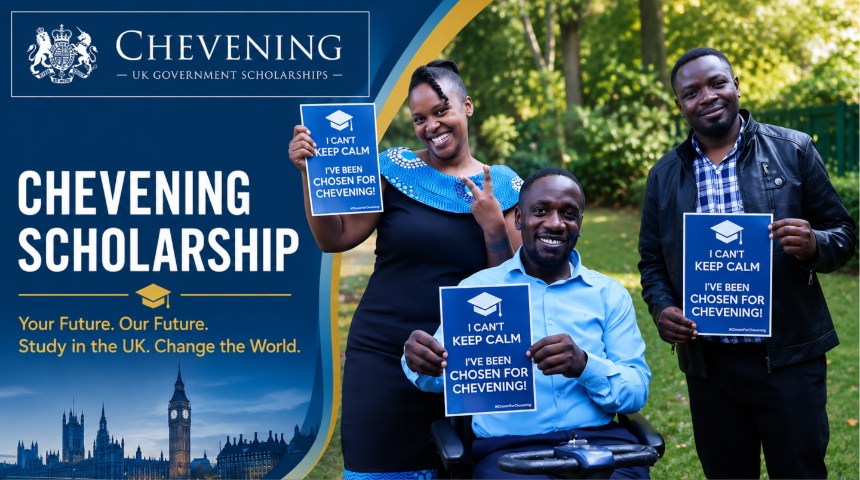
The window for one of the most sought-after scholarships among Nigerian graduates is about to open again, and this time the calendar leaves very little room for procrastination. The Chevening Scholarship, funded by the UK government through the Foreign, Commonwealth and Development Office (FCDO), opens its 2027/2028 application cycle on August 4, 2026, and closes on October 6, 2026 at 11:00 UTC. For a scholarship that fully funds a one-year master’s degree in the UK, tuition, flights, and monthly living allowance included, that’s a narrow nine-week stretch to get an application in front of an independent reading committee.
Nigeria has consistently been one of the largest sources of Chevening scholars in the world, and every year the applicant pool gets more competitive. If you’ve been telling yourself you’ll “start preparing soon,” soon just became now.
What Chevening Actually Offers
Chevening scholars get their full tuition covered no matter how expensive the UK programme, plus a monthly stipend pegged to the cost of living in their host city. Scholars based outside London currently receive £1,378 a month, while those studying in London get £1,690. On top of that, the scholarship covers a return flight to the UK, a travel allowance to attend Chevening-organised events, and in some cases an arrival allowance and a thesis grant, depending on the course.
It’s a generous package, but it comes with a serious string attached: successful applicants must commit to returning to Nigeria for at least two years after their studies. Chevening was built to develop leaders who bring what they’ve learned back home, not to serve as a quiet route to settling in Britain, and the reading committees are said to look closely for evidence that applicants actually mean it.
Who Qualifies
The eligibility criteria haven’t changed dramatically from previous cycles, but a few points trip up a surprising number of applicants every year:
- You need to be a Nigerian citizen and plan to return to Nigeria for a minimum of two years after your award ends.
- Your first degree must be equivalent to a UK upper-second-class (2:1) honours degree. There’s no official minimum CGPA published by Chevening itself, but your degree needs to genuinely qualify you for admission into a UK master’s programme.
- You need at least 2,800 hours of work experience, roughly two years of full-time work, though it doesn’t have to be continuous.
- You must have completed your undergraduate degree at least two years before the application deadline. If you graduated after October 2025, you’re not eligible for this particular cycle.
- You’ll need to apply to three different, eligible UK university courses as part of your Chevening application, and you don’t need admission offers in hand before you apply. Those come later, once you’ve been shortlisted.
One misconception worth clearing up: Chevening does not mandate IELTS or TOEFL. Whether you need one comes down to the specific universities you’re applying to, not the scholarship board itself.
How the Application Actually Works
Applicants register through the online system via Chevening’s Nigeria country page once the portal opens, complete an eligibility checker, and receive a unique access code that needs to be saved securely (losing it means starting over). From there, the form asks for personal and immigration details, up to fifteen entries each for education and work history, your three UK course choices, two referees, and four essay questions covering leadership, networking, your choice of study, and career plans.
A few practical notes people learn the hard way: the online system times out after fifteen minutes of inactivity, so drafting your essays in a separate document first and pasting them in is the safer route. Whatever you do, don’t wait until the final week of the window to start, because the portal doesn’t accept late submissions for any reason.
Once applications close in October, the sifting process runs through the rest of the year. Shortlisted candidates are typically invited to interview at the British High Commission or embassy nearest them between February and April 2027, results go out around mid-June 2027, and successful scholars are expected to have secured at least one unconditional university offer by early July 2027. Classes begin that September or October.
It’s Not Just Chevening: Other Scholarships Nigerians Should Have on Their Radar
Chevening tends to dominate the conversation, but it’s far from the only fully funded option available to Nigerians heading into the final stretch of 2026, and several of these have deadlines that either overlap with Chevening’s or fall shortly after.
Commonwealth Scholarship and Fellowship Plan (UK) – Nigeria’s Federal Ministry of Education typically announces its own application cycle for Commonwealth Master’s and PhD scholarships around September, alongside the direct UK portals run by the Commonwealth Scholarship Commission. Master’s candidates generally need a first class or second-class upper degree, while PhD applicants can qualify with a second-class lower. Applicants are also expected to have already secured admission offers from at least two UK universities before applying, so this one requires earlier groundwork than Chevening does.
DAAD Scholarships (Germany) – The German Academic Exchange Service runs multiple funding tracks throughout the year rather than a single fixed date, and deadlines for its various master’s and EPOS programmes are scattered from August through November, with some development-related awards closing as early as April. Because DAAD’s own processing can take around six months from submission to a final decision, anyone eyeing a 2027 intake in Germany should already be assembling documents now rather than waiting for a single “DAAD deadline” to appear.
Fulbright Foreign Student Program (USA) – This one is squarely aimed at doctoral candidates already at least two years into a PhD at a Nigerian university, rather than fresh graduates. The 2026/2027 cycle’s application window closed on June 1, meaning Nigerians hoping to use this route should already be watching for the U.S. Mission Nigeria’s next call, typically announced around the same time next year.
MEXT Scholarship (Japan) – Japan’s government-funded scholarship, run through its embassy track, remains one of the more generous but lesser-known options: full tuition, a monthly stipend in the region of ¥143,000 to ¥147,000, and a funded year of Japanese language training before coursework begins. Many embassy-track applicants aren’t required to sit IELTS at all, since the Japanese embassy conducts its own language and aptitude exams.
Mastercard Foundation Scholars Program – Increasingly active across partner universities in Africa, the US, and Canada, this programme has expanded its funded places in recent cycles and is worth checking specifically for partner institutions like Carnegie Mellon University Africa in Rwanda, which runs its own dedicated call each year.
Erasmus Mundus Joint Master Degrees (EU) – For Nigerians open to studying across multiple European countries within a single programme, Erasmus Mundus deadlines generally cluster between February and April for the following academic year, so this is more of a 2027 planning item than an immediate one.
Getting Your Application in Shape Before the Clock Runs Out
A few habits separate applicants who get shortlisted from those who don’t, and none of them are secret. Start your essays early and write multiple drafts; Chevening’s reading committees see thousands of submissions and can tell within a paragraph whether an answer is generic or specific. Give your referees real notice, ideally two months, along with a short brief on what the scholarship values, because a vague reference letter from a rushed referee can quietly sink an otherwise strong application. And don’t wait for admission offers before applying to Chevening; the process is designed to run in parallel, with the university offer only required after a successful interview.
For Nigerians serious about studying abroad in 2027, the next ten weeks matter more than almost any other stretch of the year. Chevening’s window alone spans just over two months, Commonwealth’s typically opens close behind it, and DAAD’s various tracks are already rolling in. Missing one of these deadlines doesn’t just cost a scholarship; it costs an entire academic year.