On August 2, 1997, Fela Anikulapo Kuti, the saxophonist, composer, and political firebrand who invented Afrobeat, passed away.
Kuti died at the age of 58 at approximately 5:40 a.m., after a period of illness.


According to a spokesman for the family, the cause of death was complications related to a long-standing medical condition, but the spokesman declined to give further details.
Olufela Olusegun Oludotun Ransome-Kuti was born on October 15, 1938 in Abeokuta. He fused West African highlife and traditional Yoruba rhythms with American jazz, funk, and soul to create Afrobeat, a hypnotic, horn-driven sound built for 15-minute grooves and even longer political sermons.
His songs like _“Zombie,” “Sorrow Tears and Blood,”_ and _“Gentleman”_ were tools and weapons against corruption, brutality, and neo-colonialism. He was arrested more than 200 times, jailed, and in 1977 his commune was raided by soldiers who threw his mother from a window. She later died from her injuries.
Despite the persecution, his influence spread far beyond Nigeria. He toured Europe, the U.S., and across Africa, drawing crowds who came as much for the politics as for the music. In the 1990s, younger artists from hip-hop to jazz began sampling his catalog, introducing Afrobeat to a new generation.
Fela is survived by his children, including musicians Femi and Seun Kuti, who both performed with his band, Egypt 80.
August 2, 1996: Chioma Ajunwa wins Nigeria’s first individual Olympic gold
On August 2, 1996, Chioma Ajunwa, a 25-year-old police officer from Imo State, soared 7.12 meters on her first jump of the women’s long jump final to win Nigeria’s first-ever individual Olympic gold medal at the Centennial Olympic Stadium in Atlanta.
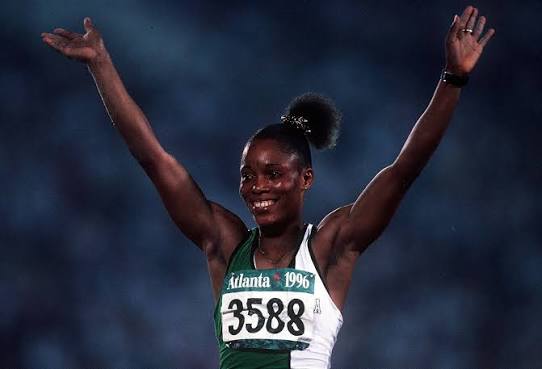

Ajunwa became the first Black African woman to win an Olympic gold medal in a field event. She took the lead immediately and never relinquished it. Her opening jump held up through five more rounds as the world’s best jumpers chased, but could not match her distance.
“I thank God,” Ajunwa said after draping the green-white-green flag around her shoulders. “I did this for Nigeria. I did this for Africa. We can do it.”
The victory was a breakthrough for Nigerian athletics. Until Atlanta, Nigeria’s only Olympic golds had come from the 1996 football team. Ajunwa’s win put an individual name on the country’s Olympic record book for the first time.