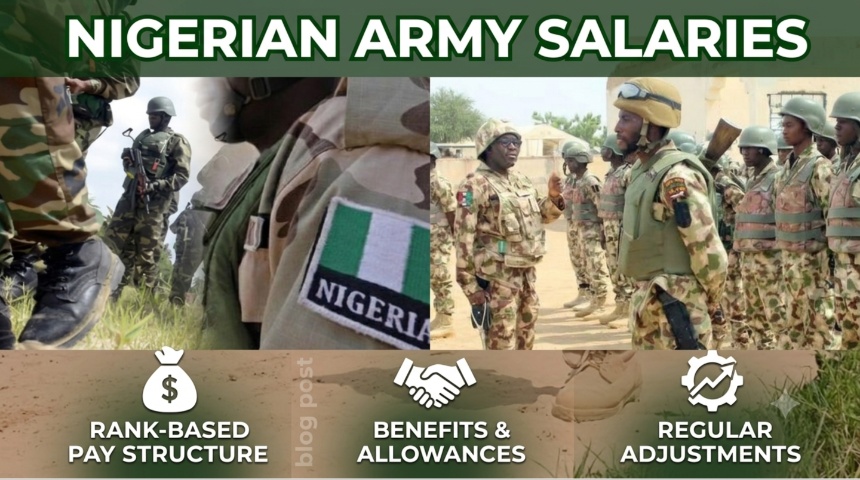
Nigerian soldiers are about to see the biggest jump in their pay packets in years. President Bola Tinubu has approved a fresh salary review for the Armed Forces, with increases ranging from 30 percent all the way up to 80 percent depending on rank. The new structure takes effect from September 1, 2026, and it touches roughly 250,000 officers and men across the Army, Navy and Air Force.
For a country where insecurity has dominated headlines for over a decade, the timing says a lot. Troops fighting banditry in the North West, insurgents in the North East, and kidnapping gangs scattered across several states are the ones this pay rise is meant to reach first.
Here is everything to know about the new Nigerian soldiers’ salaries, how the increase was structured, and what personnel at every rank stand to earn once it kicks in.
Why Tinubu Approved the New Military Salary Structure
The approval was announced on Tuesday by Bayo Onanuga, the President’s Special Adviser on Information and Strategy, who confirmed that the review had received Tinubu’s full backing. According to Onanuga, the adjustment was deliberately weighted so that junior personnel, the men and women who bear the brunt of frontline operations, receive the largest percentage boost.
Tinubu linked the decision directly to Nigeria’s security situation. “Our administration believes that no nation can achieve greatness without security. We therefore remain resolute in mobilising all military and law enforcement assets to eliminate security threats and protect the lives and property of all Nigerians,” he said in the statement.
He also urged troops to see the gesture as recognition of their sacrifice, adding that the government intends to keep investing in modern weapons and equipment alongside the pay increase.
The move raises the Armed Forces’ total annual wage bill from N660 billion to N924 billion, an increase of roughly N264 billion. Reactions have already started pouring in, with lawmakers including Senate Committee on Army chairman Senator Yar’Adua describing the package as a much-needed morale booster for troops confronting banditry, kidnapping, insurgency and terrorism.
How the Pay Rise Is Structured Across Ranks
Unlike previous reviews that applied a flat percentage across board, this one uses a graduated scale. The lower a soldier’s rank, the higher their percentage increase. Here is the breakdown as confirmed by the Presidency:
- Private to Staff Sergeant: 80 percent salary increase
- Warrant Officer to Colonel: 50 percent salary increase
- Brigadier-General and above (including Major-Generals, Lieutenant-Generals and Generals): 30 percent salary increase
This structure means the newest recruits and non-commissioned officers, who typically earn the least, will feel the biggest relative change in their take-home pay come September.
Nigerian Soldiers Salaries: Estimated New Pay by Rank
Based on the salary figures commonly reported for Nigerian Army ranks before this review, here is an estimate of what personnel could earn once the new percentages are applied. These figures are illustrative, since the military has not published an official rank-by-rank pay table, and actual take-home pay will also include allowances such as hazard, uniform, transport and operational allowances that sit on top of base salary.
Junior ranks (80% increase)
| Rank | Previous estimated salary | New estimated salary |
|---|---|---|
| Private | ₦104,500 | ₦188,100 |
| Lance Corporal | ₦112,500 | ₦202,500 |
| Corporal | ₦115,500 | ₦207,900 |
| Sergeant | ₦125,500 | ₦225,900 |
| Staff Sergeant | ₦150,500 | ₦270,900 |
Senior non-commissioned and mid-level officers (50% increase)
| Rank | Previous estimated salary | New estimated salary |
|---|---|---|
| Warrant Officer | ₦172,500 | ₦258,750 |
| Master Warrant Officer | ₦210,500 | ₦315,750 |
| Army Warrant Officer | ₦230,500 | ₦345,750 |
| Second Lieutenant | ₦240,500 | ₦360,750 |
| Lieutenant | ₦280,500 | ₦420,750 |
| Captain | ₦320,500 | ₦480,750 |
| Major | ₦380,500 | ₦570,750 |
| Lieutenant Colonel | ₦420,500 | ₦630,750 |
| Colonel | ₦580,500 | ₦870,750 |
Senior officers (30% increase)
| Rank | Previous estimated salary | New estimated salary |
|---|---|---|
| Brigadier-General | ₦750,500 | ₦975,650 |
| Major-General | ₦1,150,500 | ₦1,495,650 |
| Lieutenant-General / General | Varies by report | Increases by 30% of prior base |
A private soldier who used to take home just over ₦100,000 a month could now be looking at close to ₦190,000, before allowances are even added. That is a significant shift for families who have long complained that a soldier’s pay does not match the risk involved in the job.
Beyond the numbers, the pay rise is being read as a signal of intent. Nigeria’s military has been stretched thin for years, fighting a multi-front war against Boko Haram and ISWAP in the North East, armed bandits in the North West and North Central, separatist agitation in the South East, and oil theft networks in the Niger Delta. Retention and morale have repeatedly come up as concerns, with reports of personnel fatigue and, in some cases, desertion linked to poor welfare.
By tying the biggest raise to the ranks doing the most dangerous ground work, the administration appears to be responding directly to that criticism. Whether the increase translates into better retention, sharper focus in the field, and fewer welfare-related complaints will likely become clearer in the months after implementation begins.
When Does the New Salary Take Effect?
The Presidency has confirmed that the new pay structure becomes active from September 1, 2026. Personnel should expect the adjusted figures to reflect from that payroll cycle, though as with most federal reviews in Nigeria, some units may see the changes reach their accounts slightly later depending on processing.
Final Thoughts
This salary review is one of the most substantial welfare packages the Armed Forces have received in recent years, and it comes at a moment when Nigeria’s security challenges show no sign of slowing down. For serving personnel, especially those in the junior ranks who now stand to earn significantly more, the increase offers a tangible reason to see their sacrifice as valued. For the wider public, it raises a fair question worth watching closely: will better pay for soldiers translate into a safer Nigeria?