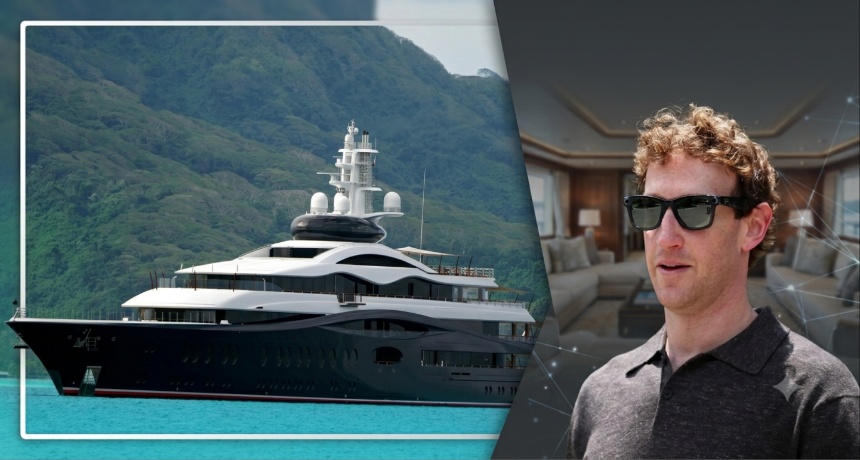
Mark Zuckerberg has a $300 million yacht built for exactly this kind of moment, a boat in trouble, a radio crackling for help, a chance to do something decent with an obscene amount of money. Instead, according to passengers who watched it happen, his crew let another ship do the job while the Launchpad sat there.
The backlash has been swift, and it’s not really about one skiff running out of gas. It’s about what people already believed about Zuckerberg, and how neatly this story fit the picture.
What Actually Happened Off Alaska
The incident unfolded on the night of August 3, in the fjords of southeastern Alaska, roughly 85 miles south of Juneau near Point Highland. A 21-foot Hewescraft skiff, carrying two women, a child, and a dog, ran out of fuel while traveling between Petersburg and Juneau. Around 9:30 p.m., someone aboard radioed the Coast Guard for help.
Nearby was Zuckerberg’s superyacht, the Launchpad: 387 feet of steel, the largest vessel ever built by Dutch luxury shipbuilder Feadship, delivered to him in 2024 and reportedly worth close to $390 million. It was, by most accounts, the closest boat to the stranded skiff.
It didn’t respond. Instead, the Wilderness Legacy, an 88-guest small-ship cruise vessel operated by UnCruise Adventures and further away than the Launchpad, changed course to help. The crew towed the skiff to safety and found the family somewhere to anchor for the night.
The Passenger Who Told the Story
None of this would have made headlines if not for Michael Love, a software developer from New York who happened to be aboard the Wilderness Legacy with his son. When the ship’s captain came on the intercom to explain the unplanned detour, Love says he mentioned that the Coast Guard had first radioed Zuckerberg’s yacht, and gotten nothing back.
Love posted about it on Bluesky, describing what he called “near-unanimous booing” from passengers once they heard why their cruise had been interrupted. He later added that the family aboard the skiff had been running low on gas and that his ship gave them fuel and helped them find safe harbor for the night.
The Alaska Beacon picked up the story and checked Love’s account against vessel-tracking data. The tracking, the outlet reported, backed up his version of events: the Launchpad had slowed to a stop just outside Farragut Bay, a stretch of water roughly five miles wide, around the time the distress call went out.
Asked why the crew of a nearly-400-foot yacht would ignore a request from the Coast Guard, Love told the Beacon he found it baffling, pointing out that most people in Zuckerberg’s position would jump at a rare shot to look like the good guy for once.
Zuckerberg’s Team Responds
Zuckerberg and his wife, Priscilla Chan, weren’t aboard the yacht when it happened, according to spokesperson Brian Baker. He told Forbes the crew had been monitoring a different radio channel at the time and weren’t aware of the call for help until the rescue was already underway, by which point another boat was handling it.
There’s a wrinkle worth mentioning here. The Coast Guard and the Marine Exchange of Alaska, which tracks vessel traffic along the coast, later clarified that this wasn’t technically a distress call in the emergency sense; it was a general broadcast asking for assistance from any nearby vessel. That’s a real distinction on paper. It hasn’t done much to change how the story is landing publicly, where “yacht ignores rescue request” has already become the headline that sticks.
Why This Story Won’t Just Blow Over
Part of what’s kept this in the news cycle is timing and context, not just the incident itself. Zuckerberg has spent the past couple of years rebuilding his relationship with Donald Trump, dining with him at Mar-a-Lago after the 2024 election, reinstating Trump’s Facebook account after its post-January 6 suspension, and publicly praising his response to the first assassination attempt against him. For a chunk of the public already skeptical of Meta’s influence and Zuckerberg’s politics, the yacht story reads less like a one-off mishap and more like confirmation of something they’d already decided about him.
There’s also a local angle simmering underneath this. Some Alaska residents have grumbled for a while about superyachts like the Launchpad showing up in their waters at all, massive private vessels cruising through small coastal communities that don’t exactly benefit from a billionaire’s summer itinerary. This incident gave that frustration somewhere to land.
Where Things Stand
As of now, there’s no indication the Coast Guard is pursuing any formal action against the yacht or its crew; this appears to be a story about optics rather than one with legal consequences. But it’s already done its damage in the court of public opinion, another data point in the long-running narrative about how the ultra-wealthy behave when nobody’s forcing their hand.
Whether the “wrong radio channel” explanation holds up or fades into the background, one detail from this story isn’t going anywhere: a small cruise ship with 88 passengers did what a $390 million superyacht didn’t.