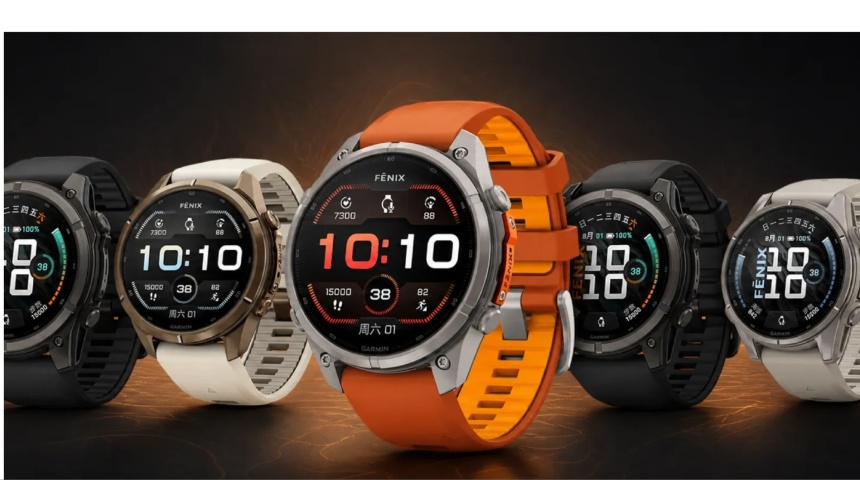
Garmin has at last revealed the Fenix 9, and after months of leaked FCC documents, searching through patents and guesses from every part of the wearables internet, the actual product turned out to be a bigger deal than most people had anticipated. The watch was presented at Garmin’s headquarters in Olathe, Kansas, on August 25, 2026, and it will be available for ordering from August 28. For a company that established its reputation with GPS handheld devices and marine electronics before going on to dominate the market among runners, hikers and triathletes around the world, this is the moment the entire Fenix fan base has been waiting for over two and a half years.
- A Genuinely Brighter Screen, Finally
- Titanium, Properly This Time
- Garmin Epic, Stamina Tracking and Smarter Training Tools
- Maps, Storage and the Stuff That Quietly Matters
- Satellite Communication Comes to Every Pro Size
- Battery Life and the Solar Question
- Pricing: What You’ll Actually Pay
- Is the Garmin Fenix 9 Worth Buying?
Well, then, what is it that has actually changed, and is any of this significant enough to warrant replacing a perfectly good Fenix 8? Let’s look at it in more detail.
A Genuinely Brighter Screen, Finally
The biggest improvement is the screen, and Garmin isn’t reluctant to admit it. The AMOLED screen on the standard Fenix 9 is rated at twice the brightness of the previous model, whereas the Fenix 9 Pro reaches a peak brightness of 3,000 nits. If you compare this to the Fenix 8’s maximum brightness of about 1,000 nits, the increase begins to be understandable; it’s the difference between having to squint at your pace figures during a sunny trail run and being able to read them at a glance.
It’s interesting that Garmin has not returned the microLED option which was such a notable feature of last year’s Fenix 8 Pro. That version reached a brightness of nearly 4,500 nits, but it was heavier, more expensive and obviously aimed at a small number of users. This year, however, Garmin appears to be satisfied with providing a very good 3,000-nit OLED for the majority of people and putting the more exotic display technology aside for another time.
If you’d also like a bigger screen, the 51mm Fenix 9 Pro is now equipped with Garmin’s largest Fenix display yet, consisting of a 1.5-inch AMOLED screen which is 15% larger than that of the Fenix 8 and at the same time fits into the identical case size. That is an impressive piece of engineering and should make a big difference to anyone who has previously had trouble reading a map on a smartwatch screen during a hike.
Titanium, Properly This Time
All the models of the Fenix 9, whether they are the standard or the Pro version, now have a titanium construction, which is a change from the combination of steel and polymer used in some of the Fenix 8 variants. The Pro models go a step further by being the first Fenix watches to feature a completely titanium case, achieved through a nano-molding process that fuses the metal and plastic at a molecular level. Garmin states that the result is a thinner and lighter watch without having to give up the ruggedness that the Fenix name is known for.
The figures show this in an interesting manner: the 43mm Fenix 9 weighs about 44 grams by itself, compared with 45 grams for the Pro model, a difference that is negligible. However, when you move up to the 51mm case, the gap becomes greater: 63 grams for the standard Fenix 9 versus 73 grams for the Pro. This kind of difference will actually be noticeable on your wrist during a long trip, so if you’re considering getting the largest size, it’s a good idea to try both models on before deciding which one is right for you.
Garmin Epic, Stamina Tracking and Smarter Training Tools
In addition to its hardware, Garmin has introduced a genuinely useful new software feature known as Garmin Epic. This allows you to combine a number of activities that have been recorded over days, weeks or even months into one shared story within Garmin Connect, with the photos, health data and performance statistics all integrated into the story. For example, you could consider a multi-day backpacking trip or a cycling stage race; rather than going through a dozen separate activity logs, you end up with a single, coherent narrative that you can actually show to others.
There’s also a new stamina tracking system, centered on stamina zones and a stamina curve, which illustrates how your endurance changes over time in view of your fitness history and the amount of training you’ve done; the system is intended to assist athletes in pacing themselves during an activity rather than just looking at the damage afterwards. Indoor rowing is being enhanced as well, with VO2 Max and power curve metrics available to users of a rowing machine fitted with a power meter, and rucking enthusiasts can now adjust their pack weight during a session, follow GORUCK-branded workouts directly from their wrist, and keep track of the calories burned even when using loads of up to 100kg.
Maps, Storage and the Stuff That Quietly Matters
Garmin has also improved the hardware used for navigation. The Fenix 9 has 50% more RAM than the Fenix 8 and Garmin states that this results in map panning which is up to 30% faster, together with a new perspective view that displays more terrain detail both when looking closely and further ahead on the trail. Storage has also been doubled, going from 32GB to 64GB, so that you can carry twice as many offline maps and up to 7,000 songs without needing to use your phone.
This isn’t particularly impressive from a marketing point of view, but anyone who has had to wait for a Garmin watch to redraw a map when standing at a trail junction will understand exactly why this upgrade is more important than most of the specifications listed in the spec sheet.
Satellite Communication Comes to Every Pro Size
For those adventurers who properly go off-grid, the notable new feature is that the inReach satellite and LTE connectivity is now available on all three versions of the Fenix 9 Pro – the 43mm, 47mm and 51mm models – for the first time; in earlier generations this feature had only been offered with the larger watches. If you have an active plan, you will be able to make voice calls, send text messages and activate SOS alerts via Garmin’s 24-hour Garmin Response coordination centre, all without having to have a phone with you.
The benefits of the connected features extend beyond emergency use. LiveTrack notifications are now sent through the Garmin Messenger app using LTE, enabling people at home to keep track of your activities in real time. There’s also a new Garmin Locate feature which allows relatives to check your position using the same app, and weather forecasts for a specific location can now be retrieved directly to your wrist via satellite or LTE. It’s a kind of safety net that transforms a solo journey into one that your family can actually stop worrying about.
Battery Life and the Solar Question
Battery life depends on the size of the watch and the type of screen as usual. The standard Fenix 9 can last up to 29 days in smartwatch mode when using its largest case, whereas the Fenix 9 Pro reaches 31 days with its largest AMOLED display. The true standout in terms of endurance is the Fenix 9 Pro Solar, which uses a MIP display instead of an AMOLED one and, with sufficient sunlight, is said to be able to operate for as long as 57 days on the 51mm model. Although it doesn’t quite match the 90-day figure that Garmin gives for the dedicated Enduro 3, for a top-tier mainstream watch it is a substantial figure.
It should be pointed out that solar charging is available on only the Pro Solar models, which are offered exclusively in 47mm and 51mm sizes; if you want both the brightest AMOLED display and solar charging in the same watch, you’ll be unable to have them together, since Garmin is currently keeping those two technologies separate.
Pricing: What You’ll Actually Pay
The Fenix 9 range becomes a bit wide-ranging here, which is why it’s helpful to divide it according to size and tier.
- Fenix 9 (43mm): $999.99
- Fenix 9 Pro (43mm): $1,099.99
- Fenix 9 (47mm): $999.99
- Fenix 9 Pro (47mm): $1,099.99
- Fenix 9 Pro Solar (47mm): $1,099.99
- Fenix 9 (51mm): $1,099.99
- Fenix 9 Pro (51mm): $1,199.99
- Fenix 9 Pro Solar (51mm): $1,199.99
If you want to attach an inReach satellite connection to any Pro model, you’ll have to pay an additional $100 and also sign up for a subscription that costs at least $7.99 per month in order to use it. For people buying outside the United States, such as those who are purchasing through importers or via international retailers in Nigeria, the local prices are likely to be considerably higher when shipping costs, duties and exchange rates are taken into account, so it’s advisable to compare different options before making a decision.
Is the Garmin Fenix 9 Worth Buying?
For someone who has a Fenix 6 or 7, the answer is a straightforward yes, since the display alone gives the impression of a generational improvement and the enhancements to storage, mapping and connectivity make the watch genuinely more capable. However, if you already have a Fenix 8 or a Fenix 8 Pro, the difference in the case isn’t as noticeable. It’s true that the brightness has increased, the titanium construction is a pleasant addition, and the fact that satellite connectivity is now available on smaller watches is a major point for anyone who found the earlier inReach models too bulky. Yet if your Fenix 8 is working well for you, none of these changes seems urgent enough to justify upgrading at this time.
The Fenix 9 is clearly the better choice for first-time buyers who are looking for the best that Garmin has to offer, as well as for adventurers who require a satellite SOS feature in a more compact and lighter device. For everybody else, it represents a solid and reasonable improvement rather than something they absolutely have to have, and in a market filled as it is with smartwatch hype, that might be the most honest thing you could say about it.