I should say upfront that both men at the centre of this story are considerably older than I am, and nothing here is written to lecture either of them from some imagined position above their experience. Rufai Oseni, in particular, has been in broadcasting long enough that, professionally speaking, he is someone I would regard as a senior colleague, even though we have never worked under the same roof.
Lere Olayinka, too, came up through journalism himself — trained at the Nigerian Institute of Journalism, and with more than two decades in the trade that included running his own radio station and publishing an online news platform — before he moved fully into political communication. This is not an attempt to referee their standing or flatter either side — just a calm look at what happened on live television last Friday, and what it says about journalism in Nigeria today.
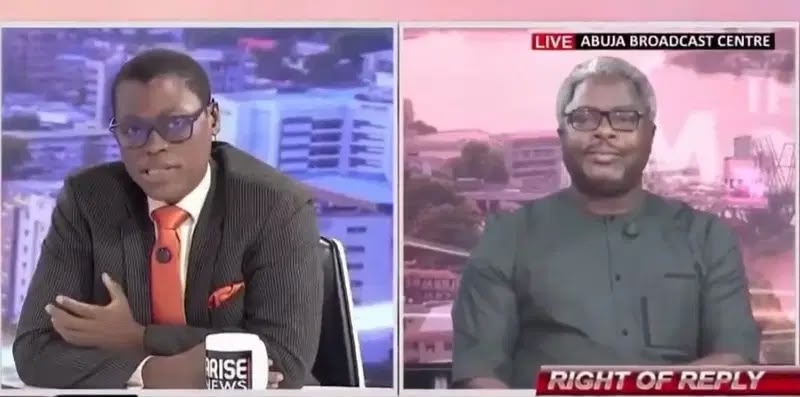
The incident unfolded on Arise Television’s The Morning Show, anchored jointly by Dr Reuben Abati, Ayo Mairo-Ese and Rufai Oseni. Lere Olayinka, senior special assistant on public communication and social media to the Minister of the Federal Capital Territory, Nyesom Wike, had accepted an invitation to appear, knowing all three anchors were part of the rotation.
He fielded questions from Abati and Mairo-Ese without incident. But when Oseni’s turn came, Olayinka refused to engage, telling his hosts that he preferred to speak only with “reasonable human beings.” Mairo-Ese, to her credit, did not let that pass — a guest who knowingly walks into a three-anchor programme cannot midway through decide one of them is unworthy of a reply — and ended the interview.
Olayinka then carried the disagreement onto social media, stretching out a controversy that need not have outlasted the broadcast.
On the narrow question of his conduct, there is little room for debate. A spokesperson does not get to hand-pick which journalist may question him once he has agreed to appear.
If he finds a line of questioning unfair or poorly informed, the professional response is to answer, push back on the premise, correct the record, or explain on the record why he won’t address a point — not to decide unilaterally that an accredited anchor doesn’t deserve one.
Nor was there merit in his subsequent jabs at Oseni’s Animal Science degree; journalism is built on training and experience rather than on what a transcript says, and plenty of respected journalists arrived from Animal Science, History, Law or any number of other disciplines.
But the walkout has also reopened a longer-running conversation about Oseni’s interviewing style, and that deserves its own hearing. Journalism is not public relations, and nobody in or speaking for public office is entitled to a gentle ride.
The job is to pursue truth, test power, and give the public what it needs to judge its leaders — which is exactly what adversarial journalism, at its best, does. Some of the most enduring interviews in broadcast history were built on that same refusal to let power off the hook, produced by the small global fraternity of hard-nosed anchors and interviewers whose names have become shorthand for holding the powerful to account on live television.
Oseni sits comfortably in that lineage — thoroughly prepared, well-informed, and able to tie disparate issues together in ways that have done a great deal for The Morning Show’s following.
Yet the same traits that make him compelling can work against him when pushed too far. There is a real difference between tough questioning and combativeness, between holding someone to account and becoming the story oneself. An interviewer doesn’t need volume to be effective; some of the sharpest questions in broadcast history were delivered quietly.
The goal is never to defeat the guest — it’s to draw out information and let viewers judge for themselves. Once an exchange turns into a visible contest of wills, attention shifts from the substance to the personalities, and nobody benefits from that, least of all the audience. None of this means Oseni should become a different journalist.
The instinct to challenge, the preparation, the refusal to be intimidated — all of that should stay. What could change is the register: fewer interruptions, less volume, letting an evasive answer run its course so the evasion speaks for itself. Calm cross-examination tends to land harder than a shouting match.
Government officials and the people who speak for them would also do well to draw something from this. Occupying a public role does not come with a guarantee of soft questions, and no journalist is under any duty to protect an official from the very scrutiny that comes with the job.
When a spokesperson genuinely believes he is being treated unfairly by a particular reporter, the honest path is to state that case openly and let the public weigh it — not to shut down mid-interview and leave viewers to draw their own conclusions.
And those conclusions rarely favour the person who went silent: walking away from a question, the way Olayinka did, tends to read as evasion rather than principle, and it robs the government of a chance to make its own case in its own words.
Whatever else is said about the personalities involved, The Morning Show itself has grown into something bigger than any single anchor — Abati, Mairo-Ese and Oseni, together with colleagues like Adefemi Akinsanya, Vimbai Muthihirin-Ekpenyong and Ojy Okpe, each bringing a distinct temperament to the desk.
A platform with that kind of reach carries a responsibility to keep sharpening its craft, not merely to defend whatever form it currently takes.
None of this is a call for Oseni to pull his punches. What separates a good interviewer from a great one is rarely volume — it is the ability to ask the one question a guest cannot talk around, and there is no contradiction between staying adversarial and staying fair.
If anything, adapting his approach where it’s warranted would make him harder to dodge, not easier.
Olayinka, for his part, might take away something simpler: showing up for an interview means answering the questions that come with it, in full, not filtering them by who is asking.
In the end, this cuts in both directions — those in government have to answer for how they govern, and those holding the microphone have to answer for how they use it.
Abdulsalam Abdullah is a journalist who writes on politics, governance, and everyday Nigerian life.