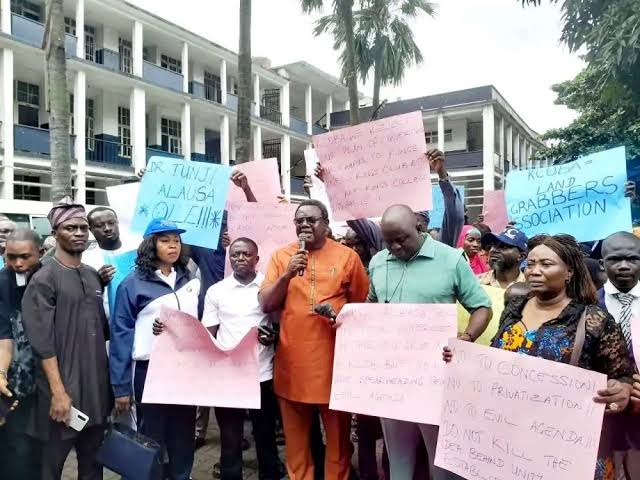
It was the morning of 27 August 2026, and Lagos had not slowed down for anyone’s grief. The chants started before the placards did — mothers in faded school-run wrappers, fathers who should have been at work, standing shoulder to shoulder outside the gates of King’s College. I was there that morning, microphone in hand and camera rolling, and what stayed with me was not the noise but the quiet determination underneath it: the unmistakable sense that these families felt they had to make their voices heard. The concession agreement being drafted in government offices miles away had, for these families, stopped being policy. It had become personal.
The row over plans to hand a slice of King’s College, Lagos, to private management has outgrown the school gates. What began as a dispute about who should run one of Nigeria’s most storied secondary institutions has turned into a referendum on the direction of public education itself, and on how far government is willing to go in reshaping the Federal Unity Colleges system.
At the centre of the storm is a concession arrangement between the Federal Government and the King’s College Old Boys’ Association (KCOBA), under which the alumni body would take on a greater role in financing and managing the school.
Officials insist the plan is not a disguised sale. Ownership, they say, would remain firmly with government; only the day-to-day running and the investment burden would shift.
That distinction matters, and so does the government’s underlying argument. King’s College, like much of Nigeria’s public education infrastructure, has been left to weather years of underfunding.
Classrooms decay, laboratories fall behind, hostels age faster than budgets can renew them. A partnership that channels private capital into repairing these gaps is, on its face, a reasonable response to a genuine problem.
KCOBA’s motives deserve similarly fair treatment. Its members are graduates with a personal stake in the school’s revival, and there is nothing inherently suspect in wanting to reinvest in the institution that shaped them. If the association is prepared to fund new classrooms, laboratories, hostels and libraries, dismissing that offer purely because it arrives wrapped in a concession agreement would be its own kind of short-sightedness.
Yet good intentions on both sides have not been enough to settle the unease building around the deal, and the sharpest of those anxieties centres on the people who keep the school running day to day.
Teachers and non-teaching staff at King’s College are federal civil servants, and it is their futures that remain least defined in the current proposal.
Questions about continued employment, salary structures, pension entitlements, promotion pathways and seniority have gone largely unanswered.
For staff unwilling to leave the Federal Civil Service for a new management framework, there is no clear picture of what becomes of them. Framing that anxiety as mere resistance to reform would be to miss the point: these are legitimate, practical concerns about livelihoods, not knee-jerk opposition to change.
Parents, for their part, are watching the fee question closely. Part of what has long made federal government colleges attractive is not simply their academic pedigree but their relative affordability, a quality that has allowed generations of Nigerian families access to quality education without the price tag of fully private schooling.
Any restructuring that introduces uncertainty over what parents might eventually be asked to pay is bound to invite scrutiny, and rightly so.
There is a broader anxiety rippling through the wider Unity Colleges network as well. If the King’s College model succeeds, or is simply allowed to proceed, other federal colleges may find themselves following the same route before long.
That prospect is precisely why unions have widened their focus beyond the fate of a single school. For organised labour, what is at stake is no longer one institution’s management structure but the long-term security of thousands of public education workers nationwide.
Students and other stakeholders occupy a more complicated middle ground. They, too, want better facilities and modernised infrastructure, but not at the cost of the continuity and character that have defined King’s College for generations.
Their interest lies in an outcome that upgrades the school without eroding the identity that makes it worth attending in the first place. It is a position the Federal Government would do well to take seriously.
None of this amounts to an argument against reform. Nigeria cannot indefinitely tolerate the slow decline of public institutions simply because government purses are stretched thin, and private capital, including that offered by alumni networks, can genuinely help arrest that decline. But a policy built on sound reasoning can still collapse if it is pushed through without securing the confidence of those it most directly affects.
Where a proposal generates the scale of apprehension this one has among workers, parents and students alike, the responsible course is not to press ahead regardless. It is to pause, document the concerns properly, and address them before implementation rather than after. On that basis, the current form of the King’s College concession should be reversed and reworked.
Reversal, it should be stressed, does not mean shutting the door on KCOBA’s willingness to invest, nor does it mean resigning the school to further decay. What it offers instead is a chance to return to the negotiating table and design an arrangement that safeguards the public character of King’s College, protects the employment rights of its staff, preserves affordability for families, and still makes room for the association’s proposed investment.
Few dispute that King’s College needs development. The disagreement is over the price of that development, and whether uncertainty for the people who teach, learn and depend on the school is an acceptable cost.
A policy that produces new buildings but corrodes public trust has only solved half the problem. In this case, that trust is still missing. Until it is rebuilt, the wiser path for the Federal Government is to step back, listen properly to everyone with a stake in the outcome, and negotiate a framework that earns the confidence the current plan has so far failed to secure.
Abdulsalam Abdullah is a journalist who writes on politics, governance, and everyday Nigerian life. He can be reached via 09091604356.