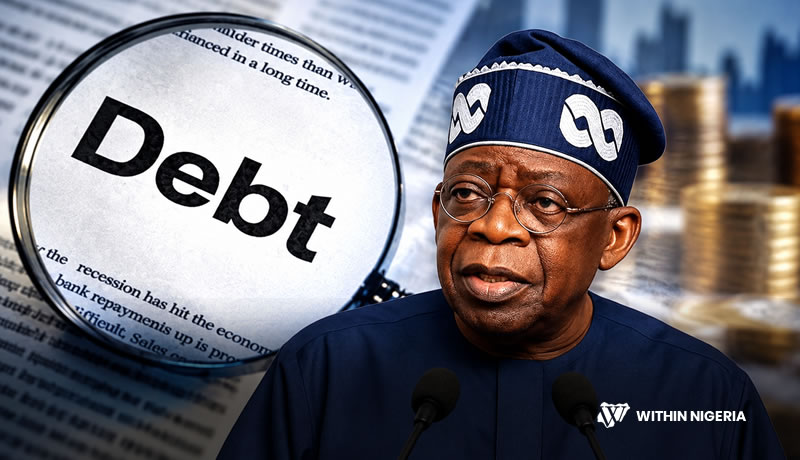
Nigeria’s public debt has climbed to ₦166.79 trillion, but the headline figure only opens the door to a much bigger story about who owes what and who is waiting on the other side of those obligations. The latest figures from the Debt Management Office show that the Federal Government carries by far the largest portion of the country’s debt, while the 36 states and the Federal Capital Territory account for a much smaller share. The external debt figures also reveal a long list of international institutions, governments, banks and investors connected to Nigeria’s outstanding obligations.
The DMO released the latest figures on September 25, 2026, covering Nigeria’s debt position as of June 30, 2026. The total had risen from ₦159.35 trillion at the end of March, meaning the outstanding public debt increased by approximately ₦7.44 trillion within 3 months. But the ₦166.79 trillion figure is a debt stock, not an amount borrowed during the period, and the distinction becomes important when the domestic debt, foreign debt, exchange rate effects, repayments and refinancing arrangements are examined together.
How much does the Federal Government owe?
The Federal Government owed approximately ₦152.77 trillion as of June 30, 2026, according to the latest DMO figures. That amount represents about 91.6 percent of Nigeria’s total public debt of ₦166.79 trillion, making the Federal Government responsible for the overwhelming majority of the country’s outstanding obligations.
The Federal Government’s ₦152.77 trillion debt is made up of approximately ₦86.99 trillion in domestic debt and ₦65.77 trillion in external debt. The domestic portion consists largely of government securities and other instruments issued within Nigeria, while the external portion represents obligations to international lenders, foreign investors, banks and other creditors.
The figures therefore answer one of the biggest questions behind the latest debt report. Out of every ₦100 contained in Nigeria’s ₦166.79 trillion public debt stock, roughly ₦91.60 is attributable to the Federal Government, while the remaining amount belongs to the states and FCT.
How much do the states and FCT owe?
The 36 states and the Federal Capital Territory collectively owed approximately ₦14.01 trillion as of June 30, 2026. That figure represents about 8.4 percent of Nigeria’s total public debt, putting the combined obligations of the states and FCT far below the Federal Government’s ₦152.77 trillion.
The combined state and FCT figure consists of approximately ₦4.59 trillion in domestic debt and ₦9.42 trillion in external debt. This means the composition of subnational debt is different from the Federal Government’s position, where domestic debt is significantly larger than external debt.
The ₦14.01 trillion should also not be treated as though every state owes the same amount. The DMO’s state level figures show major differences between individual states, with Lagos carrying the largest domestic debt figure among the states and FCT, while several states recorded relatively small domestic debt balances.
Nigeria’s ₦166.79tn debt at a glance
The total public debt of ₦166.79 trillion can therefore be broken down into 2 major categories. Domestic debt stood at ₦91.59 trillion, representing 54.91 percent of the total, while external debt stood at ₦75.20 trillion, representing 45.09 percent.
The Federal Government accounted for ₦152.77 trillion, made up of approximately ₦86.99 trillion domestic debt and ₦65.77 trillion external debt. The states and FCT accounted for approximately ₦14.01 trillion, made up of ₦4.59 trillion domestic debt and ₦9.42 trillion external debt.
Measured in United States dollars, Nigeria’s total public debt stood at approximately $120.93 billion as of June 30, 2026. The figure was about $114.95 billion at the end of March, showing an increase in the dollar value of the reported debt stock during the quarter.
Why did the debt rise by ₦7.44tn?
Nigeria’s total public debt stood at ₦159.35 trillion as of March 31, 2026. By June 30, 2026, it had risen to ₦166.79 trillion, producing an increase of approximately ₦7.44 trillion in 3 months.
Domestic debt accounted for the larger part of the quarterly movement, rising from approximately ₦87.40 trillion in March to ₦91.59 trillion in June. That represents an increase of about ₦4.19 trillion during the period.
External debt also increased in naira terms, moving from approximately ₦71.95 trillion to ₦75.20 trillion. The increase was approximately ₦3.25 trillion when measured in naira, although that figure should not automatically be described as ₦3.25 trillion of new foreign borrowing.
The reason is that external debt is largely denominated in foreign currencies. Changes in the exchange rate can alter the naira value of existing foreign obligations, meaning the movement in the naira debt stock can contain both changes in the underlying debt and valuation effects.
What is inside the FG’s ₦86.99tn domestic debt?
The Federal Government’s domestic debt of approximately ₦86.99 trillion is not one single loan. It is made up of several instruments, with FGN Bonds accounting for the largest portion by a wide margin.
FGN Bonds stood at approximately ₦64.84 trillion as of June 30, 2026, representing about 74.53 percent of the Federal Government’s domestic debt. Within that figure, FGN Naira Bonds accounted for approximately ₦41.47 trillion.
Securitised Ways and Means obligations stood at approximately ₦22.11 trillion, while FGN US Dollar Bonds accounted for about ₦1.27 trillion when measured in naira. These figures form the main part of the Federal Government’s domestic debt structure.
Treasury Bills represented another major component, with approximately ₦19.48 trillion outstanding. That amount represented about 22.39 percent of the Federal Government’s domestic debt stock.
The remaining instruments included approximately ₦1.19 trillion in FGN Sukuk, ₦1.22 trillion in Promissory Notes, ₦122.45 billion in FGN Savings Bonds, ₦47.36 billion in Green Bonds and ₦100 billion in UFTF FGN Securities.
Who are Nigeria’s foreign creditors?
Nigeria’s external debt stood at approximately $54.524 billion as of June 30, 2026. The DMO’s external debt document groups the creditors into 3 broad categories: multilateral creditors, bilateral creditors and commercial creditors.
Multilateral creditors accounted for approximately $24.76 billion, representing about 45.42 percent of Nigeria’s external debt. Bilateral creditors accounted for approximately $6.61 billion, representing about 12.12 percent, while commercial creditors accounted for approximately $23.16 billion, representing about 42.47 percent.
That means Nigeria’s largest external creditor category is the multilateral group, followed closely by commercial creditors. Bilateral creditors make up the smallest of the 3 major categories.
The figures also show that Nigeria’s foreign creditors are not limited to foreign governments. The country owes money to international development institutions, foreign government backed lenders, international banks and investors who hold Nigerian debt securities.
How much does Nigeria owe the World Bank?
The World Bank’s International Development Association, known as IDA, is the largest named creditor in the DMO’s external debt breakdown. Nigeria owed approximately $19.12 billion to the IDA as of June 30, 2026.
The IDA forms part of Nigeria’s multilateral external debt and accounts for a substantial share of the approximately $24.76 billion owed to multilateral creditors. The International Bank for Reconstruction and Development, another World Bank institution, accounted for approximately $1.61 billion.
The African Development Bank accounted for approximately $2.17 billion, while the African Development Fund accounted for about $1.01 billion. Nigeria also owed approximately $406.41 million to the Islamic Development Bank, alongside obligations to other multilateral institutions.
The concentration of debt within these institutions means that the World Bank group and other multilateral lenders represent a major part of Nigeria’s external debt structure.
How much does Nigeria owe China?
China is one of the most significant bilateral creditors listed in the DMO’s external debt records. China Exim Bank accounted for approximately $4.91 billion of Nigeria’s external obligations as of June 30, 2026.
China Development Bank accounted for another approximately $573.53 million. Together, the 2 Chinese institutions therefore accounted for a substantial portion of Nigeria’s $6.61 billion bilateral debt.
The bilateral category also includes France’s Agence Française de Développement, with approximately $906.23 million. Japan’s JICA accounted for about $126.53 million, while Germany’s KfW was listed at approximately $77.84 million.
India Exim Bank accounted for approximately $9.68 million. The figures show that Nigeria’s bilateral debt is spread across several countries, although the amounts owed to the individual lenders vary significantly.
How much does Nigeria owe commercial creditors?
Commercial creditors accounted for approximately $23.16 billion of Nigeria’s external debt as of June 30, 2026. This represents about 42.47 percent of the country’s $54.524 billion external debt.
The largest component in this category was Eurobonds, which stood at approximately $18.55 billion. Eurobonds represent debt securities issued internationally and held by investors, making them an important part of Nigeria’s foreign commercial obligations.
The commercial category also contains syndicated financing involving institutions such as First Abu Dhabi Bank, Afreximbank, Standard Chartered and UniCredit, alongside other commercial obligations recorded by the DMO.
One of the entries that stands out in the external debt document is a $1.5 billion First Abu Dhabi Bank Total Return Swap. The transaction is included in Nigeria’s external debt stock and has also appeared in the latest discussion about debt service because of a separate payment recorded in the Q2 debt service document.
Which foreign creditor category is the largest?
The DMO’s figures show that multilateral creditors account for approximately $24.76 billion of Nigeria’s $54.524 billion external debt, making them the largest of the 3 broad creditor categories.
Commercial creditors follow with approximately $23.16 billion, while bilateral creditors account for about $6.61 billion. The difference between the multilateral and commercial categories is therefore much smaller than the gap between either of them and bilateral creditors.
Within the multilateral category, the World Bank’s IDA has the largest named obligation at approximately $19.12 billion. Within bilateral debt, China Exim Bank has the largest listed obligation at approximately $4.91 billion. Within commercial debt, Eurobonds account for approximately $18.55 billion.
This gives a clearer picture of who stands behind the external debt. Nigeria’s foreign obligations are spread across international development institutions, foreign government backed lenders and commercial investors rather than being concentrated in a single country or institution.
How much do Lagos and other states owe?
The DMO’s latest domestic debt figures show considerable differences among the states. Lagos recorded approximately ₦1.195 trillion in domestic debt as of June 30, 2026, making it the largest state figure in the DMO’s domestic debt breakdown.
Delta followed with approximately ₦369.30 billion, while the FCT recorded about ₦358.79 billion. Rivers stood at approximately ₦354.64 billion, while Edo recorded about ₦214.93 billion.
Ogun had approximately ₦189.05 billion in domestic debt, while Bauchi recorded about ₦157.35 billion. Niger stood at approximately ₦140 billion, while Cross River recorded approximately ₦130.01 billion.
At the lower end of the DMO’s domestic debt figures, Jigawa recorded approximately ₦1.04 billion, Ondo recorded about ₦6.16 billion, Anambra stood at approximately ₦9.62 billion and Ebonyi recorded about ₦11.38 billion.
These figures are strictly domestic debt figures. They do not represent the complete debt position of each state because states and the FCT also have external obligations.
How much did Nigeria pay foreign creditors in Q2?
While Nigeria’s debt stock stood at ₦166.79 trillion at the end of June, the government also made payments to external creditors during the quarter. The DMO’s Q2 2026 external debt service record shows total payments of approximately $870.73 million between April and June 2026.
The payments consisted of approximately $339.75 million in principal, $491.73 million in interest and $39.25 million classified as other charges. The figures therefore show that interest payments made up the largest portion of the recorded external debt service during the quarter.
Multilateral creditors received approximately $404.22 million during the quarter, while commercial creditors accounted for about $325.70 million. Bilateral creditors accounted for approximately $140.81 million.
The $870.73 million figure is therefore separate from the ₦166.79 trillion debt stock. The first figure represents payments made during 3 months, while the second represents the outstanding public debt at a particular date.
What is the $22.5m First Abu Dhabi Bank payment?
The Q2 debt service document contains a specific entry for the First Abu Dhabi Bank Total Return Swap that has drawn attention in the current discussion. The document records $22.5 million under other charges for the transaction.
The same entry records zero principal and zero interest, leaving the $22.5 million under other charges as the total payment for that line. The Q2 document also records approximately $8.97 million in other charges against Deutsche Bank AG.
The DMO’s debt service record establishes the amount and classification of the payment, while the underlying financial agreement would be required to provide a fuller explanation of the contractual basis for the charge. The $22.5 million figure has nevertheless become part of the discussion surrounding Nigeria’s external debt service.
How much has Nigeria’s debt risen in 1 year?
Nigeria’s total public debt stood at approximately ₦152.40 trillion as of June 30, 2025. By June 30, 2026, it had reached ₦166.79 trillion.
That represents an increase of approximately ₦14.39 trillion in 1 year, equivalent to about 9.4 percent. The increase was driven mainly by the domestic component of the debt stock.
Domestic debt rose from approximately ₦80.55 trillion in June 2025 to ₦91.59 trillion in June 2026, representing an increase of about ₦11.04 trillion. External debt moved from approximately ₦71.85 trillion to ₦75.20 trillion, an increase of approximately ₦3.35 trillion in naira terms.
Again, the external debt movement should be considered alongside exchange rate changes because the naira value of foreign currency obligations can change even where the underlying foreign currency amount does not increase by the same proportion.
How much has Nigeria’s debt risen since June 2023?
The DMO recorded Nigeria’s total public debt at approximately ₦87.38 trillion as of June 30, 2023. By June 30, 2026, the debt stock had reached ₦166.79 trillion.
The difference between the 2 figures is approximately ₦79.41 trillion, representing an increase of about 90.9 percent over the period. This comparison shows the change in the reported public debt stock between the 2 dates.
However, the ₦79.41 trillion difference should not automatically be described as ₦79.41 trillion of fresh borrowing. Debt stocks can change because of borrowing, repayments, refinancing, rollovers, exchange rate movements and other adjustments.
This distinction becomes particularly important when comparing figures across several years because the naira equivalent of foreign currency debt can change significantly as exchange rates change. The debt stock therefore provides the outstanding balance at a particular point in time rather than a simple cumulative record of every naira borrowed.
What the latest figures mean
The latest DMO figures provide a direct answer to the question of how Nigeria’s ₦166.79 trillion public debt is distributed. The Federal Government owes approximately ₦152.77 trillion, while the 36 states and FCT collectively account for approximately ₦14.01 trillion.
Of the total national debt, ₦91.59 trillion is domestic debt and ₦75.20 trillion is external debt. The Federal Government’s domestic debt stands at approximately ₦86.99 trillion, while its external debt is approximately ₦65.77 trillion. The states and FCT account for approximately ₦4.59 trillion in domestic debt and ₦9.42 trillion in external debt.
Nigeria’s external debt is approximately $54.524 billion. Multilateral creditors account for $24.76 billion, bilateral creditors account for $6.61 billion and commercial creditors account for $23.16 billion. The largest named multilateral obligation is the approximately $19.12 billion owed to the World Bank’s IDA, while China Exim Bank is the largest listed bilateral creditor at approximately $4.91 billion. Eurobonds account for approximately $18.55 billion within the commercial category.
The latest figures also show that Nigeria paid approximately $870.73 million in external debt service during Q2 2026, comprising $339.75 million in principal, $491.73 million in interest and $39.25 million in other charges. Among the entries was the $22.5 million First Abu Dhabi Bank Total Return Swap payment listed under other charges.
The ₦166.79 trillion figure therefore tells only the starting part of the story. The detailed records show exactly how the debt is divided between the Federal Government, states and FCT, how much is domestic and external, which international institutions and creditors are involved, and how much Nigeria paid toward external obligations during the same quarter. Most importantly, the figure represents the outstanding public debt stock as of June 30, 2026, rather than ₦166.79 trillion of money newly borrowed during the year.