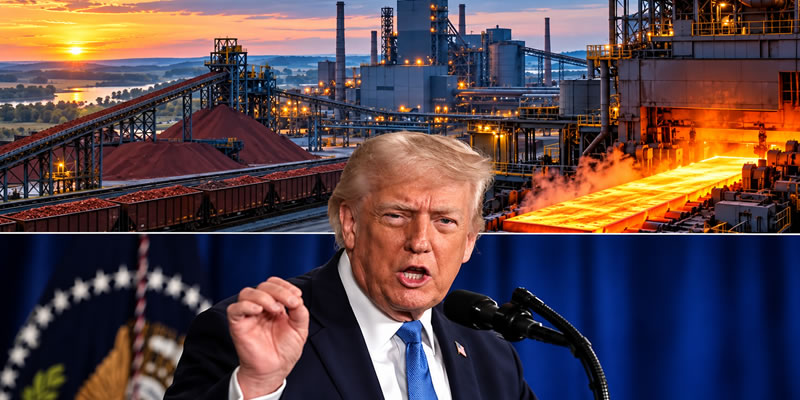
President Donald Trump used the Oval Office on Monday to unveil what the White House calls the largest steel plant in American history. The $15 billion Iowa steel plant will be built by Mesabi Metallics, a company owned by India’s Essar Group. Trump announced it alongside steel executives and Iowa Republicans, including two who are running for office.
The plan is big on paper, but the timeline is long. The company does not expect the mill to make its first steel until 2030.
What Trump Announced About the Iowa Steel Plant
In the Oval Office, Trump said Mesabi Metallics will build the largest steel plant in American history in Iowa. He was joined by Mesabi executives and a line-up of officials. Mesabi CEO Joe Broking and Chairman Rewant Ruia were there, along with Commerce Secretary Howard Lutnick, Energy Secretary Chris Wright and Export-Import Bank Chairman John Jovanovic.
Essar co-founder Ravi Ruia and his son Rewant were in the room as Trump spoke. Rewant Ruia thanked the president for restoring the importance of building things in America.
The facility is planned in stages. The first phase is estimated at about 7.5 million tons of steel a year, and it is expected to ramp up to 10 million tons annually. Mesabi has described the finished product as “100% American steel,” made from mine to mill inside Minnesota and Iowa.
The site is in Lee County, in the southeastern corner of Iowa. It is the state’s southeastern-most county and borders the Mississippi River. One caveat: Newsweek noted that Mesabi had not formally identified the site at first, though Iowa outlets were reporting Lee County. Later coverage from Minnesota and Iowa outlets states the location plainly.
An Iowa economic development expert explained the appeal. He pointed to river access to Minnesota, highway links and BNSF rail service. That matters because the plant’s raw material comes from far up the river.
The Minnesota Mine Behind the Mill
The mill will run on iron ore pellets from Mesabi’s operation in Nashwauk, Minnesota, and the story of that mine is a rocky one. The mine sits roughly 250 miles from the Iowa border, and Essar has invested more than $2.5 billion in it. Miners began blasting ore earlier this month at what is the first new iron mine in the U.S. in more than 50 years. It is expected to turn out about 7 million tons of pellets a year, which will eventually travel down the Mississippi to Iowa.
Getting here took a long time. The project goes back nearly two decades and ran into financing problems and missed deadlines. Essar Steel Minnesota filed for Chapter 11 in 2016, later emerged as Mesabi Metallics, and Essar regained control. Adding the mine to the new mill, Mesabi puts total investment at about $18 billion.
The White House is leaning hard on the employment numbers. It says the project will bring 1,750 permanent jobs to Iowa, plus 5,000 to 6,000 construction jobs in the first phase. Lutnick also cited a $95 billion boost to the US economy. These are projections, not hiring that has already happened, and the economic figure is an official estimate rather than measured activity.
For a region that has watched factory work leave, the reaction was warm. Rep. Mariannette Miller-Meeks, who represents southeast Iowa, said jobs there have long gone overseas and called the arrival of the mill transformational. She also mentioned a natural gas pipeline expected to serve the area, though it was unclear which project she meant.
Trump tied the announcement directly to his trade policy. He said the steel industry is “roaring back to life” and credited the 50% tariffs he imposed on steel imports last year. Lutnick went further, saying neither the mine nor the mill would exist without the tariffs.
The timing was not lost on anyone. The announcement came just over a month before the midterms. Trump said he would campaign in Iowa in the coming weeks, and the event at times sounded like a campaign stop. Both Rep. Ashley Hinson, running for the Senate, and Miller-Meeks, seeking re-election, were beside him. Meanwhile, a Marist poll of Iowa voters found 41 percent approve of Trump, and 58 percent disapprove.
Not everyone was cheering. Some Minnesotans see the decision as a missed opportunity. Broking recently told Itasca County commissioners that other states were more competitive on incentives for a project like this. State Rep. Spencer Igo said the Iowa siting should frustrate anyone who cares about northern Minnesota’s future. Iowa may also add its own sweetener: The Des Moines Register reported that lawmakers were being warned they might need to return to the statehouse to consider state aid
For now, the Iowa steel plant is a proposal, not a working mill. Financing has to hold together, construction has to start, and the ore supply chain has to run the way the company promises. The project is aiming at a 2030 start. Whether it becomes the flagship of an American steel revival or another big announcement that fades depends on what gets built in Lee County over the next few years.