You know that moment? You’ve written something. It’s good. But you need it to make it little different. Maybe for a different audience. Maybe because you’re repeating content. Maybe because your brain is fried from rewriting the same paragraph five times. That’s when most people give up. They settle for mediocre. Or they spend hours manually rewriting everything.
I used to do this constantly. Write something decent. Realize I need to express it differently. Spend three hours trying to rephrase it naturally. By the end, I’m so tired I don’t even know if it’s better anymore. Then I love to start using a paraphrasing tool. Changed everything.
The Real Problem With Manual Rewriting
Here’s the thing nobody admits. Rewriting manually is absolutely exhausting.
You read what you wrote. You understand it perfectly in your mind. Then you try expressing it differently. Your brain fights you. It needs to use the same words but cannot. Same structure. Same everything. It’s like muscle memory for language.
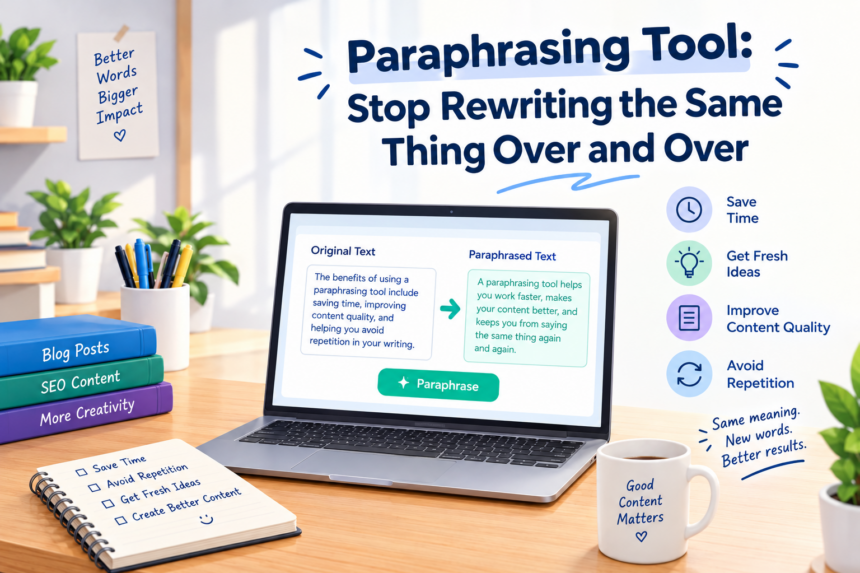
So you force it. You use a thesaurus. Swap out words. Shuffle sentences around. Then you read it back. Sounds artificial. Doesn’t flow. Loses the meaning somehow. You rewrite again. And again. And again. Three hours later, you’ve maybe improved it slightly. And you’re mentally exhausted. A paraphrasing tool skips all that. It takes your text. Completely reorganizes it. New word choices. Different structure. Same meaning. Thirty seconds instead of three hours.
When You Actually Need Paraphrasing
Freelancers deal with this constantly. You write one version of an article. Then the client says, “Can you make it sound different?” So you rewrite. Completely. Takes forever. Content agencies face similar problems. They need change of the same content. Different landing pages. Different ad copy. Same core message. Different presentation.
Students hit this when they’re researching. They read something brilliant. Realize they can’t use it directly. Have to express it themselves. Which is harder than it sounds. Marketers create email campaigns. Need multiple versions. Can’t just copy-paste. Each version needs to feel fresh. But express the same offer.
Writers working on multiple projects sometimes hit the same topic from different angles. Need to explain concepts multiple ways without sounding repetitive. All these situations would be impossible without some way to quickly generate alternative versions. A paraphrasing tool makes it actually doable.
How It Actually Works
Modern paraphrasing tools use artificial intelligence. They read your text. Understand what you’re actually saying. Then reconstruct it completely differently.
The key word is “understand.” It’s not just swapping synonyms. That would be garbage. It actually comprehends your meaning. Then expresses it in a completely new way.
Some tools maintain the same tone. Others let you adjust. Formal. Casual. Academic. Creative. Different tools have different options.
The output isn’t always perfect. Sometimes it’s weird. Sometimes the flow feels off. But it gives you a starting point. You edit from there. Which takes way less time than starting from scratch.
Real Situations Where This Saves Your Ass
I know a freelancer who got a nightmare assignment. Client wanted three different versions of the same article. Same information. Different presentation. Completely different tone for each.
Doing this manually would take days. She used a paraphrasing tool three times. Got rough versions in an hour. Edited them. Fine-tuned them. Delivered all three the next morning. Client was thrilled. Paid extra for the quick turnaround.
Another person I know is a content marketer for an e-commerce site. They run ads. They all need different content copy for different audiences. Same product. Different angles. Using a paraphrasing tool, she can generate variations in minutes. Test them. See what actually converts.
A student I met was writing a research paper. Found this perfect explanation of a concept. Couldn’t use it directly. Plagiarism issues. But needed to explain it accurately.
The Limitations You Should Know
These tools aren’t magic. They make mistakes. Sometimes they lose nuance. Sometimes they get the tone wrong. Sometimes they output something that doesn’t actually make sense.
They also can’t create. They can only rephrase what is already available there. You can’t feed in a terrible explanation and expect it to become brilliant.
And they work best on straightforward content. Technical writing. Marketing copy. News articles. They struggle with really creative writing. Poetry. Humor. Anything that relies on wordplay. Also, different tools produce different results. One might sound natural. Another might sound robotic.
When Not to Use Them
Don’t use a paraphrasing tool as an excuse to avoid writing. If you should be writing original content, write it. Don’t generate text and call it done.
Don’t use them to avoid understanding something. If you’re paraphrasing research, actually read the source. Understand it. Then paraphrase. Don’t just pass it through a tool.
Don’t use them to plagiarize. Paraphrasing someone else’s work without credit is still plagiarism. Citation is still required.
The Honest Take
A paraphrasing tool is useful. Really useful. But it’s a tool. Like a spell-checker. Or a grammar checker. It helps with the mechanical work. It doesn’t replace thinking. Doesn’t replace writing skill. Doesn’t replace understanding what you’re actually trying to say.
But for the boring mechanical work of expressing the same idea differently? It’s a lifesaver. Always use it for what you’re good at. Skip it for everything else. You’ll save hours. And your work will be better.