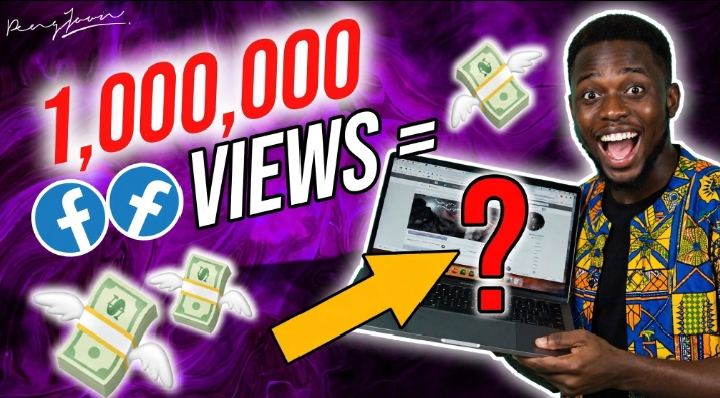
Getting 1 million views on Facebook Reels can put a creator in front of a massive audience, attract new followers and open doors to income opportunities that once seemed out of reach. For Nigerian skit makers, comedians, lifestyle bloggers and digital publishers, the appeal is obvious, especially as more people turn their phones into tools for building an online business. Yet, behind the impressive view counts displayed beneath viral videos lies a financial question that deserves a closer look, because the number of people watching a video does not automatically reveal how much money its creator will receive.
Some creators have shared impressive earnings from Facebook, while others struggle to understand why their videos attract thousands of views without producing the income they expected. The difference can come down to monetization eligibility, the quality of the views, audience engagement and the terms under which a particular account earns money. Understanding these factors is useful for anyone hoping to turn Facebook Reels into a dependable source of income in 2026, particularly in Nigeria, where content creation has become an increasingly attractive business option.
How Much Can 1 Million Facebook Reels Views Earn in 2026?
The amount a Nigerian creator could earn from 1 million Facebook Reels views in 2026 depends on the account’s monetization status and the earnings rate applied to eligible content. There is no single payment that Facebook guarantees every creator for reaching this milestone, meaning 2 people with the same number of views could receive very different amounts. Some may earn a modest sum, others may receive considerably more, while creators who are not eligible for direct monetization may earn nothing from Facebook’s content payment system despite attracting a large audience.
A useful way to understand the possibilities is to calculate earnings using different hypothetical rates rather than presenting 1 figure as the official Facebook payment. If a creator earns $0.20 per 1,000 eligible views, 1 million eligible views would generate $200. At $0.50 per 1,000 eligible views, the same volume would produce $500, while a rate of $1 would produce $1,000. These figures are mathematical illustrations, not confirmed Facebook rates for Nigerian creators in 2026, and the actual amount may fall outside these examples.
The calculations also assume that all 1 million views qualify for payment under the stated rate. Public view counts can include views that do not generate monetizable activity, so a creator should not automatically multiply the total number displayed on a Reel by an assumed rate and treat the result as guaranteed income. The earnings information available in the creator’s own Professional Dashboard is a better starting point for estimating revenue than a figure circulated on social media.
The Earnings Breakdown for 1 Million Views
Creators who want to plan their income can compare several possible earnings rates to see how strongly the final payment depends on the rate applied to eligible views. The following examples assume that all 1 million views qualify and that the stated rate remains consistent throughout the calculation.
At a hypothetical rate of $0.10 per 1,000 eligible views, 1 million eligible views would generate $100. If the rate were $0.20, the same number of views would produce $200, while a rate of $0.50 would generate $500. At $1 per 1,000 eligible views, the estimated earnings would reach $1,000, increasing to $2,000 at a rate of $2, $5,000 at a rate of $5 and $8,000 at a rate of $8.
These figures are not an official Facebook earnings guide, and they should not be interpreted as a promise that Nigerian creators can obtain any of the listed rates. They simply demonstrate how the same number of views can produce different financial results depending on the rate used in the calculation. A creator who wants to estimate income accurately must first establish whether monetization is active, how many views qualify and which earnings rate applies to the content.
Another point worth considering is that the money shown in an earnings dashboard may not be the final amount received in a bank account. Payment thresholds, account verification, tax requirements, currency conversion and the platform’s payment arrangements can affect when and how earnings are received. Anyone building a business around Facebook content should therefore separate estimated revenue from money that has actually been paid.
Why Sirbalo’s Reported $4 Million Earnings Claim Attracted Attention
Nigerian comedian and content creator Sirbalo has been associated with a striking earnings claim involving a Facebook video that reportedly attracted approximately 2.1 billion views. A report published on July 17, 2026, described his account of earning more than $4 million from the video, making the story an example of the extraordinary figures that can circulate around viral content. The reported claim has attracted attention because it suggests how lucrative a highly successful video could be under certain monetization conditions.
Sirbalo reportedly recalled a period when the earnings rate could rise to $8 per 1,000 views, adding that 100,000 views could previously bring in about $200 or $300 at another rate. Those figures describe different earning experiences and should not be treated as a single rate that applies to every video or every period. His reported account provides a useful starting point for understanding the mathematics behind large earnings claims, although the public account alone does not establish the video’s complete payment records or independently verify every dollar earned.
The arithmetic helps explain why the claim caught the public’s attention. If 2.1 billion views were paid at $2 per 1,000 views, the resulting amount would be $4.2 million. However, applying a rate of $8 to every 1,000 views would produce $16.8 million, which illustrates why an earnings rate mentioned in an interview cannot automatically be applied to every view of a particular video. The calculations are hypothetical, and they do not independently establish how Sirbalo’s reported earnings were calculated.
His story should therefore be understood as a reported creator earnings claim rather than evidence that 1 million Nigerian Facebook Reels views currently pay a fixed amount. A creator may experience unusually favourable monetization conditions at a particular time, but that experience does not establish a standard rate for other accounts. Anyone using such examples to plan a content business should pay closer attention to their own earnings records and the platform’s current monetization rules.
Facebook’s Monetization System in 2026
Meta has continued to develop its Facebook content monetization arrangements, bringing different types of eligible content into its broader earnings system. On June 27, 2024, Meta announced the expansion of monetization opportunities for eligible Nigerian creators, opening another route for local publishers and entertainers to earn directly from content on the platform. The announcement was encouraging for creators who had previously relied heavily on brand promotions, affiliate sales or other indirect sources of income.
The system available to an individual creator depends on the programme, account status and content involved. Facebook Content Monetization is designed to reward eligible content based on performance, but it does not mean every video published by every account automatically generates payment. Eligibility requirements, policy compliance and the monetization options available in the account determine whether a creator can participate.
Meta’s March 2026 guidance described Facebook Content Monetization as an invitation based programme, with eligible creators able to express interest through their Professional Dashboard. This means that having a large following or reaching 1 million views does not, by itself, guarantee access. Creators should check the options available to their accounts rather than assuming that the experience of another publisher will be identical to theirs.
The practical approach is to establish monetization eligibility before setting an income target. A creator who has not been accepted into an applicable programme should not build a financial forecast around direct Facebook payments that have not yet become available. That person may still use Reels to attract customers, build an audience or secure sponsorships, but those activities are different from receiving money directly through Facebook’s content monetization system.
Why 1 Million Views May Not Produce the Expected Income
A public view count is a measure of audience activity, not a complete statement of monetization revenue. Some views may not qualify for payment, while others may contribute differently depending on the content, the viewer’s activity and the monetization rules applicable to the account. This explains why a Reel with 1 million views does not necessarily generate more money than another video with a smaller audience.
Consider 2 Nigerian creators who each publish a Reel that reaches 1 million views. The first creator has active monetization and records a substantial number of qualified views, while the second has not been admitted into the relevant programme. Even though both videos display the same view count, the first creator may receive direct content earnings while the second receives no payment from Facebook for those views. The difference comes from their account arrangements, not from the headline number beneath the videos.
A similar difference can occur between 2 monetized accounts. One video may attract a large number of views that generate relatively little revenue, while another may perform better under the platform’s applicable monetization arrangements. This is why creators should examine their earnings insights alongside their view counts instead of judging a video’s financial success by popularity alone.
Paying actors, renting locations, buying costumes, travelling to film shoots or hiring an editor can become expensive, and a viral result is never guaranteed. Before spending money on a production, a creator should consider the possible costs, the audience they want to reach and the other ways the video could generate business value.
How Audience Location Can Influence Earnings
The location of a creator’s audience can be relevant to the commercial value of content because advertising demand and the monetization arrangements available to an account may differ across markets. Advertisers do not place the same value on every audience in every circumstance, and the resulting revenue opportunities can vary. However, audience location should not be treated as a universal formula that guarantees a particular amount per 1,000 views.
Nigerian creators may attract viewers from Nigeria, the United States, the United Kingdom, Canada and other countries through comedy, entertainment, educational videos and lifestyle content. A video with an international audience may perform differently from one watched mainly by local viewers, but the final payment still depends on the monetization system and the eligible activity recorded for that content. Simply attracting viewers from a country associated with higher advertising spending does not guarantee a specific payout.
Creators should use their own audience insights to understand where their viewers come from and which videos generate the strongest results. A Nigerian comedian whose audience is concentrated locally may find that relatable skits, recurring characters and a loyal following create valuable opportunities for sponsorships and live performances. Another creator may build an audience around educational content that attracts viewers across several countries, opening different commercial possibilities.
The sensible strategy is to understand the audience rather than chase foreign views without a clear content plan. A video designed only to attract viewers from another country may struggle if the subject, language or presentation does not connect with them. Content that serves a clearly defined audience can build repeat viewership, strengthen the creator’s identity and provide a better foundation for long term business growth.
Meta’s March 2026 Guidance on Original Content
Originality remains a central consideration for creators who want to build a sustainable presence on Facebook. On March 13, 2026, Meta published updated guidance explaining how the platform treats original and unoriginal content, including material that is reposted or altered without adding meaningful creative value. The guidance reinforced the importance of producing work that gives audiences a genuine reason to watch a creator rather than simply recycling another publisher’s videos.
Content filmed or produced directly by a creator can qualify as original, while third party material may require substantial new information, analysis or creative contributions to demonstrate meaningful value. Minor edits, borders, captions or simple combinations of other people’s clips may not be enough to turn reused footage into original work. Repeatedly publishing unoriginal material can also affect distribution and put monetization opportunities at risk.
Nigerian creators who produce skits, interviews, commentary, tutorials or original entertainment can use this guidance when planning their work. A comedian could develop recurring characters and write new scripts, while an entertainment blogger could record original interviews and provide substantive commentary on a public event. A tutorial creator could film each demonstration and explain the process in their own words rather than simply reposting somebody else’s finished video.
Original production does not guarantee that a Reel will go viral or earn a particular amount, but it helps establish a clear identity and reduces dependence on content that belongs to other people. Creators should also respect copyright, music licensing requirements and Facebook’s community standards. A popular video that creates a policy problem may not provide the financial return its creator expected, even when the view count is impressive.
How Nigerian Creators Can Check Their Monetization Status
The first step for anyone hoping to earn directly from Reels is to check whether their account has access to the relevant monetization features. Facebook provides account management tools through the Professional Dashboard for eligible profiles and Pages, although the precise interface may differ according to the account and the version of the app. Creators should use the status and instructions displayed on their own accounts instead of relying entirely on screenshots shared by other users.
Open the Facebook profile or Page used to publish content, then enter the Professional Dashboard where available. Look for the Monetization section and review the programmes or options displayed for the account. If Facebook offers an opportunity to express interest in Content Monetization, follow the instructions provided, while recognising that expressing interest is not the same as being accepted into the programme.
Creators who already have access should review their earnings insights and available performance information. Depending on the tools provided to the account, these details may help explain eligible views, earnings rates, estimated revenue and the performance of individual videos. Comparing several Reels over time can reveal whether certain formats consistently attract stronger engagement or generate more income than others.
Account compliance should also be reviewed before expecting regular payments. Creators need to follow applicable monetization policies, maintain accurate account information and complete any verification or payment setup required by Meta. A large audience cannot replace these requirements, and resolving account issues may be more useful than immediately producing more videos in the hope of earning money.
Other Ways to Earn From 1 Million Facebook Views
Direct Facebook monetization is only 1 part of the potential business value of a successful Reel. A creator who reaches 1 million views may also gain followers, increase awareness of a business, attract enquiries and create opportunities to work with brands. These outcomes are not guaranteed, but they can provide additional sources of income that do not depend entirely on the platform’s direct payment rate.
Brand partnerships are one option for creators who have developed a recognisable audience. A Nigerian food creator, for example, could work with a restaurant or food brand to produce sponsored content, while a fashion creator could feature clothing or accessories under an agreed commercial arrangement. The amount paid depends on the campaign, the creator’s audience, the work required and the terms negotiated with the advertiser rather than the view count alone.
Creators can also use Reels to attract customers to their own businesses. A fashion seller might demonstrate products and direct interested viewers to a shop, while a digital publisher could use short videos to promote paid guides, newsletters or other services. In these cases, the financial return depends on how many viewers become customers, the price of the product and the cost of delivering it.
Affiliate marketing offers another possible income stream when a creator promotes products through an arrangement that pays a commission on qualifying sales. However, reaching 1 million views does not guarantee that viewers will buy anything, and creators should disclose commercial relationships where required. The strongest approach is to promote products that suit the audience and provide clear information about what is being offered.
Facebook Creator Fast Track Is a Separate Opportunity
Meta announced Creator Fast Track in March 2026 as a programme designed to help established creators from platforms such as Instagram, TikTok and YouTube build an audience on Facebook. The initiative includes guaranteed payments for qualifying participants over a 3 month period, with published payment tiers linked to their follower counts on other platforms. Its terms and eligibility requirements should be reviewed directly before a creator decides whether to apply.
Creator Fast Track should not be confused with the regular Facebook Content Monetization system. A qualifying participant may receive payments under the specific terms of the initiative, while another creator with 1 million Facebook Reels views may earn a different amount through regular monetization or have no access to direct payments. The programme does not establish a universal payout rate for every million views.
Established creators considering this opportunity should assess the requirements carefully, including the eligible platforms, audience thresholds and any conditions that apply to participation. Smaller creators who do not qualify can still focus on original videos, audience development and the monetization features available to their accounts. It is better to pursue opportunities that match an account’s actual status than to base a business plan on an incentive programme for which the creator is not eligible.
Planning a Realistic Facebook Reels Income Target
Creators who want to make Facebook a source of income should start with their own performance records rather than a viral earnings story. A useful monthly review would include the number of videos published, total views, eligible views where available, actual earnings, production expenses and revenue from sponsorships or product sales. Looking at these figures together makes it easier to identify which activities are contributing to the business and which are consuming money without delivering a reasonable return.
Suppose a creator spends ₦50,000 producing several Reels during a month and receives $100 in direct Facebook earnings. That payment alone may not cover the production costs, depending on the applicable exchange rate and any other expenses. However, if the same content also attracts a sponsored campaign or generates product sales, the overall business result may be more favourable. The creator should record each income source separately to understand how much money the content actually brings in.
A realistic forecast should also allow for fluctuations in views and revenue. One successful Reel can attract a large audience, but subsequent videos may receive fewer views, and monetization results can vary. Creators who depend on a single viral video to cover recurring bills may find it difficult to plan their finances, particularly when production costs and payment timing are uncertain.
Consistency, audience understanding and cost control are more useful foundations than assuming every video will produce a major payout. Creators should experiment with different formats, study audience retention and engagement, and develop a recognisable style without sacrificing originality. Over time, this approach can help them understand their own results and make more informed decisions about investing in content production.
The Real Value of 1 Million Facebook Reels Views
Reaching 1 million views is a significant audience milestone, but its financial meaning depends on the circumstances surrounding the video. A monetized creator with a favourable earnings rate may receive a substantial payment, while another creator with the same view count may earn considerably less. Someone without access to direct monetization may receive no payment from Facebook for the views, although the attention could still help generate customers, sponsorships or other business opportunities.
The reported Sirbalo earnings claim shows why large creator income stories attract attention, but it should not be used as a current payment benchmark for Nigerian publishers. His reported experience involved a much larger audience figure and earnings conditions that cannot simply be transferred to every account in 2026. The hypothetical calculations in this article explain how different rates would affect 1 million eligible views, not what Facebook has promised to pay Nigerian creators.
Meta’s published guidance provides a firmer basis for planning: check eligibility, understand the monetization features available to the account, produce original content and examine the actual earnings information recorded for published videos. Creators should also consider the commercial value of their audiences beyond direct platform payments, particularly where their content can support a business or attract brand partnerships. These steps offer a more dependable way to approach Facebook Reels as a business than relying on a single earnings figure circulating online.
1 million views can represent an opportunity, but the number alone cannot tell a creator how much money will arrive. The most useful measure is the revenue the account actually generates, together with the costs required to produce the content and the additional business opportunities that result from reaching an audience. Nigerian creators who understand these factors will be better positioned to turn attention into income without mistaking a viral view count for a guaranteed payday.