In recent days, public discourse has been awash with reports of a breach at the Independent National Electoral Commission (INEC), where artificial intelligence-generated fake and ghost voters have infiltrated the electoral body’s voter register. As expected, these troubling developments have raised serious concerns among Nigerians, most of whom deeply distrust the electoral body.
Since the inclusion of fictitious voters in the voter register became public knowledge, the commission has, on two separate occasions, admitted the infiltration was an inside job, saying its own officers uploaded artificial intelligence (AI)- generated photographs into the national voter database.
“The infiltration is bad. I have seen what they did, and it is horrible. The commission is trying to build trust because the trust is at ground zero, and some staff are trying to take us back to where we are coming from,” Lawrence Bayode, Director of ICT, INEC, confirmed the internal sabotage during an interview on Sunday’s Politics Today.
He disclosed that field officials used their official login details to deliberately inject fake records. The commission’s Automated Biometric Identification System (ABIS) eventually flagged these anomalies. However, INEC claims it still does not know the motive behind this sabotage.
Rogue Officers and Weak System
The imbroglio erupted when citizens combed through the preliminary voter register online.
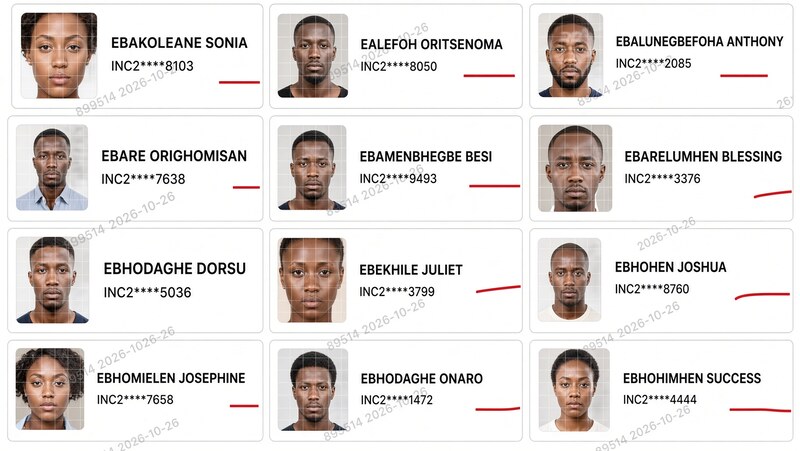
A viral social media post revealed an unsettling anomaly in voter registrations from a polling unit in Etsako West Local Government Area of Edo State. Duplicate entries, details of deceased persons, and entirely synthetic faces. Nigerians raised alarm about this grave data breach and quickly demanded to know how fake images and phantom voters circumvent biometric systems designed to register real humans and stop the inclusion of fictitious voters.
Bayode’s public admission removes the possibility of a simple technical glitch and exposes a jarring human sabotage. It underscored a massive susceptibility in INEC’s front-line data collection. It revealed how trusted field agents used their important position to undermine the system to serve the interests of selfish and power-hungry politicians. They successfully loaded the system with shoddy data and irregular information, which Bayode described as AI-generated but poorly executed.
This situation elicits urgent operational concern. Modern biometric systems usually require the physical presence of the person to be registered before their live facial and fingerprint data are captured. If field officers can bypass this to upload pre-generated AI images, the front-end software lacks basic anti-spoofing filters. It is commendable that the ABIS backend eventually detected the fraud.
However, having a system that allows for seamless and easy uploads of fake voters by whom the electoral body wants us to believe are compromised officers does not only further impugn INEC’s already sullied reputation, it put intense strain on its resources. It forces the commission to spend precious time scouring and erasing false data that should never have entered the system in the first place.
An Electoral Credibility Crisis
This data breach is profoundly consequential because it strikes at the very heart of electoral credibility.
Many Nigerians are still not entirely convinced by INEC’s explanation that the data breach is the handiwork of unscrupulous officers and not a systemic manipulation and sabotage signed off by the electoral body hierarchy because of how the body has lent itself to the shenanigans of politicians in the past. The voter register is the bedrock of transparent elections and a productive democratic process. A credible election is impossible if the voter data is brazenly corrupted. The voting process is already beset by high mistrust, scepticism, and pessimism. If citizens don’t have confidence in the voter roll call, they will instinctively reject the outcome of the polls.
Trust is a delicate thing in Nigerian politics. When a digital system that is supposed to be foolproof allows the electoral umpire’s own officials to submit fictitious characters as registered voters, it spurs dangerous suspicions. Voters naturally wonder if Permanent Voter Cards (PVCs) were secretly printed for these ghost identities. They question if political actors paid these officers to create synthetic voters to pad future election results.
A compromised register dampens voter confidence and ultimately hampers turnout in elections. Citizens will not stand in long polling lines under scorching sun if they believe the system is already rigged before the first ballot is cast.
Furthermore, political parties will inevitably use these data errors to challenge election outcomes. This drags the judiciary into endless electoral disputes and weakens the overall democratic process.
The Race for Probity and Pristine Data
With less than 70 days to the election, time is not on INEC side. INEC is under intense pressure to complete the data cleanup within the statutory 90-day period. Bayode noted that the commission actively began cleaning the register before publishing the preliminary version. The question to ask now is how INEC did not detect the ghost voters during the clean-up exercise it stated before publishing it online?
However, Nigerians are demanding more than routine administrative corrections. To salvage its credibility for 2027, INEC must go beyond merely deleting fake names.
To redeem its image and instil confidence in the electorate, INEC must, in the interest of probity and transparency, release the names of the officials who allegedly created fake voter profiles using AI-generated photos, names, and polling unit details.
It must investigate and prosecute those responsible to prove that it is serious about conducting free and fair elections.
Creating fake voter profiles is electoral fraud, not a mistake and should attract the stiffest of penalties. It is good and laudable that INEC has admitted that this happened, but that is not enough. Nigerians want names. They want arrests and prosecutions. You cannot publicly admit that the voters’ register was manipulated and expect Nigerians to move on without anyone being held accountable.
The commission must identify and publicly prosecute the rogue registration officers. Quietly dismissing or easing them out of the system will not rebuild public faith. Criminal charges must follow to deter future sabotage.
Second, INEC must immediately strengthen and fortify its registration software. The data capture devices must be revamped and strengthened to detect and reject any non-live image uploads