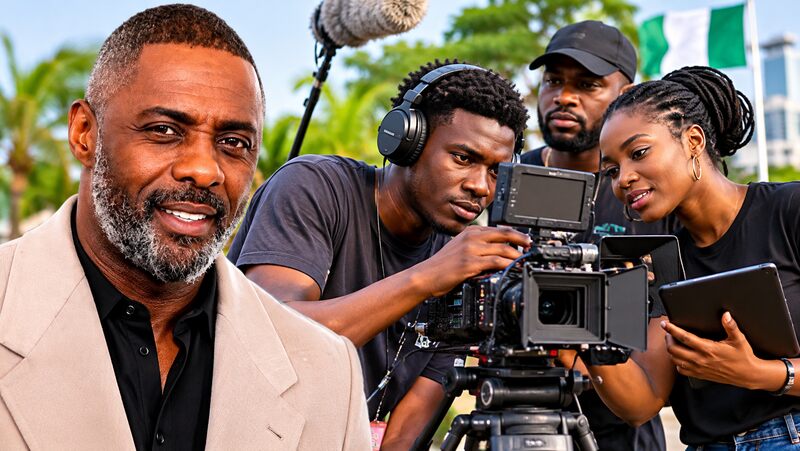
African filmmakers, writers and digital content creators have a new opportunity to take their creative ambitions beyond social media videos, short scripts and independent productions, with a major initiative bringing artificial intelligence training, professional mentorship and competitive film production funding to the continent. Backed by Google.org and led by The Akuna Group, the programme is designed to help African storytellers develop original ideas into films while gaining practical skills in an industry increasingly influenced by artificial intelligence.
The initiative, known as From Script to Screen with AI, has attracted attention because of its $1 million funding support and the involvement of British actor and filmmaker Idris Elba, who chairs The Akuna Group. Nigeria is among the 5 African countries included in the first intake, giving eligible Nigerians an opportunity to participate in an international creative development programme without relocating abroad.
Applications opened on October 26, 2026, with November 15, 2026, set as the deadline. Although the funding figure may attract people looking for direct financial assistance, the programme offers a broader opportunity involving free professional training, certification, mentorship and a competitive process through which selected creative teams can secure money to produce their films.
What Idris Elba’s $1 Million Filmmaking Programme Is About
From Script to Screen with AI is an African filmmaking development initiative established through a partnership between The Akuna Group and Google.org, with Curious Refuge serving as the training partner responsible for developing the artificial intelligence filmmaking curriculum.
Google announced the initiative on October 28, 2026, explaining that the programme would equip African visual storytellers with creative, technical and practical AI skills. Its central objective is to help participants combine conventional storytelling techniques with emerging artificial intelligence technologies to develop and produce original films.
The $1 million investment comes from Google.org and supports the wider programme, including its educational and production pathways. Idris Elba is associated with the initiative through his position as chairman of The Akuna Group, which is leading the programme through its educational platform, Akuna Learning.
The arrangement brings together organisations with different responsibilities, as Google.org provides the financial backing, Akuna Learning coordinates the academy and programme activities, while Curious Refuge develops the specialist training content. Participants are expected to learn how modern AI tools can support different stages of filmmaking, from developing a story and creating characters to producing visual scenes and completing a film.
5 African Countries Eligible for the Programme
The first intake is open to applicants physically residing in 5 African countries, with Nigeria included alongside Ghana, Kenya, Sierra Leone and South Africa. This makes the initiative relevant to creative professionals across different parts of the continent, rather than restricting participation to filmmakers based in major entertainment centres.
Nigerians living in Lagos, Abuja, Ogun, Oyo, Rivers, Kano and other states can apply, provided they satisfy the remaining eligibility requirements. The residency condition is important because applicants must physically live in one of the participating countries, meaning Nigerian citizenship alone will not automatically qualify someone who currently resides outside the eligible locations.
The programme is also structured around African storytelling, with participants expected to develop creative projects that reflect their interests, experiences and perspectives. Its selection process will involve country level reviews before applications proceed to a final assessment across the participating countries.
Who Can Apply for the $1 Million Opportunity?
The programme is open to a broad range of creative professionals, making it accessible beyond established Nollywood actors, film directors and movie producers. Eligibility includes screenwriters, digital content creators, photographers, animators, video editors, graphic designers, visual artists, creative directors, advertising professionals, and other storytellers.
This means a Nigerian blogger who regularly develops original stories, a photographer who produces creative visual projects or a digital creator who makes short videos may have relevant experience for the application. People who write scripts, develop documentary concepts, produce advertisements or create animated content can also consider applying under the pathway that best represents their creative abilities.
Previous experience with artificial intelligence is not compulsory, and applicants are not required to possess a film school certificate. However, they must demonstrate existing creative ability through a portfolio or an example of work they have previously produced.
Applicants must be at least 18 years old and have access to a laptop, reliable internet connection and consistent electricity. They must also be available to participate fully in the academy and subsequent programme activities if selected, while women are particularly encouraged to apply.
5 Creative Pathways Available to Applicants
Applicants are expected to select 1 preferred specialisation when completing their applications. The available pathways cover different aspects of film development and commercial storytelling, allowing people to apply according to their existing skills and the kind of creative work they want to develop.
The 5 pathways are fiction filmmaking, documentary filmmaking, animation, advertising and screenwriting. Each provides a different direction for participants, although the overall academy begins with a shared foundation in artificial intelligence filmmaking before participants develop their preferred areas of expertise.
Fiction filmmaking focuses on creating original stories for film and television, including character development, screenplay adaptation, world building and visual storytelling. Nigerian applicants interested in romance, crime, historical drama, family stories and other fictional productions may find this pathway particularly relevant.
Documentary filmmaking is designed for people interested in presenting real life experiences through visual productions. Potential subjects include Nigerian history, cultural traditions, community development, education, business and social issues, with participants learning how to develop factual subjects into engaging films.
Animation covers animated storytelling, digital characters, motion design and the creation of fictional environments. Participants interested in cartoons, animated films and visual effects can explore how AI tools support character development, backgrounds and other production elements.
Advertising focuses on commercial storytelling, promotional videos, branded content, product campaigns and marketing productions. This pathway may interest Nigerian digital marketers, graphic designers and advertising professionals who already create promotional materials for businesses.
Screenwriting concentrates on turning original ideas into scripts suitable for film production. It covers story structure, dialogue, character development and screenplay refinement, making it relevant to writers who have compelling stories but need professional skills to develop them into film projects.
What Participants Will Learn During the Academy
The training is designed to introduce participants to the relationship between traditional filmmaking and generative artificial intelligence. Rather than concentrating solely on producing AI images or writing prompts, the curriculum explores how the technology can support a complete creative production process.
Developed with Curious Refuge, the programme covers screenwriting, story development, world building, animation, digital production workflows, AI assisted visual storytelling and practical filmmaking techniques. Participants will gain exposure to tools and methods that can help them transform written concepts into visual productions.
The academy is scheduled to run for 12 weeks, from January 25 to April 18, 2027. Selected participants will take part in online learning, weekly activities, assignments and progress checks, with Akuna providing facilitation throughout the training period.
Those who successfully complete the academy will receive certification. The qualification is an important part of the programme, although completing the training does not automatically guarantee access to the subsequent film production funding.
8 Things Nigerians Must Prepare Before Applying
Applicants need to provide personal information, professional details and examples of their creative abilities. The application process requires more preparation than simply completing an online registration form, particularly because the selection panel will assess the quality and potential of submitted creative work.
The official application requirements cover 8 major areas.
1. Personal information: Applicants must provide their full names, age, gender, contact details, country of residence, state or province and city of residence.
2. Professional profile: A CV or professional profile is required, alongside proof of identity to support the application and verification process.
3. Preferred creative pathway: Applicants must select 1 of the 5 available specialisations, covering fiction, documentary, animation, screenwriting and advertising.
4. Area of expertise: Candidates should explain their current creative skills, which may include screenwriting, directing, video editing, animation, visual effects, sound production or graphic design.
5. Creative portfolio: Each applicant must submit 1 example of their best creative work, which could be a film, photograph collection, script, animation or design portfolio. Moving image submissions can be up to 3 minutes long.
6. Personal statement: Applicants must write a statement of not more than 250 words explaining why they want to join the programme and what excites them about AI storytelling.
7. Introduction video: Candidates must record a 60 to 90 second video introducing themselves and explaining a story they are excited to explore. The organisers emphasise authenticity and passion rather than professional production quality, meaning a phone camera is acceptable.
8. Commitment declaration: Applicants must confirm that they meet the technical requirements and can participate fully in the programme. This includes the relevant consent arrangements for identity verification and the stated use of application information and programme activity recordings.
Creative Portfolio Requirements
One important detail is that applicants do not need to submit a professionally produced film to demonstrate their creative abilities. The organisers accept examples from different creative disciplines, provided the submitted material gives the selection panel a reasonable understanding of the applicant’s skills and storytelling potential.
A Nigerian writer could submit an existing screenplay, a photographer could provide a collection of photographs, while a digital content creator could present a previously produced video. An animator may submit an existing animation, and a graphic designer could use a portfolio of original visual projects.
The creative work does not have to be recent, lengthy or produced with artificial intelligence. This gives applicants who have developed their skills through independent projects an opportunity to demonstrate their abilities without first investing money in expensive filmmaking equipment.
The introduction video is a separate application requirement, so submitting a portfolio alone will not complete the process. Applicants should also use their personal statements to explain their creative interests, the stories they want to develop and how the academy could help them improve their work.
How the Selection Process Works
Admission into the academy is competitive, with applications undergoing screening before successful candidates receive admission offers. The organisers have outlined a series of stages covering application assessment, professional training, mentorship, pitching and film production.
The first stage runs from October 26, 2026, to January 2027, covering application submissions, country level reviews and the final selection process. Successful candidates are expected to receive their admission offers by December 14, 2026.
The second stage is the 12 week academy, scheduled for January 25 to April 18, 2027. Participants will receive AI filmmaking training through Curious Refuge, supported by weekly Akuna facilitation, with opportunities for in person meet ups in participating countries.
After completing the academy, participants will move into the mentorship and team formation stage, scheduled for April 19 to June 2027. Graduates will submit original 1 page film ideas, after which promising concepts will be shortlisted and their creators may become team leaders.
The selected team leaders will recruit other academy graduates interested in developing their projects. Each team will receive 4 weeks of mentorship and expert support to refine its concept, prepare its production plans and develop a stronger proposal.
The next stage, scheduled for June to July 2027, will involve pitching projects to expert panels comprising representatives from Akuna, Google and the wider film industry. Teams will present their proposals for consideration, with the strongest projects selected for production funding.
The final production stage runs from July to October 2027, when funded teams will develop their films with creative and technical support. The programme expects completed productions to reach festivals and showcases, with October 2027 identified for the film showcase.
How the $1 Million Production Funding Will Be Shared
The financial aspect of the initiative requires careful attention because the $1 million figure does not represent a direct grant available to every applicant. Google.org is providing the money to support the overall programme, including the training academy and the competitive production funding pathway.
The organisers have confirmed that selected creative projects will receive dedicated production funding, but a fixed amount payable to each team has not been published. There is also no official confirmation that the entire $1 million will be distributed directly to filmmakers.


Participants must first gain admission, complete the academy and receive certification before they can progress to the project development stage. They will then need to submit original film ideas, secure shortlisting, form teams, receive mentorship and present their proposals to the funding panel.
The programme funds selected teams rather than automatically paying individual graduates. According to the official FAQ, each team must include at least 3 academy graduates, including the team leader, and a screenwriter, although the screenwriter can also serve as the team leader.
Teams can bring in additional collaborators from outside the academy, allowing them to strengthen their productions with people who possess relevant creative and technical expertise. However, only projects that successfully pass the competitive pitching process will receive production funding.
Who Owns the Films Produced Through the Programme?
Intellectual property ownership is another important consideration for creative professionals who may want to participate. The organisers state that creators retain intellectual property rights to their work throughout the programme, meaning the initiative does not make a general claim to ownership of participants’ original stories and creative projects.
However, funded productions will be subject to a separate agreement before production money is released. The agreement covers production support and a distribution window on Google platforms, establishing specific conditions for projects that receive financial backing.
The programme also includes an intellectual property clinic during the mentorship stage to help participants understand the relevant arrangements before pitching their projects. Applicants should therefore pay attention to the agreement governing funded productions, particularly the distribution conditions, even though creators retain ownership of their intellectual property.
Is the Training Online or Physical?
The main academy will be delivered online, making it possible for selected Nigerians to participate from different parts of the country without relocating to Lagos, Abuja or another participating city. The arrangement is particularly relevant to applicants who have the required laptop, internet access and electricity to attend the training sessions and complete assignments.
However, the programme also provides opportunities for in person meet ups across the 5 participating countries. These meetings are intended to create opportunities for participants to interact, build professional relationships and connect with other creative practitioners.
Applicants should be prepared for the full 12 week training commitment and understand that progressing into mentorship, pitching and production will require additional participation. The programme is therefore more than a short online course that participants can complete without sustained involvement.
Important Dates for Nigerian Applicants
The application window opened on October 26, 2026, and closes on November 15, 2026. Final admission offers are scheduled for December 14, 2026, while the academy begins on January 25, 2027, and ends on April 18, 2027.
Mentorship and team development will take place from April 19 to June 2027, followed by project pitching between June and July 2027. Production of selected films is scheduled for July to October 2027, with the final showcase expected in October 2027.
The programme also indicates that a second intake is scheduled to open on October 19, 2027, giving another group of African storytellers an opportunity to participate in a subsequent cycle.
Application Fees, Tuition Costs
There is no application fee for the From Script to Screen with AI programme, and selected participants will not pay tuition for the 12 week academy. The training and certification opportunities are provided without tuition charges, making the initiative accessible to eligible creative professionals who may otherwise struggle to afford specialist AI filmmaking education.
However, applicants must have their own laptop, reliable internet connection and consistent electricity. The organisers have not announced a guaranteed cash allowance for participants attending the academy, and admission should not be treated as an offer of personal financial support.
Production funding is competitive and becomes available only to teams whose projects successfully progress through the development and pitching stages. Consequently, applicants should understand the difference between free training, certification and the opportunity to secure money for film production.
How Nigerians Can Apply for the Programme
Interested applicants should begin by visiting the official Akuna Learning website and reading the programme requirements before opening the application form. The application is hosted on Award Force, where candidates are expected to provide their personal information, professional profiles and supporting creative materials.
The next step is to select a preferred creative pathway and prepare the required portfolio, personal statement and introduction video. Applicants should also ensure that their CV, identification documents and commitment declaration are ready before submitting the application.
The official programme website provides the application instructions and access to the application process.
Application deadline: November 15, 2026.
Google’s announcement can also be accessed through its official Africa blog.
Frequently Asked Questions
Can Nigerians who have never used AI apply?
Yes. Previous experience with artificial intelligence is not compulsory because the academy is designed to teach participants how to use AI in filmmaking. Applicants must, however, demonstrate existing creative ability through their submitted work.
Can a Nigerian blogger or digital content creator apply?
Yes. Digital content creators and storytellers are among the categories identified by the organisers. Applicants should submit relevant creative work that demonstrates their storytelling or visual production abilities.
Is a film school certificate compulsory?
No. The programme does not require applicants to possess a film school qualification, although they must satisfy the age, residency, technical and portfolio requirements.
Must applicants have produced a complete movie?
No. An existing script, photography collection, animation, design portfolio or another example of creative work can be submitted. Moving image submissions can be up to 3 minutes long.
Will every participant receive part of the $1 million?
No. The $1 million supports the wider programme, and production funding is reserved for selected creative teams that progress through mentorship and the competitive pitching process. Completing the academy guarantees certification for successful graduates, not individual production funding.
Can applicants select more than 1 creative pathway?
Applicants are required to select 1 preferred pathway when submitting their applications. The selection process will determine their final placement.
Can someone living outside Nigeria apply using Nigerian citizenship?
The first intake requires applicants to physically reside in one of the 5 participating countries. Nigerian citizenship alone is insufficient if the applicant lives outside the eligible countries.
Does the programme take ownership of participants’ films?
The organisers state that creators retain their intellectual property rights. However, funded projects must sign an agreement covering production support and a distribution window on Google platforms.
My Assessment for Nigerian Applicants
From Script to Screen with AI presents an opportunity for Nigerians who already have creative interests and want to develop them into professional filmmaking skills. Its strongest attraction is the combination of free specialist training, certification, mentorship and the possibility of securing production funding for original film projects.
Writers who have developed stories without the resources to turn them into films may find the screenwriting pathway useful, while photographers, video editors, animators and digital content creators can explore the other specialisations according to their experience. The absence of compulsory previous AI experience also makes the academy accessible to creative professionals who are still learning how artificial intelligence can fit into their work.
However, the $1 million should be understood as the overall programme investment rather than a guaranteed grant for applicants. The financial opportunity comes later, after successful participants complete their training, develop original film ideas, form teams and convince the funding panel that their projects deserve production support.
With applications closing on November 15, 2026, interested Nigerians have a limited period to prepare their portfolios, personal statements and introduction videos. Those with existing creative work should pay particular attention to presenting their strongest projects and explaining the stories they hope to bring to the screen through the programme.