One achievement that earned the administrations of the late former president, Umar Yar’Adua, and his successor, Goodluck Jonathan, enduring commendation was their deliberate, conscious effort to sanitise Nigeria’s electoral system after the 2007 general elections.
The 2007 presidential election in Nigeria is widely deemed the most contentious and perverse. It was fraught with irregularities and manipulations. Violence and rigging marred it. At the core of the abhorrent elections of 2027 was political violence. So atrocious was the poll that the winner, former President Musa Yar’Adua, declared that the election that produced him as president and brought him the highest office in the land was deeply flawed, which led to his initiation of a comprehensive electoral reform that brought some semblance of tidiness, credibility and maturity to our elections until the progress was upended in recent years.
While public consensus and jury is that the Yar Adua and Goodluck Jonathan era brought a much-needed sanity, civility and cleanup not just to our electoral system but to our fledgling and fragile democracy. It gave people hope and renewed their belief in democratic rule. But that was over a decade ago. The belief and assurance that were ushered in by the electoral reforms of the two former presidents have since given way to pessimism and hopelessness, with people now seeing voting and elections as an albatross to the nation’s progress rather than exercises meant to herald and drive growth and prosperity. This discontent and disillusionment have heightened in recent years owing to pervasive economic hardship and the cost-of-living crisis.
The worry of many Nigerians isn’t so much about the troubling and precarious condition of the nation but how the only democratic means — free fair and transparent election, they have to salvage the situation, rescue themselves from the clutches of corrupt and unscrupulous politicians, pull the nation out of doldrums and change its current trajectory — are actively being destroyed and made impossible by the government of the day and the ruling party in connivance with public institutions who are supposed to stay away from politics and remain neutral in matters of democratic activities.
Barely two months before the 2027 general elections, political violence across Nigeria are ramping up across the country at a rate never seen before, despite various bodies warning against mayhem before, during and after the polls.
In the last seven days, there have been cases of political violence in no less than seven states, with the latest in Lagos, where several supporters of the Nigeria Democratic Congress (NDC) were injured after suspected political thugs disrupted a town hall meeting organised on Thursday by the party for its presidential candidate, Peter Obi, and his running mate, Rabiu Kwankwaso.
Other states that recorded violence within the period included Edo, Delta, Gombe and Cross River states. The incidents have been more frequent this year, with states like Katsina, Kebbi, Enugu, Ekiti, Ondo, Ebonyi, Osun and Nasarawa all experiencing various forms of political violence. Prominent and influential political actors, mostly those from the ruling All Progressives Congress (APC), have also threatened voters in ways that could clearly undermine the credibility of polls in 2027.
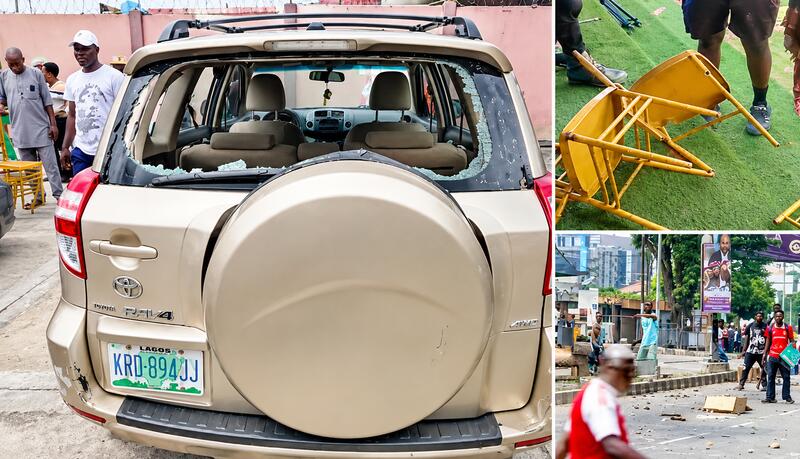
On Thursday, suspected political thugs, armed with guns, cutlasses, axes and other weapons, stormed the venue of the NDC Town Hall meeting on Kudirat Abiola Way, Ikeja, and disrupted preparations for the event. The attackers, who reportedly arrived from the Oregun area of Ikeja, stormed the event centre in large numbers, fired gunshots and destroyed items around the premises, forcing people to flee for safety. Vehicles were vandalised, and at least three people were injured during the attack.
Last week, thugs attacked the convoy of the NDC presidential candidate, Peter Obi, in Calabar. Political thugs also disrupted rallies and processions of NDC supporters in Delta and Benin. Last month, one NDC supporter was killed in Enugu during a road rally.
On Friday, President Bola Tinubu decried the spate of political violence in the country and warned politicians and their supporters to shun violence as we approach the 2027 election.
He said: “I have followed recent reports of violence accompanying political events in different parts of the country. Every form of violence stands condemned. Violence should never have a place in our political campaigns as we move toward the 2027 general elections.
“Our campaigns should be about issues, a contestation of ideas that promote the welfare of our people and the progress of our country.
As the leader of this country, I commit myself to a peaceful, free, and fair election, and I urge political leaders and supporters across party lines to conduct themselves responsibly.”
The president’s admonition to political stakeholders is what you would expect from the leader of a nation, but his words ring hollow in the minds and ears of those who heard them. Whether the president knows it or not, his actions and those of members of his party, particularly governors and other high-ranking members, have contributed significantly to the atmosphere of fear, intimidation and violence that has characterised this electioneering season.
While the president would have us believe that he is oblivious to the fact that the violence has mostly been perpetrated against opposition parties in states controlled by the ruling party, of which he is the leader, no cases of violence or attacks against members of the opposition have been reported in states not under the ruling party. In states controlled by the ruling party, oppositions are not even allowed to display their campaign posters in public or are given permission to rent a place for their campaigns or political events.
While the banners and posters of candidates, especially those of the president, of the ruling party are strewn across the states of the Federation, opposition parties don’t enjoy similar privileges, either through the imposition of exorbitant and prohibitive fees or outright denial of permission to freely use their campaign material in public places. In rare instances where banners and posters of opposition candidates, particularly those of NDC presidential candidate Peter Obi, are erected, they are swiftly destroyed by state officials or thugs working for them
There is no denying the fact that the ruling party has faced attacks and harassment. But these attacks happened in states it controls, particularly in the northern part of the country, which shows that these pockets of attacks and occasional outbursts of public anger are outlets through which much-tried and forlorn Nigerians, who are enduring the hardship and suffering the present government has created through its policies, are expressing their discontent and disgust with the government.
If the president is truly dismayed by how violent the political campaign and electioneering are, then he must go beyond mere condemnation and take firm and decisive steps to stop it. He must rein in his governors and other influential politicians in his party who have been implicated in these despicable and heinous acts that undermine our electoral process and democracy. He must prevent the witch-hunting of security officers who genuinely want to do their jobs of providing a secure and peaceful environment for everyone to engage in democratic and political exercise without fear or intimidation.
Just last week, a report emerged that the commissioner of police in Enugu was transferred after he ignored the state’s governor’s order to release some of the arrested political thugs who attacked supporters of the NDC during their procession in the state. These would not have happened without the involvement of the federal government. If the president is truly determined to stamp out violence during campaigns, security agents who are doing their job of ensuring the perpetrators of violence face the law should not be persecuted but praised.
To what extent the president is willing to go to ensure electioneering does not become synonymous with violence will determine whether his Friday admonition will alter the scope of political campaigns and remove violence from the equation, or it will remain a mere perfunctory statement not aimed at riding the political space of the distasteful and reprehensible actions that have marred it.