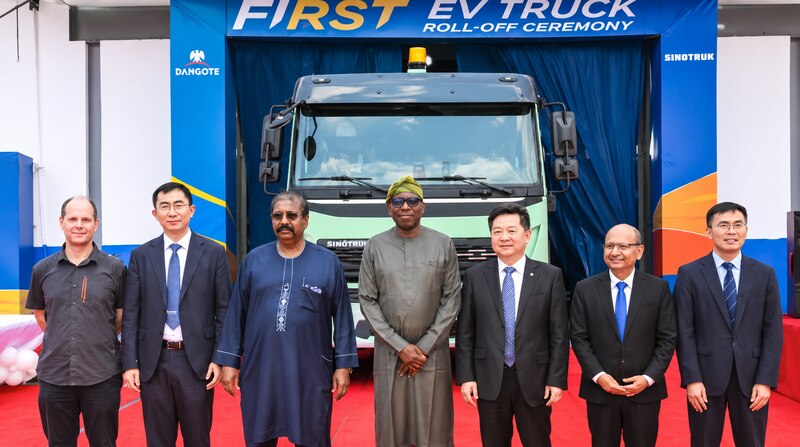
Nigeria now has a heavy-duty electric truck that was put together at home. Dangote Sinotruk West Africa Limited, the Lagos truck-assembly venture linked to Aliko Dangote, rolled the vehicle out at its plant in Ikeja on Sunday, November 15, 2026.
The Aliko Dangote Sinotruk electric truck is, according to the company, the first of its kind to leave a Nigerian assembly line. Sinotruk Group’s president went further and called it the first new-energy truck assembled anywhere on the African continent.
What happened at the Ikeja plant
The ceremony drew senior figures from the Dangote Group, Sinotruk Group and the Lagos State Government, along with customers, business partners and community leaders. The Dangote Group confirmed the details in a statement issued the same day.
Devakumar Edwin, Group Vice-President at Dangote Industries Limited, said the electric truck is the latest step in the joint venture’s growth. The plant, he said, now builds heavy-duty trucks, tippers, light trucks, pickups and buses, and electric heavy-duty vehicles join that list.
Edwin tied the launch to what the company has already done on gas. “So, we went into CNG technology and now we are going into electric technology,” he told guests. Dangote’s businesses have spent the past two years loading up on compressed natural gas trucks, so the electric truck follows a path the group was already on.
Liu Wei, president of Sinotruk Group, called the day a historic moment for Nigeria, for the joint venture and for Africa’s automotive industry. In his words, it is “the first new-energy truck to be assembled on the African continent.” He added that it fits Nigeria’s long-term goals on cutting carbon and modernising its energy mix.
What we still don’t know
Here the story gets thinner. The companies have not published the truck’s price, battery capacity or driving range, and they have not said how many electric units the plant will build. Fleet owners trying to work out whether an electric tractor makes sense on a Lagos-to-Kano run will have to wait for those numbers.
Edwin was upfront that the economics depend on conditions. Electric commercial vehicles can lower running costs and tailpipe emissions, he said, but how much depends on the price of electricity, what the truck is used for, and whether charging points, spare parts and trained technicians are within reach.
Edwin said the company is building the support structure before customers start asking for it. “We have set up our team,” he said, adding that Dangote Sinotruk will help buyers with charging facilities and technical know-how. The company also plans to work with government and partners on a wider electric vehicle ecosystem.
That promise carries weight. Anyone who runs a generator for a living in Nigeria knows that a vehicle is only as useful as the power and service behind it, and the grid has not made life easy for electric transport so far.
From CKD plant to electric trucks
The partnership has a long paper trail. Sinotruk’s Liu said the joint venture was formally established in 2014, with the first heavy truck coming off the line in 2017. A commercial vehicle welding and e-coating paint line started operating in 2024, and the venture has assembled more than 8,000 vehicles locally.
Early reports from 2017 described a $100 million plant owned 60 per cent by the Dangote Group and 40 per cent by Sinotruk, sited in Ikeja. The plant’s stated capacity is about 10,000 trucks a year on one shift. In June 2024, Senate President Godswill Akpabio commissioned a new completely knocked-down (CKD) plant for the company, and the Lagos State Government placed an order for 100 more refuse compactor trucks around the same time.
Dangote has long had its own reasons to care about trucks. Reports from the time the plant was announced said the group ran one of the biggest truck fleets in Africa, with more than 10,000 vehicles hauling cement, sugar, flour and pasta. Building trucks locally was pitched as a way to cut the foreign exchange spent on imports and to create jobs.
Training and local skills
The technology transfer side drew a lot of attention. Sinotruk said it will train Nigerian engineers and technicians, including practical sessions for selected staff at its facilities in China. Liu also said the company aims to open more technical and manufacturing roles to young Nigerians.
Representing the Lagos State Commissioner for Transportation, Olasunkanmi Ojowuro, managing director of Lagos Bus Services, described the rollout as a significant moment in Nigeria’s industrial history. He said locally assembled electric trucks could lower emissions and long-term transport costs, and could build skills that feed a competitive automotive and battery manufacturing industry.
The Ologba of Ogba Kingdom, Oba Latif Egbeyemi, welcomed the investment but pushed for more. He asked the company to prioritise local content and training, and to do more for the host community through youth empowerment and environmental protection. He also urged government to provide reliable electricity, charging facilities, standards and incentives for local assembly. Akeem Dauda, chairman of Ikeja Local Government, said the council would support the investment with a friendly business environment and better infrastructure.
Where this fits in Dangote’s wider truck push
The electric truck lands in the middle of a much larger fleet story. Dangote said in 2025 that the group had bought 10,000 trucks, including 4,000 CNG tankers for refinery fuel distribution and 6,000 dry-cargo trucks. In February 2026, the group signed a deal in Beijing for more than 1,000 additional CNG tractors and semi-trailers from Foton. Dangote Cement has also said it intends to move its haulage fleet to CNG.
A presentation reported by trade outlet CemNet earlier this year spoke of a target of 8,000 CNG and electric trucks by 2027, with about 155 electric trucks planned for pan-African operations in 2026. Those figures describe the group’s wider fleet plans and were not tied to this specific Ikeja-built model.
Dangote Sinotruk is not the only company bringing electric commercial vehicles to Nigeria. Earlier this month, Nigerian Sinotrucks Limited, a separate assembler and distributor of the Sinotruk brand, introduced Sitrak electric trucks, starting with light vehicles for city deliveries. The two companies are different businesses, and the Dangote venture’s truck is the heavy-duty model assembled in Ikeja.
The ceremony answered the question of whether Nigeria can assemble an electric heavy-duty truck. It left the commercial questions open. Pricing, range, battery supply, charging sites and the first customers will decide whether this stays a showpiece or becomes a common sight on Nigerian highways.
Edwin said the company wants Dangote Sinotruk to become one of West Africa’s leading vehicle assembly and manufacturing businesses, and that Nigeria’s large market and industrial base make it a natural regional hub. Whether the electric truck helps get it there will depend on what the company says in the coming weeks.