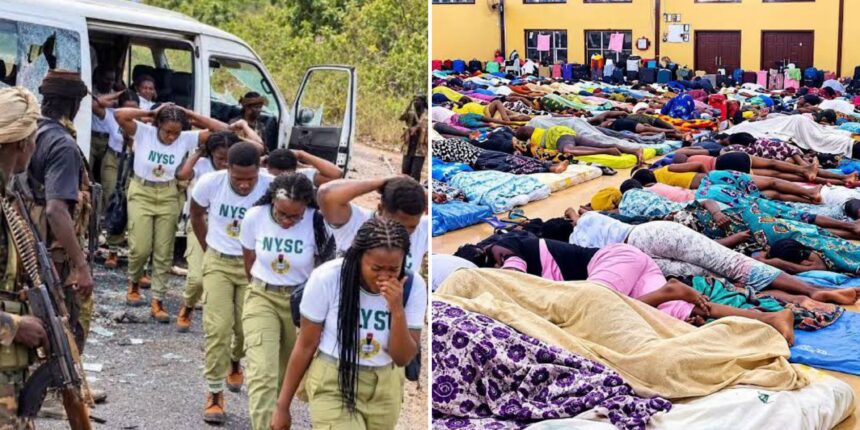
For thousands of Nigerian graduates, receiving an NYSC call up letter marks the beginning of a journey they have anticipated for years. It is a chance to leave familiar surroundings, meet people from different backgrounds, begin a new chapter and fulfil the national service requirement. However, the journey from receiving a posting to completing the orientation exercise has become increasingly difficult for some participants, with security concerns and inadequate accommodation raising questions about their experiences.
The challenges have taken different forms across the country, from armed men intercepting vehicles carrying graduates on major highways to prospective corps members sleeping on mattresses arranged closely together in overcrowded halls. Some have faced danger before reaching their orientation camps, while others have encountered uncomfortable conditions after arriving at facilities expected to accommodate them for 3 weeks. These experiences have brought renewed attention to the safety and welfare of young Nigerians participating in the national service programme in 2026.
Kogi State: 16 corps members kidnapped after orientation
One of the major security incidents involving NYSC members occurred on August 26, 2026, along the Aloma Egane Expressway in Ofu Local Government Area of Kogi State. Armed men reportedly emerged from surrounding bushes and intercepted 2 commercial buses conveying passengers travelling along the route. Among those on board were corps members returning from the permanent orientation camp in Kolokuma Opokuma Local Government Area of Bayelsa State, where they had completed their 3 week orientation exercise.
The graduates were travelling towards Abuja before proceeding to their respective places of primary assignment when the attack occurred at approximately 4:40 pm around the Ogene Zaria area, near the Ogene Zaria Onicha Igo Junction. According to the police, the attackers blocked vehicles travelling in opposite directions and abducted some passengers, while others escaped into nearby bushes. A white Peace Mass Transit Hummer bus and a yellow 18 seater bus were recovered at the scene.
Initial reports indicated that 15 NYSC members had been kidnapped, while the police subsequently announced the rescue of 11 victims, including the drivers of the 2 vehicles. The full number of corps members involved was not immediately established by the police, but NYSC later confirmed that 16 corps members had been abducted. On September 1, the organisation announced their successful recovery and commended the military, police, Department of State Services, Kogi State vigilante groups and other security personnel involved in the operation.
The incident attracted attention because the victims had already completed their orientation exercise and were travelling to begin their primary assignments. Their experience showed that the security challenges associated with national service can extend beyond the state where graduates are posted, with journeys between orientation camps and their destinations also exposing them to danger.
Imo State: 20 prospective corps members kidnapped before orientation
Another major incident occurred on October 1, 2026, along the Owerri Onitsha Expressway in Imo State, where gunmen reportedly intercepted 2 commercial buses near Umunoha in Mbaitoli Local Government Area. The passengers included 20 prospective corps members travelling from Ibadan, Oyo State, to orientation camps in Abia and Akwa Ibom states, alongside another passenger. Reports identified graduates of the University of Ibadan and Ladoke Akintola University of Technology among those travelling.
Unlike the Kogi incident, the graduates had not started their orientation exercise when they were abducted. They were simply travelling to fulfil the requirement of national service when the attackers stopped their vehicles and took them away. The Imo State Police Command confirmed the incident and announced that security agencies had commenced efforts to locate the victims and rescue them.
The search operation involved security personnel using intelligence gathering and drone surveillance to identify the suspected kidnappers’ location. Police subsequently disclosed that operatives had located the camp where the victims were believed to be held, but advancing into the area was complicated by suspected improvised explosive devices reportedly planted around the location. The operation eventually led to the rescue of all 20 prospective corps members and the additional passenger on October 7 at the Amakohia Ubi forest in Owerri West Local Government Area.
Following their rescue, the victims were taken to a DSS medical facility in Owerri for examination and treatment. The operation brought an end to their ordeal, but investigations continued as security agencies worked to identify and apprehend those responsible for the abduction.
5 suspects arrested, ₦48 million ransom allegation
Between October 10 and October 14, security operatives arrested 5 suspects during intelligence led operations in Port Harcourt, Rivers State, and Aba, Abia State. The operation involved the DSS, military, police and other security personnel, while 3 additional suspects reportedly escaped with gunshot wounds and remained subjects of a manhunt.
On October 20, the 5 arrested suspects were arraigned before the Imo State High Court. They were identified as Usman Aliyu, 25, also known as Chonge, Babangida Aliyu, 21, Mohammed Ali, 23, also known as Smallie Pepper, Aminu Haliru and Tange Ibrahim. The prosecution specifically accused the first 3 defendants of conspiring to abduct the prospective corps members.
During the proceedings, the prosecution alleged that the suspects demanded and collected ₦48 million, alongside an undisclosed amount in US dollars, for the release of victims. They were also accused of possessing 3 AK 47 rifles, 4 magazines, a pistol and 81 rounds of live ammunition. The 2 other defendants were accused of involvement in the abduction of 4 other people in separate incidents, while all 5 defendants pleaded not guilty. The allegations remain subject to determination by the court.
At least 70 corps members abducted within 5 years
The 2 major kidnapping incidents in Kogi and Imo have added to a longer record of security incidents involving serving corps members and prospective participants. An investigation published on October 9, 2026, reported that at least 70 corps members had been abducted across Nigeria within 5 years, based on an examination of reported incidents across the country’s 6 geopolitical zones. The investigation also identified at least 36 corps members abducted between August and October 2026.
Some of the earlier incidents involved graduates travelling on major highways, including the March 29, 2024, attack along the Patani Ughelli Road in Delta State, where a serving corps member was among 9 people abducted. On July 18, 2024, 5 corps members travelling from an orientation camp were kidnapped along the Benin Owo Expressway. Additional cases were reported between November and December 2024, while another serving corps member was abducted along Enugu Ezike Road in Enugu State on January 9, 2025.
Further incidents were reported along the Benin Ore Expressway in February 2025 and in Plateau State in September 2025, where a corps member serving in Bauchi State was kidnapped. The Kogi and Imo incidents subsequently brought the issue back into national attention in 2026. The reported figure of 70 is based on media documentation rather than an official national NYSC kidnapping register, but the number provides an indication of the repeated security challenges faced by participants.
Travel advisories, recognised transport companies offer no complete guarantee
NYSC has issued travel safety guidance advising prospective and serving corps members to avoid night journeys, unfamiliar routes and unnecessary long distance movements. Participants are also encouraged to use recognised transport companies, inform trusted people about their travel arrangements and identify police or military formations during stopovers.
However, the circumstances surrounding the 2026 attacks have raised questions about how much protection these precautions can provide. The Kogi attack happened at approximately 4:40 pm, while the Imo incident occurred during the morning. Previous attacks have also involved passengers travelling with recognised transport operators, including Benue Links, ABC Transport, God Is Good Motors, Akwa Ibom Transport Company and Niger State Transport Authority.
This has made the journey to orientation camps an important part of the NYSC safety discussion. Prospective corps members generally arrange their own transportation to their assigned states, leaving them responsible for selecting transport operators, planning connections and navigating unfamiliar highways. The experiences in Kogi and Imo have consequently brought attention to the possibility of coordinated transportation, designated departure points and stronger security arrangements for graduates travelling to orientation camps.
Sagamu, Ogun State: Corps members sleep in overcrowded hall
Beyond the security concerns on Nigerian highways, accommodation conditions at orientation camps have also attracted attention in 2026. On November 9, videos showing prospective corps members sleeping on mattresses arranged closely together in a multipurpose hall at the NYSC orientation camp in Sagamu, Ogun State, circulated online. The footage showed graduates lying on the floor with limited space between mattresses, raising questions about the facilities available to participants during their compulsory orientation exercise.
The Ogun State Government attributed the situation to an increase in the number of prospective corps members deployed to the state. According to the government’s explanation, the camp normally accommodates slightly more than 2,000 participants per batch, but more than 4,300 graduates arrived for the affected exercise. The Special Adviser to Governor Dapo Abiodun on Media and Strategy, Kayode Akinmade, explained that the multipurpose hall was temporarily converted into a sleeping area for graduates whose registration and screening extended late into the night.
The state government also disclosed that it provided 500 mattresses for the affected graduates, while the Akarigbo of Remo donated another 100. An additional 200 mattresses were subsequently provided, bringing the reported total to 800. However, the intervention did not remove the wider accommodation challenge, particularly concerning the availability of adequate hostel space, toilets, bathrooms, healthcare facilities and other essential services.
On November 13, NYSC Director General Brigadier General Olakunle Nafiu apologised to corps members over the accommodation difficulties and discomfort experienced at the Ogun camp. He attributed the pressure on facilities to the growing number of graduates mobilised annually, explaining that mobilisation had increased from approximately 400,000 in 2025 to 450,000 in 2026.
The Ogun State NYSC Coordinator, Omolabake Adewuyi, subsequently provided the actual registration figures, disclosing that 4,315 corps members registered for the exercise. Of this number, 3,834 were originally deployed to Ogun State, while 481 were originally deployed to Lagos but temporarily accommodated in Ogun. She also disclosed that construction of an additional hostel block was ongoing at the camp.
Lagos: 6,775 graduates unable to use temporary orientation camp
The accommodation challenge is also evident in Lagos State, where the number of graduates deployed for national service has exceeded the capacity of the temporary orientation facility. On November 12, the Lagos State NYSC Coordinator, Christiana Salmwang, disclosed that 11,155 corps members had been deployed to Lagos for the 2026 Batch C service year.
However, the temporary orientation camp at Iyana Ipaja could accommodate only 4,380 participants. This left approximately 6,775 graduates unable to use the Lagos facility for their orientation exercise. The affected participants were distributed to neighbouring states, including Ogun, Oyo, Edo, Kwara and Delta, where they were expected to complete their orientation before returning to Lagos for their primary assignments.
The situation illustrates the pressure on existing orientation facilities as more Nigerian graduates become eligible for national service. The NYSC Director General disclosed that Lagos was constructing a permanent orientation camp with a proposed capacity of 10,000 corps members, an arrangement expected to improve the state’s ability to accommodate future batches.
NYSC seeks 5,000 capacity orientation camps across states
Following the accommodation concerns, Brigadier General Olakunle Nafiu called on state governments to expand their orientation facilities to accommodate at least 5,000 corps members each. On November 12, he explained that many existing camps were built when the scheme mobilised approximately 100,000 graduates annually, whereas the number had now increased to about 450,000.
He disclosed that Lagos was constructing a permanent 10,000 capacity camp, while Adamawa, Gombe and Borno were at advanced stages of delivering new orientation facilities. Existing camps in Sokoto, Kwara, Enugu and Osun were also undergoing extensive renovations.
The problems are not limited to overcrowding. Previous incidents have included damaged buildings, inadequate toilets, poor sanitation and structural problems affecting accommodation. At the Ise Emure orientation camp in Ekiti State, 2 corps members were injured after a bathroom wall collapsed in July 2024, prompting the state government to announce rehabilitation measures and additional toilet construction.
Oyo State also experienced accommodation difficulties in 2025 when more than 4,000 corps members reportedly exceeded the capacity of the Iseyin camp, which was designed for fewer than 3,000 participants. Some graduates reportedly slept in churches and mosques. Similar concerns were raised about the Okada camp in Edo State, while a rainstorm damaged buildings at the Yikpata orientation camp in Kwara State in April 2025.
More recently, NYSC postponed an orientation exercise in Niger State in June 2026 following damage caused by a windstorm. The Obubra camp in Cross River State also attracted attention in October 2026, when the Director General reportedly considered suspending postings over its condition. A relocation arrangement to Akamkpa was subsequently announced while rehabilitation work continued.
₦985.13 billion budget provisions, questions over infrastructure
The condition of orientation camps has also brought attention to the funding available to NYSC and how much is provided for infrastructure development. An investigation examining federal budget documents and GovSpend payment records found that the scheme had approximately ₦985.13 billion in budget provisions between 2022 and 2025.
Of this amount, approximately ₦873.72 billion was allocated to personnel, while ₦106.71 billion went to overhead expenditure. Capital expenditure accounted for approximately ₦4.71 billion. The 2025 allocation alone was about ₦430.70 billion, including ₦388.44 billion for personnel, ₦40.28 billion for overhead and approximately ₦1.98 billion for capital expenditure.
The investigation also identified approximately ₦645.96 million in budget provisions for bunk beds and mattresses between 2022 and 2025. Its examination of 3,319 GovSpend payment records identified approximately ₦185.17 billion in NYSC payments between January 2022 and June 2026, including ₦71.18 billion for corps members’ allowances, ₦56.27 billion for orientation operations and state remittances, and ₦28.74 billion for uniforms and kits.
Only approximately ₦635 million of the recorded payments could be explicitly identified as infrastructure, construction and repairs. These figures represent budget provisions and identifiable payment records, not proof that every allocated amount was released or spent as budgeted. Nevertheless, they raise an important question about whether the capital resources available to NYSC are sufficient to maintain existing facilities and construct additional accommodation for the growing number of participants.
Federal Government approves 7 major NYSC reforms
While security and accommodation concerns have continued, the Federal Government approved a comprehensive reform package for NYSC on June 29, 2026. The Federal Executive Council approved 7 major changes announced by Youth Development Minister Ayodele Olawande following a meeting at the State House in Abuja.
The first reform involves a technology driven mobilisation and call up process intended to modernise registration, deployment and other administrative activities. The second is risk sensitive deployment, which considers prevailing security conditions and gives attention to graduates who are indigenes of affected states, reside in those states, studied there or come from neighbouring states within the same geopolitical zones.
The third reform proposes extending the traditional 3 week orientation exercise to 6 weeks. The redesigned programme is expected to provide additional training in leadership, entrepreneurship, digital skills and professional development. The fourth involves skills based primary assignments, with graduates expected to receive postings that better reflect their academic qualifications and career interests.
The fifth proposal concerns civilian operational leadership, with civilian administrators expected to take greater responsibility for the organisation’s operations while the military continues to provide security support. The sixth introduces a national grading and certification system for orientation camps, with attention to accommodation, sanitation, healthcare, training facilities and general welfare.
The seventh reform involves a redesigned NYSC uniform and a new graduation ceremony expected to replace the traditional Passing Out Parade. The Federal Government maintained the compulsory 1 year duration of national service, meaning the June announcement did not abolish NYSC or reduce its service period.
The Ministry of Youth Development also announced that the Attorney General of the Federation and the ministry had been directed to commence amendments to the NYSC Act and regulations to provide the legal foundation for implementation. Consequently, the 7 reforms should be understood as an approved policy package rather than a confirmation that every proposed change has already become operational.
House of Representatives demands review of NYSC deployment
The security concerns surrounding national service received further attention on November 18, 2026, when the House of Representatives called for an urgent review of NYSC mobilisation and deployment policies. The motion, sponsored by Yallema Makki, raised concerns about graduates travelling long distances from their states of residence to locations where they had been deployed, sometimes passing through areas affected by insecurity.
The lawmakers called for a more flexible deployment arrangement that considers geographical proximity to corps members’ homes, prevailing security conditions and identified high risk routes. They also requested consideration of postings to states closer to graduates’ places of residence, arguing that national integration should not require unnecessary exposure to danger.
The House mandated relevant committees to engage NYSC management and other stakeholders on reviewing the existing deployment arrangements, monitor compliance and report their findings and recommendations. The intervention followed the Federal Government’s June approval of risk sensitive deployment, bringing renewed attention to how the policy should work in practice.
But, the adoption of the motion does not mean that a new nationwide posting policy has already been implemented or that the NYSC Act has been amended. It represents a legislative intervention seeking further action on the security of graduates participating in national service.
Who is responsible for the safety of corps members?
The developments of 2026 have placed responsibility for corps members’ welfare under renewed attention, particularly because the challenges occur at different stages of national service. While NYSC provides travel safety guidance and organises mobilisation, prospective corps members generally arrange their own transportation to orientation camps. State governments own the orientation facilities, while their maintenance and expansion require cooperation with the Federal Government and NYSC management.
The Federal Government is expected to provide institutional support and appropriate funding, while state governments have significant responsibility for the physical condition of their camps. NYSC management must also consider the number of graduates mobilised for each batch, the available accommodation and the arrangements required to ensure that participants are properly received.
The 2026 incidents have shown how these responsibilities connect. A graduate can face danger while travelling to an orientation camp, experience inadequate accommodation after arriving and encounter further security concerns while moving to a place of primary assignment. Addressing only one part of the problem will therefore leave other aspects of the national service experience exposed.
For a programme that mobilises approximately 450,000 graduates annually, the need for adequate accommodation, reliable welfare arrangements and safer deployment has become increasingly important. The approved reforms, proposed camp expansion and November 18 legislative intervention provide a framework for addressing some of these concerns, but their effectiveness will depend on implementation, funding and the ability of relevant authorities to protect participants throughout their service year.