

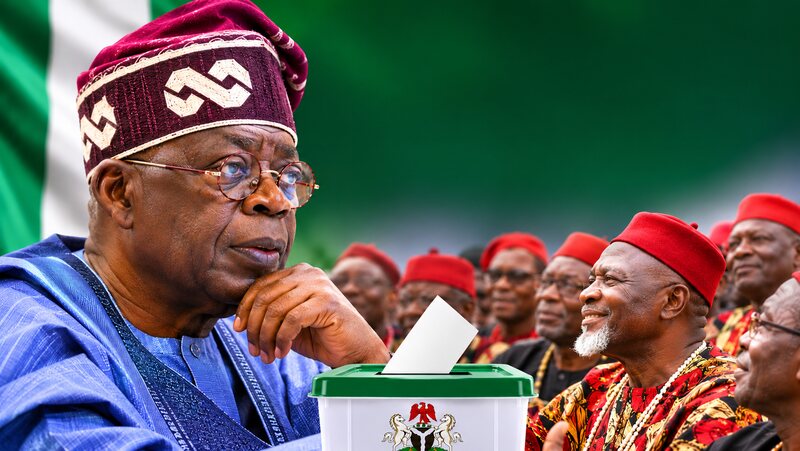
President Bola Tinubu’s campaign train stopped in Lagos on Monday, where he met with Igbo stakeholders to woo them, appeal for their support and canvass for the votes of the Igbo as he seeks a second term. There is nothing wrong with Tinubu meeting with stakeholders of different ethnic groups for the actualisation of his re-election bid.
However, there is something about yesterday’s meeting with the supposed Igbo stakeholders that made the encounter feel less like an attempt to curry electoral favour and appeal to the sensibilities of a group of people whom the president feels are less likely to vote for him and trying to persuade and win them to his side and more about the use of intimidation and coercion of a group that shares the same ethnic extraction as his main challenger to get their votes.
From his explicitly accusing the Igbo of being responsible for his loss in Lagos in the last presidential election to openly threatening them that they have to vote for him if they want to continue staying in Lagos, the meeting smacks of a desperate attempt to reinforce the narrative that scapegoats the Igbo for the president’s political misfortune in Lagos.
“Some of you didn’t vote for me for 2023, I vex woo, we don settle, get your PVC, you will vote this time, come January 16 your get your PVC you come vote, agreement na agreement, na Bola Tinubu be APC. You do for me, I do for you. At this point, I’m ready to serve, to serve you. I have served the first term because, seriously, I must ask for a second term. The constitution says I must ask for a second term; I want a second term. As you are here today to make me happy, you have made me excited. I will go home happy and eat apples,” Tinubu said.
While the president is free to meet with whoever he wants to achieve his political goals, his thinly veiled attempt to frame his loss in Lagos in 2023 as an Igbo conspiracy amounts to a serious error in judgment and a socio-political miscalculation that could lead to a repeat of what happened in 2023 in next year’s presidential election. There is no denying the fact that there is a considerable voting population of Igbos in Lagos. 11% of the over seven million voters in Lagos are Nigerians of Igbo extraction.
The Igbos may have voted overwhelmingly for Peter Obi in the 2023 presidential election, who was the candidate of the Labour Party at the time, but their votes did not hand him the decisive victory in the state. Obi only won because the Yorubas also voted for him en masse, and the 2027 election will likely produce the same dynamic, owing largely to the unsettling and perilous state of the nation.
Furthermore, the stakeholders Tinubu met with do not represent the interests of an average Igbo person; neither do they speak for them, and the fact that he thinks the reason he lost Lagos in 2023 is that Igbos did not vote for him only serves to create a false impression of what the outcome of next year’s presidential election will be.
Tinubu’s quest to win over the Igbos in Lagos and, by extension, other Nigerians to his side would have been easier and simpler if his government had not gone out of its way to plunge more than half of Nigeria’s population into unprecedented poverty, suffering and hardship. Many Igbos may have gravitated towards him and voted for his re-election if runaway inflation had not eroded the purchasing power of the people and decimated their disposable income and savings. If insecurity has not become a routine and national feature of the nation.
Whether the Igbos and millions of other Nigerians will vote for President Tinubu next year will be determined by his performance and the impact of his government on the people, not by subtle threats or by rehashing the same old promises he made in his first term but didn’t fulfil.