



The hum of the jet had a rhythm — smooth, confident, expensive. A kind of mechanical lullaby that only the privileged few in Nigeria’s entertainment aristocracy have learned to trust. Beneath the soft lighting, glasses clinked faintly against the hush of altitude. Then, without warning, the rhythm broke. The jet lurched, violently, as though the sky had suddenly changed its mind.
A camera phone caught the moment — a star, one who had filled stadiums, gasping mid-air like a child lost in a storm. His laughter turned brittle, the confidence that once commanded tens of thousands of fans reduced to whispered prayers and widened eyes. The sound of turbulence became a sermon. Every shudder of the aircraft seemed to ask the same question: What remains of fame when gravity stops playing along?
At 40,000 feet, the hierarchy of celebrity collapses. It doesn’t matter who owns the jet, who paid for the champagne, or who once closed a sold-out tour in London. Up there, the sky has no VIP section. Every heartbeat becomes a negotiation. Fear becomes a language even billionaires speak fluently.
This is not a story about aviation; it is a story about revelation — how turbulence stripped Nigerian celebrities of the illusion of control, forcing them to face their most human selves.
From Davido’s trembling calm to Burna Boy’s protective silence, Charles Okocha’s near-comic terror to Maleke’s mid-air praise session, each found, in the shivering air, the same reminder: no one is too famous to fall.
When the Sky Tests Fame
Davido has never hidden his affection for the air. For years, the jet was part of his signature — an emblem of mobility and mastery. The hum of turbines was the soundtrack to his empire: Lagos to Atlanta, Abuja to Dubai, one flight after another, as if the clouds themselves worked on his schedule.


But even the most polished symbol can turn against its owner. In one viral clip, Davido sat reclined inside a cream-toned cabin, designer hoodie up, smile half-formed — until the first drop came. The jet dipped, rose, and dipped again. His laughter fractured into anxious chuckles. The words came out half-joking, half-desperate: “I don’t like turbulence… I love my life.”
Those who watched the clip saw entertainment; those who understood the air saw a man humbled. Turbulence, after all, doesn’t discriminate. It doesn’t care if your name opens stadium gates or if your streaming numbers touch billions. In that moment, Davido’s wealth, charisma, and legacy meant nothing to the invisible air currents pushing against the fuselage.
His earlier tweets suddenly gained context — the time he begged his father to send a jet after a rough commercial flight, calling it “sacrifice weather.” Behind the humor was memory. Behind the luxury was fragility. For a generation that had watched him embody invincibility, that brief footage became unsettlingly intimate. Fame had always made Davido larger than life, but fear, just for a moment, made him recognizably human.
And when the jet finally steadied, when laughter returned to the cabin, there was an aftertaste — the silence of survival. It was a silence every celebrity knows: the moment the heart races faster than applause, the instant when the price of living large is measured in heartbeats, not currency.
Burna Boy and the Family Flight That Shook the Heavens
There’s a different kind of fear that comes when you’re not alone in turbulence — when your family shares the same cabin. For Burna Boy, the experience wasn’t about personal panic; it was about control.


The video showed his sisters — one filming, one gripping her seat, visibly shaken as the jet rocked through a storm. Burna sat upright, his usual aura of defiance dimmed into protective watchfulness. He leaned over, murmuring, reaching out. It was a small gesture, but in that gesture lay an entire portrait of manhood in motion — the African big brother turned air-borne guardian.
The clip trended for days, not because of celebrity gossip, but because it revealed something audiences rarely see: tenderness under pressure. Burna, whose lyrics often project power, whose stage persona is woven from rebellion and pride, was suddenly seen doing something unglamorous — comforting, reassuring, surviving.

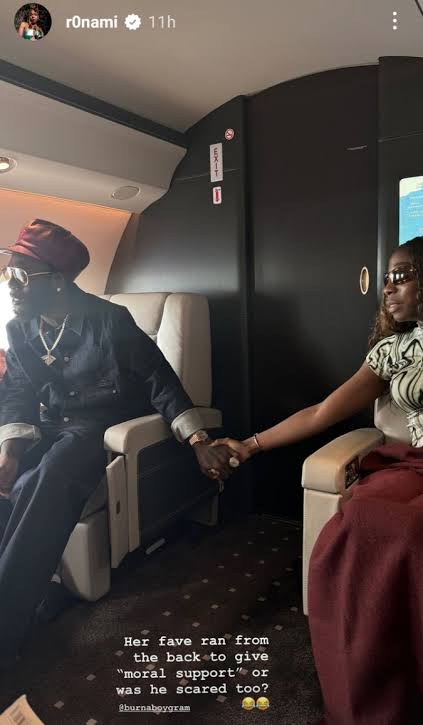
In Nigerian culture, especially within the masculine frame of success, vulnerability is often exiled. But turbulence doesn’t negotiate with ego. The private jet, long seen as the final frontier of wealth and achievement, suddenly became a floating confessional. There, amid blinking cabin lights and erratic altitude, the performance stopped. The man remained.
It was an unintentional echo of history. For decades, the Nigerian elite had used air travel as both escape and declaration — from political leaders fleeing coups in the 1980s to modern pop icons chasing tours across continents. In Burna’s cabin that day, one could feel that lineage colliding with something primal. As the jet shuddered, fame met ancestry — and both bowed to the wind.
When they landed, there were smiles, laughter, retweets. But something deeper lingered. The experience had folded fear into their flight logs — a reminder that in the sky, every altitude carries its own humility.
Charles Okocha’s Cabin of Convulsion
Fear has its own theatre, and few people perform it quite like Charles Okocha. Known for his flamboyant energy and comedic bravado, he’s the type who can turn panic into spectacle — and yet, the footage of him during turbulence was different.
The actor sat motionless, body tensed like a coiled wire. His lips moved in prayer, his fingers crossed the air repeatedly. The bravado dissolved; the “phenomenal” persona evaporated. Every jolt of the aircraft seemed to test the distance between faith and performance.
Viewers found the clip both hilarious and haunting. Here was a man who had made a career out of dramatizing chaos, suddenly caught in the real version of it. His face — half-grimace, half-plea — became a mirror of every passenger who has ever pretended to be fine while whispering silent bargains to God.

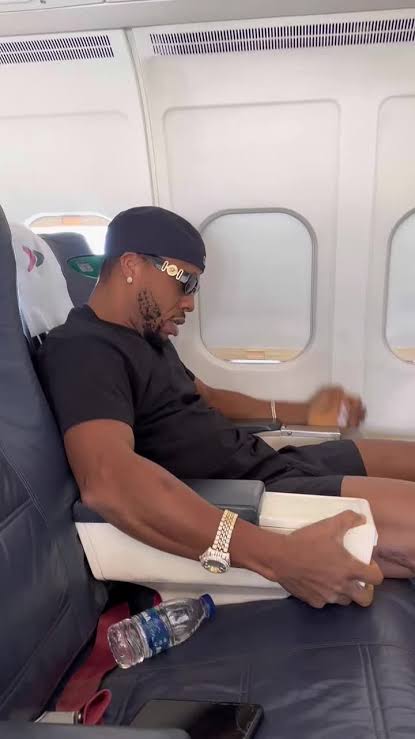
The irony wasn’t lost on anyone. In Nollywood, Okocha often played characters who escaped gunfire or cheated death with cinematic ease. But there, inside a pressurized tube at cruising altitude, the script was gone. The air was unscripted. The fear was pure.
What makes this moment culturally resonant isn’t the celebrity’s reaction alone; it’s what it says about Nigeria’s relationship with spectacle. Every viral clip of turbulence becomes a communal ritual — laughter layered over empathy, mockery covering recognition. Because in a country where survival is an everyday turbulence of its own, seeing fame tremble becomes both comic and cathartic.
When Comedians Lost Their Laughter
There are moments when laughter becomes prayer. Comedian Maleke Idowu learned that somewhere between Lagos and Benin, when his flight met a wall of turbulence so fierce it silenced the cabin. The man who once made crowds howl in joy found himself leading a praise session mid-air, his voice breaking through fear.
It wasn’t a performance; it was surrender. The video later showed him and other passengers singing gospel songs, hands raised, faces damp with relief as the plane steadied. The clip went viral, but few caught the weight of its symbolism.
Nigeria’s collective memory of air disasters runs deep — the Dana Air crash of 2012, the Sosoliso tragedy of 2005, the eerie silence that follows every aviation siren. For anyone who’s flown in that context, turbulence is never “just turbulence.” It is memory shaking awake. It is trauma testing faith.


For entertainers like Maleke, whose job is to mask fear with humor, that moment revealed an ancient truth: fear and faith share the same heartbeat. When the cabin steadied and passengers clapped, Maleke smiled again, the way survivors do when they realize they’re still here. The laughter returned — quieter, truer, more grateful.
The Myth of Control in the Sky
Every celebrity who has sat through turbulence learns a private gospel: you can’t control the air.
Private jets, for all their luxury, are fragile fortresses. They represent power, success, and escape — yet they move through a realm where no amount of money can command calm skies. Inside that paradox lies the true metaphor of fame.
For Nigerian celebrities, the jet isn’t just transportation; it’s identity. It’s how success is measured — how far one has flown from scarcity, from the ground-level struggles that defined early life. But turbulence disrupts that narrative. It reminds them that the sky has no memory of their chart positions or endorsement deals.
When Davido prays mid-flight, or Burna Boy reaches for his sister’s hand, it’s not weakness — it’s awareness. Awareness that life, no matter how gilded, hangs by the same thread for everyone.
In that moment, turbulence becomes something else — a cosmic joke, a reset button, a lesson in humility. It exposes the myth that control is real. Fame gives access, but not immunity. Wealth buys convenience, not certainty.
It’s the same lesson pilots whisper to nervous passengers after a storm: We were always safe, but never in charge.
Silence After the Storm
When the shuddering stops, silence fills the cabin like oxygen. It’s not the silence of relief alone — it’s reverence. Phones turn back on, selfies return, laughter recovers its rhythm, but somewhere in that silence, a new awareness breathes.
For celebrities, that silence is especially loud. It’s the point where image and humanity intersect. Davido might post the clip with humor later, Burna Boy’s sister might upload the video to Instagram, Okocha might turn his fear into a meme — but inside, something shifts. They’ve glimpsed a truth that doesn’t trend easily: the air owes nobody gentleness.
And when those videos go viral, the public plays its part — laughter, commentary, edits, jokes. Yet behind every trending moment lies a sobering duality: we laugh because we recognize ourselves in them. We know that fear, that tremor of mortality, that fleeting helplessness.
The jet, that modern emblem of success, becomes an unlikely chapel. Every bout of turbulence becomes a sermon on perspective.
Conclusion: Fear as Flight Instructor
Fear is an uninvited teacher. It arrives mid-flight, between luxury and chaos, to remind even the highest flyers that altitude is never ownership.
At 40,000 feet, Nigerian celebrities discovered what millions on the ground already know — that life is fragile, control is temporary, and gratitude is the only stable altitude.
When Davido whispered prayers, when Burna Boy steadied trembling hands, when Okocha crossed himself like a novice pilgrim, when Maleke turned turbulence into worship, they were all students of the same invisible instructor.
The sky, after all, teaches in silence. And at that height, where clouds blur the earth below, titles, awards, and wealth fade into vapor. Only heartbeat remains — steady, defiant, human.
Because in the cabin where fame once felt eternal, fear wrote its own truth: every turbulence is just heaven reminding you to hold on tighter — not to your seat, but to your soul.