


On the night Lagos held its breath, the moon hung low above the Atlantic, silver and watchful, as though it knew something extraordinary was about to unfold. The city below shimmered — restless, electric, alive. Cars pulsed through traffic like migrating fireflies. Somewhere between the noise of engines and the silence of dreams, a woman prepared to challenge what the human body could bear.
Her name was Kafayat Oluwatoyin Shafau — Kaffy to the world — and that night, she was not just a dancer. She was a question, a rebellion, a storm wrapped in discipline. While the city’s clubs throbbed with music and laughter, she was inside a gym on Victoria Island, binding her ankles, tightening her resolve. Around her, cameras blinked, timers waited, and a strange stillness hovered — the kind that visits a place before history begins.
Outside, the moonlight spilled across the lagoon, turning the water into a sheet of trembling glass. Inside, Kaffy inhaled deeply, feeling the air thicken with purpose. In a few minutes, the countdown began. She danced not for fame, not for applause, but to test the very definition of time.
When the music started, it wasn’t just rhythm that filled the room — it was defiance. With every beat, Lagos seemed to sway with her. The moon, now high above, became a silent metronome, keeping witness to the impossible. What began as motion became mythology.
This is a tale of how a dancer entered the mouth of time — and came out free.
From Childhood Shadows to Studio Lights: How a Girl Named Kafayat Turned Motion Into Language
Long before the Guinness spotlight, Kafayat Shafau was simply a girl trying to make sense of her world through movement. Born in Lagos in 1980, she was raised in a country still navigating its post-military anxieties — a world where ambition was often tempered by cultural restraint. She learned early that dreams needed resilience to survive. Her body became her language, her rebellion, her survival kit.
She began dancing not as a professional pursuit but as a coping mechanism. Movement gave her meaning where words failed. The body — elastic, expressive, enduring — became her canvas. Friends recall her as the girl who couldn’t sit still, who saw rhythm in the hum of generators, in the sway of laundry lines, in the footsteps of commuters rushing through Ojuelegba.


By the early 2000s, Nigeria’s music industry was reawakening. Afrobeat, hip-hop, and highlife fused into new sounds that demanded new movements. Dancers were no longer background ornaments — they were becoming culture bearers. Kaffy found herself at the right place, at the right cultural turning point. She began choreographing for artists, organizing dance workshops, and founding Imagneto Dance Company, which would soon become one of Nigeria’s most recognized performance brands.
But while others saw performance as entertainment, Kaffy saw it as theology — a way to reach something divine through discipline. She was fascinated by endurance: how far the body could stretch before breaking, how much the spirit could carry before surrender. The Guinness Record was born not from vanity, but from this almost spiritual curiosity.
Anatomy of a Dream: The Guinness Vision That Would Bend Time Itself
The idea came like a dare whispered to her soul. One evening, after rehearsing for hours with her team, someone mentioned the Guinness Book of World Records — the kind of casual conversation that sparks revolutions. Kaffy listened, half-smiling. She asked how long the record was. Someone said, “Fifty-four hours.” The silence that followed wasn’t hesitation; it was ignition. She looked at her team and said quietly, “Then we’ll do fifty-five.”
Behind that simple statement was an abyss of preparation. The Guinness Record wasn’t a casual dance-a-thon. Every second had to be monitored. Every rest period — a mere five minutes per hour — was logged. Meals were measured, hydration calculated, steps tracked. There would be no room for error. The attempt was sanctioned, the logistics overwhelming.
Weeks turned into months of conditioning. They trained under brutal schedules: 18-hour rehearsals, blackout simulations, heart rate monitoring. Medical professionals were on standby, and sponsors cautiously came aboard. Nigeria’s entertainment scene was skeptical. Some mocked the idea — “Who dances for two days straight?” But others sensed history in motion. Kaffy never spoke much about her fears, though her diary, later revealed in interviews, hinted at the deeper struggle: not against fatigue, but against the fear of insignificance.
She wanted the world to know that Nigerian dancers could make history without compromise — that Africa’s rhythm could set not just trends, but records. That desire became her oxygen.
The Gathering Storm: When Lagos Became a 55-Hour Stage
On June 6, 2006, Lagos became something else — a living metronome counting down to immortality. Eko Gym’s lights glared white-hot as the music erupted. Cameras rolled. Guinness officials started the clock. From that moment, sleep became an outlaw.
The first 10 hours were euphoric. Energy surged through the room. Dancers laughed, shouted, and moved with abandon. The crowd cheered each routine. But by the 20th hour, laughter gave way to silence. Blisters appeared. Ankles throbbed. Eyes glazed. Movement became survival. The rhythm no longer lifted them; it demanded sacrifice.
By the 30th hour, exhaustion turned spiritual. Kaffy’s voice grew hoarse. Her team began hallucinating. Medics hovered near the edge of the stage, watching for collapse. Yet somehow, every time the music dipped, Kaffy raised her arm — signaling another round, another step. Her leadership was both fierce and maternal, rallying her team not with orders, but with presence.


By the 50th hour, the crowd sensed the enormity of what was happening. Lagos wasn’t just witnessing a record; it was witnessing endurance in its purest form. Sweat glistened like oil on her skin. Her body trembled but didn’t yield. And then came the final hour — the moment when time itself seemed to bow.
Between Sweat and Spirit: The Dance That Questioned the Human Body
No one truly knows what the human body can do until it stops listening to reason. By the 51st hour, Kaffy was running on instinct alone — muscle memory, adrenaline, faith. Her body had long since crossed into uncharted territory. Her pulse fluttered between exhaustion and euphoria. The medics whispered; her blood pressure fluctuated. But her eyes remained open, wide and fierce.
Observers said she moved like someone possessed — not by madness, but by purpose. Every turn, every jump seemed to test gravity. The pain was visible, but so was the glory. Her team mirrored her defiance, though some faltered, some collapsed. But Kaffy refused to stop. “We’re not done,” she mouthed, lips cracked. “Not yet.”
By the 54th hour, sound and motion fused into something otherworldly. Her body was no longer a dancer’s — it was a vessel, translating something larger than itself. Witnesses swore they could feel the air shift, as though the city’s heartbeat synced with hers.
And when the final countdown began — five minutes to go — even the skeptics rose to their feet. Because by then, they weren’t watching a competition. They were watching resurrection.
The Breaking Point: When Sleep, Pain, and Faith Became One
Sleep deprivation is a cruel god. It toys with perception, twists time, turns seconds into centuries. Kaffy’s face was swollen, her knees visibly bruised. The world around her blurred. Yet in the fog, she found clarity — that the body’s limitations are merely invitations to transcend.
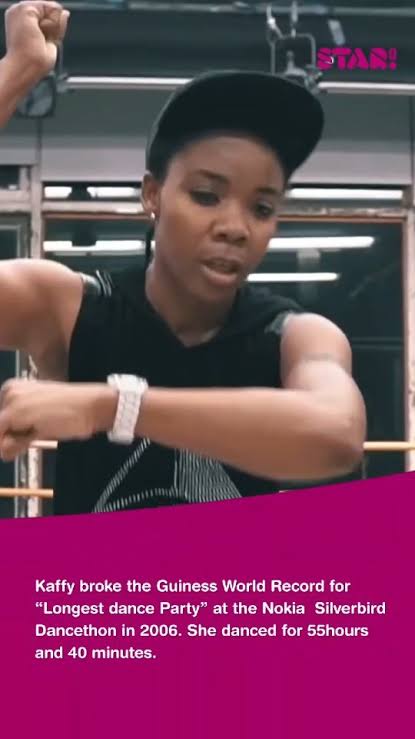
When she hit the 55th hour, her arms dropped, her chest heaved, and silence swept the hall. The crowd exploded into tears and applause. Guinness officials confirmed: she had broken the world record for the Longest Dance Party — 55 hours and 40 minutes.
But in that victory, there was no arrogance. She collapsed into a chair, face wet with sweat and disbelief. For a moment, she didn’t celebrate. She just breathed. Because what she had done was not about winning — it was about surviving her own miracle.

The City That Watched Her Fall and Rise
Lagos has seen endurance before — in its traders, its traffic, its ceaseless struggle for survival. But never like this. That night, the city became witness, participant, and prophet. Every face in the crowd mirrored something sacred: awe, disbelief, empathy. They had seen celebrities perform, politicians make promises, preachers cry. But here, before them, was something rarer — truth made visible through motion.
When Kaffy finally sat, the room erupted. Some cried openly; others simply stood in silence, unable to comprehend the magnitude of what had just occurred. The atmosphere was thick, electric, almost spiritual. A DJ played softly in the background, but even music felt inadequate. The medics approached her with towels, glucose water, and ice packs, but she waved them off gently, whispering, “Let me feel this.”
Her team — battered, blistered, but beaming — gathered around her. They had not just danced; they had crossed into myth. In that moment, Lagos felt smaller and larger at once — small because it contained this singular miracle, large because it realized how vast the human will could be. News outlets reported the story with disbelief; international agencies began calling. For the first time, Nigeria’s dance community was not an afterthought — it was the headline.
Outside, as dawn touched the skyline, Lagos moved again, returning to its chaos. But those who were there that night knew the city’s rhythm had changed. It was as if the spirit of that 55-hour performance had infused the city’s bloodstream.
When the Drums Stopped: The Hour Silence Became Holy
When the music ceased, what followed wasn’t quiet — it was reverence. The air hung heavy, vibrating with the residue of something immense. Kaffy sat motionless for a long while, her breathing deep, eyes unfocused. Her team hugged her in slow motion, as though afraid that touch might shatter the illusion.
Doctors took her vitals. Her heart rate was dangerously high. Her knees were swollen. Her lips trembled when she tried to speak. But her mind was sharp — alert in a way only those who have danced with death can be. “I’m fine,” she said softly, though her voice carried exhaustion and triumph in equal measure.
Television crews swarmed, microphones thrust forward, but the words that followed were not rehearsed. She thanked her team, her city, her country — but mostly, she thanked time itself. “It tried to break me,” she murmured, “but I made it my rhythm.”
That line would echo for years. Because what Kaffy did in those 55 hours wasn’t just physical endurance — it was a spiritual confrontation. She had turned time, the most powerful enemy of human existence, into a dance partner. And in doing so, she exposed a truth the world often forgets: the body is finite, but the will is infinite.
After the Applause: What It Means to Survive Your Own Miracle
Fame came swiftly, but so did the silence after it. Guinness officially recognized the record, media platforms celebrated her, and brands came knocking. Yet behind the flashbulbs was recovery — physical, emotional, existential. The days after the record were filled with fatigue and emptiness. Her body rebelled. She couldn’t climb stairs. She couldn’t sleep. Sometimes, she couldn’t stop crying.
But beyond the exhaustion lay something deeper — a quiet reckoning. When one achieves the impossible, what remains to strive for? For Kaffy, the answer was purpose. She began to see the record not as an endpoint, but as a doorway. Dance had given her identity, but now it demanded responsibility.
She turned her pain into pedagogy. Through her Imagneto Dance Company, she began mentoring young dancers — not just in movement, but in mindset. She taught them that excellence was not about applause but endurance. In her workshops, she spoke about discipline, hydration, diet, faith. She trained like an athlete, taught like a philosopher, and healed like a survivor.
To the public, she was a Guinness World Record holder. To those who trained under her, she was a testimony — living proof that greatness was not inherited; it was rehearsed.
From Endurance to Empire: How the Record Rewired Nigerian Dance Culture
Before Kaffy, Nigerian dance was an accessory to music. After her, it became its own economy. Her world record had done what few government programs could — professionalize a craft. Suddenly, choreographers were in demand. Music videos, concerts, and television shows sought the energy and structure her methods brought.
Her influence rippled beyond entertainment. Corporate Nigeria began sponsoring dance tours. Fitness clubs integrated Afro-dance routines into health programs. Universities began recognizing choreography as a legitimate art form. Kaffy’s name became shorthand for excellence — a benchmark for resilience and creative power.
But her impact wasn’t just structural; it was spiritual. She reframed the dancer’s identity from entertainer to cultural ambassador. Every movement, she taught, carries ancestry, memory, and defiance. In this way, the Guinness record became more than a statistic — it became a declaration that Nigerian bodies could define global standards.
Through Imagneto, she trained hundreds who would go on to choreograph for artists like Davido, Wizkid, Tiwa Savage, and Burna Boy. Her students carried her philosophy across continents. The seed she planted in that 55-hour inferno had become a forest.

Timekeeper’s Daughter: Lessons from the Woman Who Danced Against the Clock
Kaffy often refers to time as both her enemy and her teacher. In later interviews, she described how, during the record, minutes expanded into eternities — how pain altered her sense of chronology. She said she learned to “hear” time differently, to understand that endurance is not about resisting suffering but about redefining it.
That mindset would later shape her career. She ventured into wellness advocacy, teaching dancers to respect their bodies, to treat recovery as part of artistry. She spoke at leadership summits, preaching the gospel of motion: that consistency is a dance with destiny, and time is the rhythm we must learn to master.
Students recall her workshops as emotionally charged spaces — part sermon, part therapy. She would ask, “What are you running from?” Then she’d make them dance until they found the answer. It was her way of turning movement into meditation.
Through these teachings, Kaffy evolved from performer to philosopher. Her story stopped being about the record and started being about legacy — about how one act of endurance could teach a generation to believe in motion as medicine.
Legacy in Motion: Why the World Still Remembers That Night in Lagos
Nearly two decades later, the footage of Kaffy’s 55-hour marathon still feels surreal. Grainy clips circulate online — her sweat-soaked face, the trembling arms raised in victory, the crowd’s roar melting into disbelief. But beyond nostalgia lies significance. She didn’t just dance for recognition; she danced for representation.
In the early 2000s, Africa was often portrayed as a place of limitation. Kaffy shattered that narrative. Her record became a metaphor for the continent’s resilience — a message that Africa could define its own boundaries. Western publications wrote about her. International dancers began to take Nigerian choreography seriously.
Even today, her name appears in cultural studies, documentaries, and motivational seminars. She is often cited not just as a performer but as a philosopher of endurance — a woman who proved that art can rewrite biology. Her legacy continues in every young Nigerian dancer who refuses to stop moving, even when the music does.
When Movement Became Memory: The Silence After the Song
After all the lights dimmed, what remained was memory. Kaffy’s dance became myth — passed down in studios, classrooms, and conversations about human limits. Younger dancers born after the record still speak of it like a legend. They refer to her not by title, but by essence: “the woman who danced through time.”
But memory, like dance, is fragile. She knew that to preserve it, she had to institutionalize it. She began archiving performances, documenting Nigeria’s dance evolution, and hosting cultural dialogues about choreography as history. She became both curator and custodian.
When people asked if she’d ever try to break another record, she smiled and said, “You don’t dance to outdo yourself. You dance to outgrow yourself.” That line encapsulates her post-record philosophy. She no longer sought to conquer time — she sought to live within it, fully, rhythmically, gratefully.
And perhaps that’s the truest victory of all — to survive your own myth and still keep dancing.
Final Thoughts – Into the Mouth of Time and Out Again
In the years since that night, Kaffy has become more than her record. She is a mother, mentor, wellness advocate, and cultural historian. Yet the image that endures — the one the world cannot forget — is of a woman standing barefoot on a sweat-soaked floor, smiling through tears as the clock stopped.
She had gone into the mouth of time, been chewed by exhaustion, and spat out free. The freedom she found was not from fatigue, but from fear. She proved that pain can be beautiful when it serves purpose, and that motion, at its purest, is prayer.
On that unforgettable day, she didn’t just dance for herself — she danced for a generation that needed proof that dreams, no matter how impossible, can be choreographed into reality.

And somewhere in Lagos, where music never truly stops, the echoes of her footsteps still linger — a reminder that the greatest movements in history are not made by machines, but by those who dare to move until the world stands still.