



When the Shuga Band took the stage at Pintos, Allen Avenue, in the late 1990s it was hard to imagine that the man who led the three-piece group with a voice full of swing would one day be spoken of as a national institution. Akinloye Tofowomo, popularly known as Akiin Shuga did more than headline weddings and corporate galas. He professionalised an entire class of live entertainers, transformed a small club ensemble into a 14-piece company, and turned personal adversity into advocacy. He died on 30 October 2025 in New Brunswick, Canada. He was 50.
The curtain rises: a life in rhythm


Born on 6 January 1975 in Ile-Oluji, Ondo State, Akinloye Tofowomo’s story reads like a catalogue of determination. Stricken with polio at age five, he refused to be defined by it. Instead he learned to walk with purpose and to find his first steady ground in music.
Sources trace his early years to Enugu and Calabar, and to a formative decision to study music business abroad. He pursued a short course at the Berklee College of Music in Boston that seemingly influenced his later efforts to professionalise live performance in Nigeria.
In 1998 he founded the Shuga Band at Pintos, a compact bar on Allen Avenue owned by Segun Onobolu. What began as a three-piece ensemble soon grew into a 14-member outfit whose name became shorthand for polished, dependable live music across Nigeria’s social calendar. Weddings, state occasions, corporate launches — if the event required dignity and precision, organisers phoned Shuga.
Reinvention from club sets to national stage


Akiin Shuga’s ambition was not merely musical. He wanted to change how live bands were seen and paid. After his study in Boston he returned intent on modernising the business around live performance.
He then introduced structured bookings, brand collaborations, stage choreography and digital sound engineering to an industry that often relied on improvisation. Those innovations helped convert live bands from ad-hoc party fixtures into premium services. It automatically created a shift that raised fees, improved working conditions for musicians, and created steady career paths for players.
Colleagues describe him as a reformer and a perfectionist. Those standards helped Shuga Band win repeated industry recognition, ranging from Best Live Band awards at the Beatz Awards to repeated nods from City People and other industry bodies, cementing the group’s reputation.
Songs, slogans and social purpose


On record, Akiin Shuga remained connected to themes of resilience. His songs ‘I Can Walk’, ‘My Lady’, and ‘You Are Married Today’ are part of a catalogue that mixed ceremony and celebration with a narrative of survival.
On stages and at events he used his profile to amplify causes. He founded the Shuga Limb Foundation, a charity that supports polio survivors and people living with limb disabilities, and in 2018 he was unveiled as Rotary International District 9110 Polio Ambassador — honours that recognised both his biography and his activism.
Beyond the foundation work, Akiin became an industry organiser. He was elected president of the Association of Music Band Owners of Nigeria (AMBON), where he lobbied for better pay, safety standards and recognition for live bands. This role extended his impact beyond show nights to policy and professionalisation.
Accolades and the yardstick of influence


Awards followed the work. Shuga Band repeatedly won Best Live Band at industry ceremonies, including The Beatz Awards (2016, 2017) and City People recognitions. In 2017 Akiin received a City People special recognition / lifetime achievement nod for his contribution to live music.
These accomplishments, for colleagues and younger musicians, were less about trophies and more about validation of a craft finally taken seriously.
More than the prizes, his influence is visible in the way live music is packaged today using professional contracts, sound checks that resemble rehearsals for theatre, signed agreements, and premium pricing.
The private life, the public loss


The family confirmed his death in a public statement that described him as “a revered music icon, Grandmaster, and custodian of rhythm, culture, and the spirit of performance.” They asked for privacy as they mourned. Akiin is survived by his wife, Maria Tofowomo, their children, and his extended family.
Tributes poured in from across the Nigerian music community and beyond, including fellow performers, event planners and admirers who had experienced his band’s quiet command of a room. 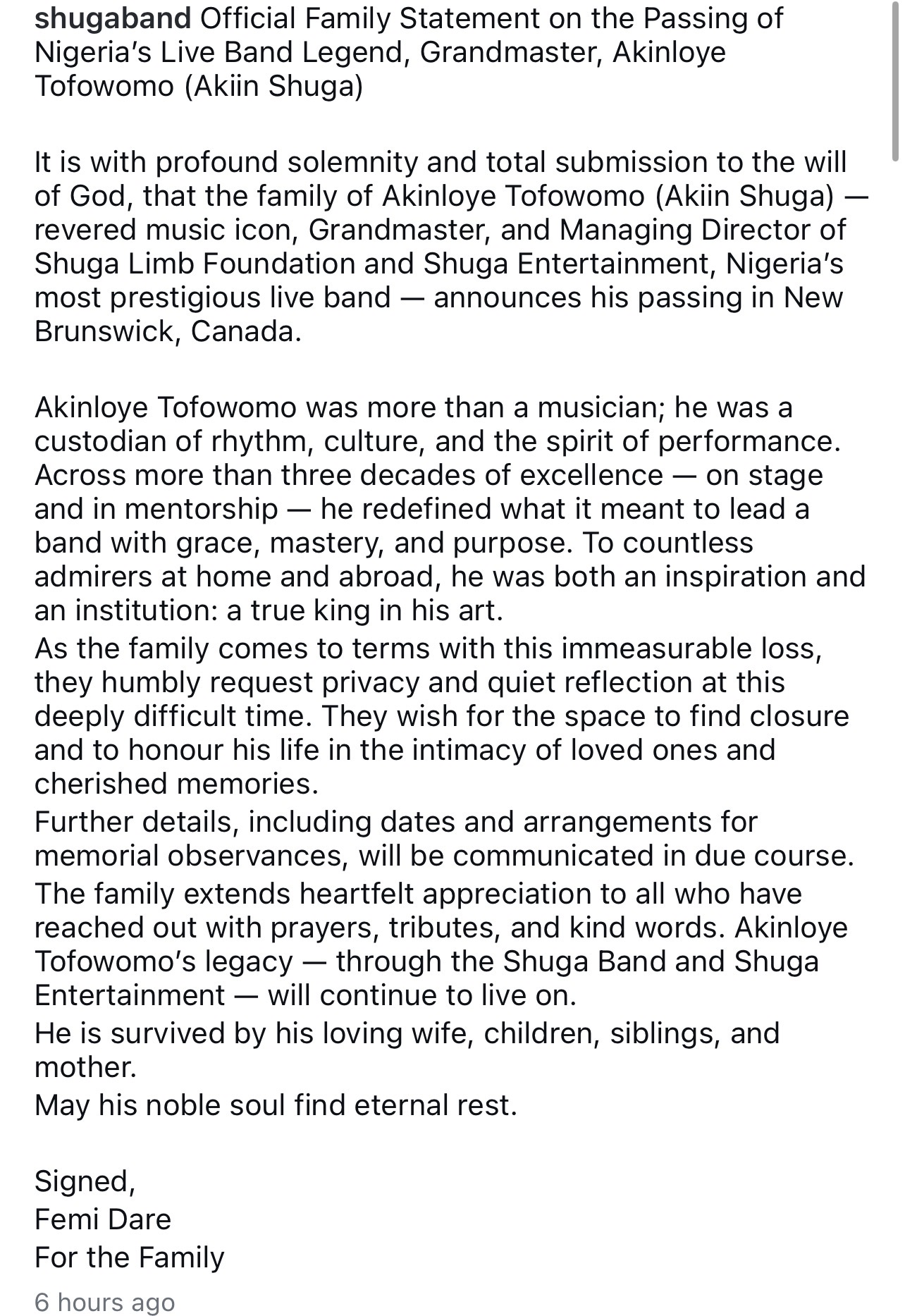

How he changed the music business


Five changes trace his imprint.
First, standards. Akiin insisted that bands arrive as a professional unit with exact dress codes, punctuality, and consistent set lists. The effect was immediate, as corporate clients who had once relied on DJs began booking live bands for the cachet it brought.
Second, structure. He pushed for formal booking systems and contracts that protected artists’ pay and his band’s rights. That approach reduced no-shows and payment disputes in an industry long plagued by informality.
Third, advocacy. As AMBON president and founder of a foundation that assisted polio survivors, he modelled how musicians could be both cultural custodians and social actors, using celebrity not only for performance but for policy influence and charity.
Fourth, versatility. He broke from the tradition of bands fixated on a single genre (like Juju or Highlife) by incorporating a wide range of local and international genres (R&B, Jazz, Country, etc.) into the band’s repertoire, appealing to a broader, more cosmopolitan audience.
Fifth, innovation. After studying Music Business at Berklee College of Music, he introduced modern elements to the Nigerian live music scene, such as brand collaborations, stage choreography, and digital sound engineering, which reshaped audience expectations and improved the quality of performances.
Conclusion


Akinloye Tofowomo’s life was a series of reframes: from a child with polio to a singer who could stride the stage; from a bar band’s leader to a national standard-bearer for live performance. He showed that excellence in craft need not be separated from activism or business sense. In his own lyrics and in the lives he touched, the message was consistent: movement matters, and not merely motion, but purposeful, disciplined motion that lifts others.
As Nigeria’s music community pauses to remember him, the drums will go silent for a while. But in the long, measured work of professionalising live music — in contracts signed, in young musicians trained, in the dignity afforded to a craft — Akiin Shuga’s final performance will still be heard, in every beat that follows.