


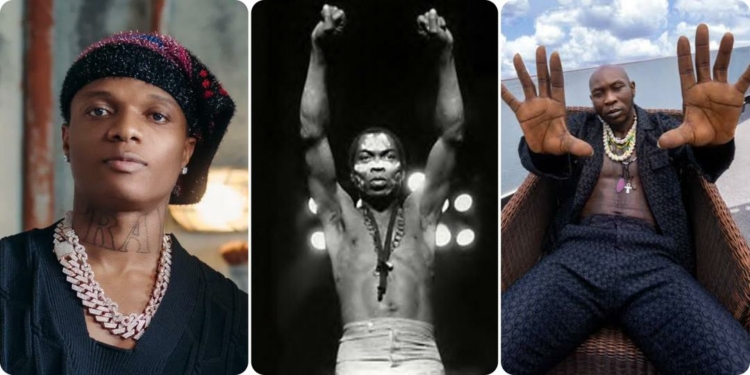
The Nigerian entertainment industry is never short of celebrity feuds and drama. from a musician trying to stamp his authority on the industry to actors and socialite trying to outdo themselves in the race to remain relevant by whatever means necessary, even if they have to throw caution to the wind, overstep the due bound of propriety and needlessly court controversy, for these eternal inhabitants of our virtual space and hegemons of our social media, nothing is too much for the validation of the public.
The latest squabble in the music industry between two distinct characters has dominated social media for weeks. It is not the type that fits into the conventional rift that many have come to attribute to the industry. Some will even say it is a mismatch of profiles. A bickering of two personalities with different egos and temperaments. The characters at the centre of the furore are Wizkid and Seun Kuti. Wizkid, though hugely popular and widely celebrated, is largely taciturn and reclusive. Seun, on the other hand, is controversial, truculent and garrulous.
One would ordinarily not expect the duo to have a go at each other, let alone get caught up in a feisty verbal war, but when the legacy of the inimitable and highly revered Fela Anikulapo Kuti is questioned, undermined and belittled, then a full-blown controversy and media frenzy should be expected. The fuse of the ballyhoo and rift was lit after what started as harmless fan chatter on the superiority of Fela’s legacy vis-à-vis Wizkid’s heritage snowballed into a frenetic and vicious exchange of diatribe between Wizkid and Seun.
Wizkid fans, who are popularly known as Wizkid FC, have repeatedly arrogated the unassailable position of the most iconic and successful musician in Nigeria. They asserted that he has surpassed the achievements of every other artist, including Fela. The comparison struck a nerve in Seun. If any is expected to reject the Wizkid comparison with Fela, then it is Seun. Other Fela children may not feel the need to prove the solidity, significance and credibility of their father’s legacy because they know his contribution to not just Nigeria’s music but the socio-economic and political firmament of the country is unrivalled and will forever be respected and cherished by millions of people around the world.
However, Seun, given his disposition, is not the type to stay mute and look the other way while such a comparison gains traction. He stepped in to correct the impression of those who see no wrong in comparing Wizkid to Fela but his intervention, instead of disabusing the mind of those who engage in such needless juxtaposition, worsened the situation. Instead of the bickering ending as differing opinions on history influence, clout and history, it morphed into something scandalous and messy.
In one widely shared Instagram story, Wizkid directly taunted Seun Kuti, declaring “@bigbirdkuti I’m Big Wiz everyday bigger than your papa!! Wetin u one do fool?” and calling him a “hungry bastard.” On X, he doubled down with a further tirade and a pointed contrast between what he presented as Fela’s historical struggle and Seun’s fight with fans: “Fela fight for freedom, this fool dey fight FC! Oloshi omo ale!”
In another post that left many aghast and stupefied, Wizkid completely veered off course and became personal. He tweeted, “Everyday Wizkid! I fu*k ur ugly wife? Wetin!” Wizkid’s crude and unrefined rebuttal made him lose moral ground in the fight as those who initially had his back made known their displeasure at his resort to attack on Seun’s dignity and family.
Be that as it may, Seun did not respond to Wizkid’s vituperations and diatribe with vitriol and invectives of his own even though that is what many expected him to do. He was civil, levelheaded and measured in his response. While he acknowledged the success and accomplishment of Wizkid, he reiterated the lofty legacy of his father and his glorious place in the pantheon of not just the Nigerian music industry but also revolutionaries who inspire radical changes in the nation.
As the bickering between Wizkid and Seun Kuti raged on, another high-profile voice from the Kuti family, Motunrayo Kuti, daughter of the late Afrobeat pioneer Fela Anikulapo-Kuti and sister to Seun, stepped into the fray. She was not as civil or conciliatory in her tone as her brother. In her reaction to the feud, she didn’t only throw her weight behind her brother, she lampooned Wizkid. She took the conversation beyond the scope of music and accomplishment and veered into personal and family territory where she impugned the image of Wizkid.
“Wizkid is bigger than Fela, abi?” she asked rhetorically, before turning the same comparison on Wizkid himself. “Wizkid, you are also bigger than your father, that useless father, that one wey abandon you and your mama wey don die so,” Motunrayo said, referring to Wizkid’s dad, Muniru Olatunji Balogun.
Her words were sharp and blunt, and she didn’t mince them: “You are also bigger than your uselessfather. As you are bigger than our own father.” Driving home a larger point that Fela’s cultural impact remains unmatched no matter how big contemporary fame might seem, she added: “Our father Fela is now bigger than your father… Yes, Fela big pass those two.”
But beyond the vitriol, invective, name-calling, expletives and vituperations, the conversation about the legacy of Fela and how people view him in relation to contemporary artistes must be had. It is largely a conversation about old versus new. A debate about two different eras where different types of music meant different things to different people. Fela’s music is evocative and socially conscious. It strikes at the heart of the malaise and scourge that pervades the nation. It is why many today, even years after his passing, still turn to his discography as a profound reminder of our socio-economic issues.
Seun’s bust-up with Wizkid is not about the Ojuelegba crooner’s talent or accomplishments; Wizkid’s achievements are visible to everyone, and only a handful of his contemporaries within and outside Nigeria can boast of his kind of achievement. His decision to echo and amplify his fans’ subjective arrogation of a legendary status to him is a bit tacky and borders on indiscretion, especially when done the way he did it. In doing so, Wizkid, scoffed at the legacy of an iconoclast who paved the way for him and those before him, who laid the foundation and pioneer what will later morph into afrobeat, who crawled so that the next generation can walk and fly.
Wizkid should have left the baseless and needless comparison to his overzealous fans and not join in. He may have won covet music awards like Grammy and break streaming records, but the undeniable truth is, Fela played in completely different level during one of the perilous times in Nigeria. His music shaped minds, he railed against corrupt officials, he confronted power-hungry military officials, he challenged the power that be and awaken the consciousness of Nigerians through raw and unfiltered language of rebellion and defiance.
The memory and legend of such man cannot be eclipsed by anyone who has not walked through the same path of struggle or put his body on the line for a greater cause. Wizkid’s place and contribution to Nigeria music industry is well established and acknowledged but they pale in comparison to the monumental ideals and grand contributions of Fela to the Nigerian society as a whole.