


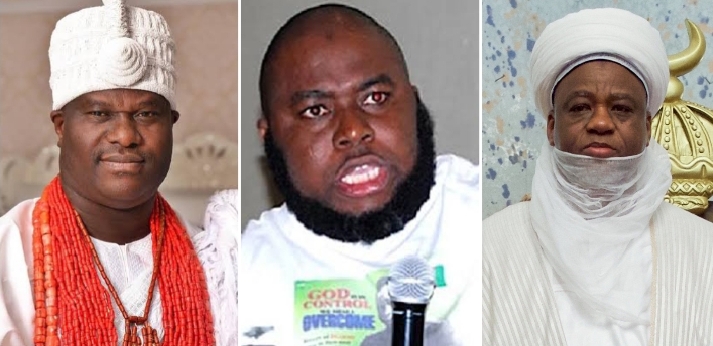
A new legislative proposal before the Nigerian Senate has sparked heated debate across the country, with prominent Niger Delta figure, Asari Dokubo, outrightly rejecting the elevation of the Ooni of Ife Adeyeye Enitan Ogunwusi and the Sultan of Sokoto Muhammadu Sa’ad Abubakar, as co-chairmen of Nigeria’s traditional rulers.
The proposed law, officially titled the National Council for Traditional Rulers of Nigeria (Establishment) Bill, 2024, is currently under scrutiny by the Senate Committee on Establishment and Public Service after it passed second reading in March 2025.
The bill, sponsored by Senator Simon Bako Lalong (Plateau South), seeks to formalize a national council of traditional rulers and designate the Ooni of Ife and Sultan of Sokoto as permanent co-chairmen of the body.
But in a strongly worded reaction, ex-militant leader and political activist Asari Dokubo dismissed the proposal, labeling it “arrant nonsense.”
He argued that neither the Ooni nor the Sultan represents his identity, tradition, or history as an Ijaw man, and insisted that Nigeria’s multicultural and multi-ethnic makeup should not be reduced to two symbolic monarchs he does not recognize.
Dokubo expressed the view that the Sultan of Sokoto, widely acknowledged as the spiritual head of Muslims in Nigeria, functions primarily in a religious capacity and should not be positioned as a national secular traditional leader.
He also stated that the Ooni of Ife and the Sultan of Sokoto are not connected to his cultural or traditional identity, emphasized that traditional rulers should be rooted in the heritage and consent of the people they represent.
According to him, the bill contradicts Nigeria’s federal character principle and marginalizes other ethnic nationalities, particularly in the South-South and Southeast regions. His rejection, he noted, is based on historical, cultural, constitutional, and moral grounds.
WATCH HIM SPEAK IN CLIPS BELOW


The Senate’s proposal has ignited a nationwide conversation on the place of traditional institutions in Nigeria’s governance structure, with many questioning the basis for elevating two monarchs above others in a multi-ethnic nation.
As debates continue, the bill remains under consideration, with stakeholders across Nigeria voicing varying perspectives on the future of traditional leadership representation at the national level.