

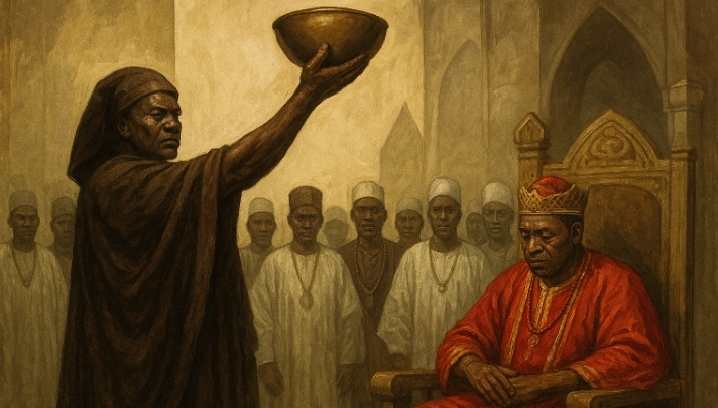
On a damp dawn in Old Oyo, the palace gates groan open to admit a lone figure. Rain persists in small, steady droplets on red earth pathways. The great court is silent. At its heart stands the Bashorun—majestic, stern, veiled in ritual cloths. Behind him, twelve council elders (the Oyo Mesi) flanked by Ogboni priests wait. No trumpets. No drums. No proclamations.
Then, in the hush, the Bashorun lifts a calabash. It is empty. No adornment inside: no token, no odor, no whisper. That calabash, in that moment, carries a sentence—one that has felled Alaafins, kings whose crowns once glowed with power. The people watch, the heavens seem to hold their breath, and in that empty vessel lies the end of a reign.
What power does an empty gourd hold, that it can unseat kings? How did ritual and religion, politics and morality conspire to make a simple object a sovereign’s doom? If you imagine this as legend, myth, or metaphor—you’re not wrong. But there is history behind it: traditions, recorded events, tacit powers of society, and the unseen architecture of legitimacy in the Oyo Empire.
In what follows, we will walk through the origin, the meaning, the power, and the consequences of the “empty calabash” ritual. We will trace how it was used—when and why—to demand a king’s removal; how the society viewed the king’s obligation; how political structure allowed such ritual removal; and how this system shaped the Oyo Empire over centuries.
The Oyo Empire: Structure, sacred and secular
To understand the calabash, one must first understand Old Oyo: its institutions, its moral geography, and how power was conceived.
Foundations and growth. The Oyo Empire (Oyo-Ile), founded by Ọranyan (also called Oranmiyan) from Ile-Ife, emerged as a major Yoruba state from around the 17th century onward. It became powerful through military success, trade, tributary relations with vassal states, and an effective bureaucratic and ritual structure.


Political institutions. The Alaafin was king of Oyo, symbol of authority and guarantor of external protection and internal peace. But the Alaafin was not absolute. Two important bodies balanced royal authority:
1. Oyo Mesi: a council of seven high chiefs who represented elite non-royal lineages. They advised the king, sometimes constrained him, sometimes contested him.
2. Ogboni society: a religious/secular body, older in some senses, with ritual authority, wisdom, age; commoners also respected it—religious sanction often resided here.
Legitimacy and ritual. In Yoruba cosmology, rule is both political and sacred. The king is not simply a war leader or administrator; his legitimacy is embedded in moral order, in ritual correctness, and in his comportment before gods, people, and tradition. A failure in governance, cruelty, or overreach could be seen as a breach of duty to the gods or society. And Old Oyo had built in mechanisms—formal and informal—to check kings who violated expectations.
The Empty Calabash and Parrots’ Eggs: Symbols of Rejection
Now we come to the ritual object itself: the empty calabash (or alternatively, a dish of parrot’s eggs). What does this mean? How was it used?
What is it? The empty calabash is a hollow gourd, dried and cleaned; nothing inside. Alternatively, a dish of parrot’s eggs might be used. Either signifies, in ritual form, that the king has been rejected. It is a public, symbolic, and formal declaration: “You are no longer acceptable.”
When is it used? This act was sometimes performed at or just after the Bere festival—a periodic festival of acclamation, during which the king reaffirmed his right to rule and the people’s assent. After Bere, there was a three-year peace period (in some accounts). At the end of that period, or if grievances had grown, the Oyo Mesi (with Bashorun) might decide the king had lost moral authority. Then, the ritual of rejection could be invoked by presenting the empty calabash or parrot eggs.
What does it imply? The presentation of the calabash meant that the king was expected to commit ritual suicide. This was not a matter of mere political deposition—by custom, the Alaafin could not simply be overthrown. But he could be compelled, by recognized authorities in the system, to end his life to restore balance. Accompanying the Alaafin in this act were his eldest son (Aremo) and his personal counselor (Asamu).

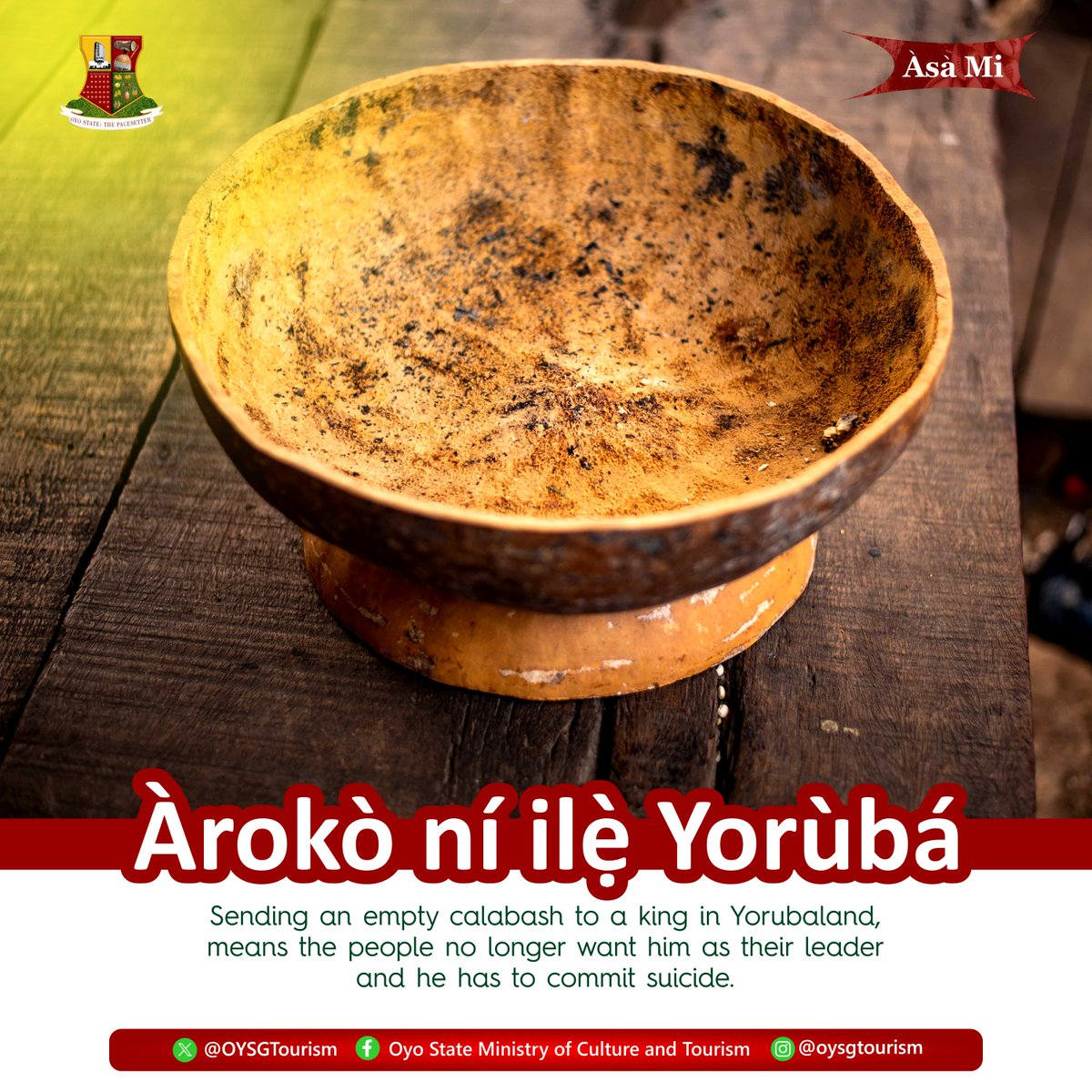
The phrase Awon Eniyan Koo (“the people reject you”). The ritual rejection might be accompanied by saying that the people reject him, the world rejects him, the gods reject him. It is a total repudiation. The empty calabash or parrot’s eggs is the physical symbol of that repudiation.
Case Histories: When Emptiness Fell Crowns
Historical records (oral, colonial, missionary, and Yoruba traditions) show that the empty calabash was not merely theoretical, but used repeatedly—especially during a period of crisis.
Mid-18th century spike: From around 1754, there is evidence that the political intrigue led by the Bashorun (especially one known as Gaha) used this ritual to force multiple Alaafins to suicide in quick succession. Two Alaafins in a matter of months were given the symbolic dish of parrot’s eggs, forced to commit suicide; others held throne very briefly. This indicates that the ritual had become a tool of extreme political maneuvering.
Alaafin Awonbioju and Alaafin Labisi are among those forced off the throne in this period; Awonbioju’s reign lasted about 130 days, Labisi only 17 days.
Alaafin Abiodun, who came later, ended Gaha’s abuses: Gaha was executed by Abiodun. But the damage—political instability, weakened legitimacy, factionalism—had been done.
Longer‐term consequences: Repeated use (and misuse) of the calabash ritual, political turmoil, wars lost, revolts among vassals—over time the Oyo Empire weakened. It lost its grip over tributaries, its military edge, and its internal cohesion. The ritual which once was meant as a balance, became a flashpoint of crisis.
Moral and Political Consequences
What was the toll—on kings, on state, on people—of employing the empty calabash?
Kings under constant threat. Alaafins lived in perpetual tension: how far could one push? To what extent could one exercise royal prerogative without triggering the Mesi or Ogboni? Some kings tried to extend their powers, accumulate wealth, centralize military might—but always within constraints. Overreach risked ritual repudiation. This constrained tyranny in some periods, but also made royal power fragile.
Succession instability. Because the ritual required the king’s eldest son (Aremo) and his counselor (Asamu) to also commit suicide, abrupt removal could destabilize succession lines. Governing continuity suffered. Rival factions in the Mesi could exploit the ritual. Sometimes multiple short reigns, quick removals, weakness.
Legitimacy erosion. If kings are removed ritualistically for political reasons (e.g. manipulated by power brokers), the rituals themselves can lose sacral aura. When people see the ritual being misused for factional ends, legitimacy of both kingship and ritual suffers. Over time, that contributes to weakening of central authority. This is seen in the decline of Oyo empire in late 18th / early 19th centuries.
Cultural, psychological impact. The knowledge that no matter how secure a king seems, ritual norms enforce limits, shapes kingship. It also shapes the people’s relation to authority: rulers are not absolute; they are bound by tradition, moral expectations. That in itself can stabilize society. But when the ritual becomes a tool of intrigue, fear, or oppression, it creates anxiety, factionalism, perhaps even resistance.
Comparative Reflections: Ritual, Removal, and Empty Symbols
While Oyo’s empty calabash is particularly striking, it fits into a broader pattern in many societies of a symbolic object being used in ritual condemnation or removal of leaders.
In other Yoruba polities, similar symbolic acts exist: oracles, curses, taboos. But the empty calabash in Oyo is special because of its formalization: it is codified, with clear roles (Bashorun, Oyo Mesi, Ogboni), recurring ceremonies (Bere), and definite consequences (ritual suicide).
Comparison to “sending an egg” or “presenting a message” in other African societies: sometimes these are metaphorical; sometimes literal, but seldom with the legal‐ritual weight Oyo placed on its calabash.
Also, the Oyo system shows how ritual and political institutions intertwine: the boundary between “religious duty” and “political obligation” is porous. Kingship is not only inherited; it is continuously earned, validated by ritual, public perception, and moral performance.
Myth, Memory, and Oral Tradition
Because much of what we know comes from oral tradition, colonial accounts, and Yoruba historiography, there is ambiguity. But that ambiguity is meaningful: legends, myths, and recorded events often overlap; oral accounts sometimes differ; but all concur that the empty calabash was an established, feared, real instrument of rejection.
Some accounts speak of “parrot’s eggs” instead of an empty gourd; some specify particular Alaafins; others emphasize the moral failure rather than political intrigue as trigger. These variations may reflect region, time period, or bias in the sources.
Writers like Stride & Ifeka (in their work on Oyo history) note that beyond ritual, there was always a tacit political calculus: who held power in the Mesi; what alliances existed; whether military success or failure; how vassal states responded. The ritual of the calabash sometimes masked political struggles rather than purely moral judgment.
Some Yoruba oral historians consider the empty calabash ritual as part of a larger cultural fabric: stories of kings who become tyrants, gods who punish hubris, oracles that warn. The calabash is sometimes moral metaphor—empty when virtue is lacking. The memory of it continues in phrase, proverb, ritual allusion even when the literal practice has receded.

Legacy: Then, Now, and What It Might Mean Today
What is the modern relevance of this almost mythic ritual? What can the empty calabash teach us in our times?
As moral check on leadership. Even today, many societies struggle with leaders who overreach, who ignore accountability. The empty calabash is a permanent reminder that legitimacy depends on more than force or title—it depends on responsibility, virtue, recognition by people and community.
Symbolic power in culture. Rituals, symbols, traditions carry weight beyond laws. They are part of identity, of collective memory. Reviving or remembering rituals (even as metaphor) can help people think about their leaders in moral, not just political, terms.
Understanding African political history on its own terms. Too often myths are dismissed. But the ritual of the empty calabash shows how much of Yoruba, and African, governance was ritualized—how spiritual, moral, symbolic dimensions were woven through political institutions. To lose that understanding is to flatten history.
Memory in literature and art. The empty calabash has inspired stories, poems, plays, perhaps even political protest imagery. It lives in proverbs: “If the calabash is empty, the king’s favor is gone.” That kind of language continues. It shapes moral imagination.
The Takeaway
In the end, the empty calabash of Oyo is more than an object. It is an idea—of emptiness, of rejection, of the binding of power to moral duty. It is a device by which a society reminded its rulers that crown and authority are conditional. It is a ritual promise that kings do not stand beyond reproach.
That day in Old Oyo, when the Bashorun raised the calabash, the silence that followed was thunderous. That empty vessel carried the weight of history, of collective will, of gods, of ancestors. And in that stillness, a reign ended.