



In the quiet hum of government offices, there exists a rhythm unseen, a shadow that moves alongside the clatter of keyboards and the rustle of paper. Salaries appear, disappear, and reappear elsewhere, ghostlike, in accounts where no living hand has touched them. For millions of Nigerians, the public payroll should be a promise—a reflection of their labor and contribution. Instead, it is a trapdoor into uncertainty, a ledger of vanished hope.
There are no dramatic sirens here, no confrontation in broad daylight. The theft happens in whispers: a name added to a list that doesn’t exist, a stipend collected for someone who is not there, a transaction masked by layers of bureaucracy. The victims are many, yet invisible—teachers waiting months for salaries, nurses juggling overtime without compensation, civil servants questioning the integrity of the system meant to sustain them.
The metaphorical landscape of payroll fraud is one of ghosts and shadows. The “ghost workers” are not literal apparitions, yet their presence haunts budgets, siphoning billions of naira from the state. These invisible figures are woven into the fabric of local government payrolls across Nigeria, from Katsina to Bayelsa, exploiting trust, technology, and the gaps in oversight.
And yet, in the quiet corridors where suspicion simmers, the story is not only about loss. It is about discovery, confrontation, and the arduous process of reclaiming what was stolen. This is a story about the invisible battle over the nation’s resources and the resilience of the targeted Nigerians who demand their share.
Katsina’s Ghostly Ledger
In Katsina, the air was thick with the weight of administrative duty, yet beneath the daily routine, a shadowy presence lingered. The state’s biometric audit revealed a staggering 3,488 ghost workers among over 50,000 staff members. Like specters in a ledger, these names existed on paper but not in reality, drawing salaries that should have supported living, breathing citizens.
The audit did more than expose numbers; it illuminated patterns of deceit. Absenteeism, falsified certificates, illegal promotions—each discovery was a brushstroke in a larger painting of systemic corruption. The recovered N4.6 million was small compared to the broader economic hemorrhage, yet it was a tangible victory against an abstract adversary.


Government officials moved swiftly, removing the fraudulent names and reinforcing the mechanisms meant to protect salaries from theft. The implementation of biometric verification emerged as a sword against these shadows, slicing through the layers of deception that had taken root over years. But the psychological impact lingered—how many citizens had felt the absence of their rightful wages, wondering if the ledger had swallowed them whole?
For the people of Katsina, the story became a cautionary tale. The ghost workers were more than anomalies; they were symbols of distrust, a reflection of the fragility of systems entrusted to protect the welfare of the living. And yet, the uncovering of these specters offered hope—a promise that transparency could wrestle control from the hands of the invisible.
Bayelsa’s Billion-Naira Mirage
Across the Niger Delta, in Bayelsa State, a different kind of phantom played its part. The state’s payroll was a labyrinth, hiding N12 billion annually in phantom wages. Here, the deceit was more audacious, a testament to the ingenuity of fraudsters who exploited the cracks in governance to their advantage.
A commission of inquiry uncovered a landscape littered with falsified documents, phantom promotions, and salaries paid to entities that did not exist. The economic cost was colossal, yet the human cost was felt most acutely by those who depended on timely compensation to support their families. Teachers, health workers, and civil servants bore the invisible wounds of betrayal.

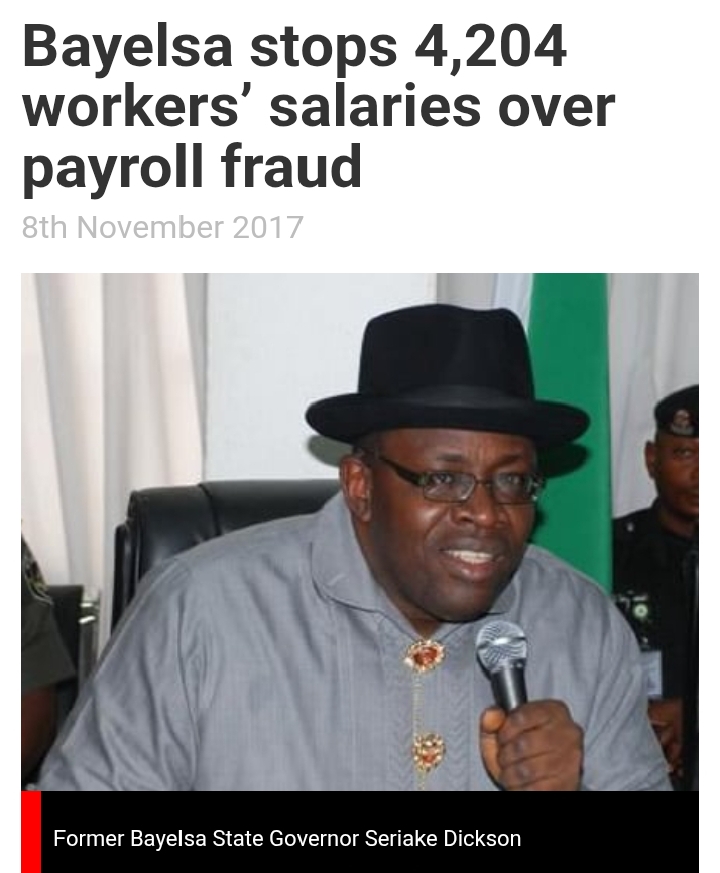
Forensic accounting and ICT deployment emerged as torches in this dark labyrinth, illuminating paths to accountability. The commission’s findings rippled through public consciousness, igniting outrage and demanding reform. In the halls of power, the echoes of these revelations were impossible to ignore, a reminder that shadows cannot thrive where vigilance persists.
Bayelsa became both cautionary tale and beacon. It illustrated that payroll fraud is a national phenomenon, one that transcends geography and politics, but it also demonstrated that deliberate, structured intervention could begin to reclaim lost resources and restore faith in governance.
The Presidential Amnesty Programme’s Hidden Drains
In the Niger Delta, a program designed to bring peace and stability became an unexpected conduit for fraud. The Presidential Amnesty Programme, intended to rehabilitate and integrate former militants, revealed a hidden network of ghost beneficiaries. Hundreds of individuals were drawing multiple stipends, siphoning resources through duplicity and the opacity of oversight.
The fraud was systemic, embedded within the mechanisms designed to reward reintegration. As auditors combed through records, the numbers alone told a story of betrayal: one individual receiving stipends for dozens of others, payments made to non-existent participants, and the ripple effects of these misallocations felt across legitimate beneficiaries.
The response was procedural yet symbolic. New management instituted stricter verification measures, recalibrating contracts, and leveraging technology to untangle the web of deceit. These reforms aimed not only at financial recovery but at restoring dignity to those whose rightful payments had been usurped by ghostly entities.
For the targeted Nigerians—those reliant on these stipends—the impact was profound. Trust had been eroded, and the financial lifelines intended to stabilize lives had been compromised. Yet in exposing the system’s weaknesses, the auditors offered a roadmap for redemption, where transparency could once again illuminate pathways meant to support human lives.
Whistleblowers and the Price of Seeing
Amid these systemic shadows, some dared to see too clearly. Whistleblowers, often unnamed for their safety, became the human agents confronting the invisible. They navigated threats, retaliation, and bureaucratic indifference, risking reputations and freedom to illuminate corruption.
The story of whistleblowers is not merely about courage; it is about moral clarity in environments clouded by deception. Their reports, petitions, and evidence serve as anchors in a turbulent sea of fraud. Yet too often, their bravery is met with resistance, arrests, and intimidation, as if society seeks to silence the very eyes that can pierce its shadows.
Protection for these individuals remains tenuous, yet their existence is a testament to the possibility of systemic correction. Without whistleblowers, ghost workers remain unchallenged, and fraud festers unseen. With them, however, a narrative of accountability can emerge, tangible as a ledger balanced after months of chaos.
The metaphor here is stark: in a world haunted by invisible theft, the whistleblower is both lantern and compass, guiding society toward recognition, understanding, and justice.
The Human Cost of Shadows
Payroll fraud is not an abstract crime; it manifests in the lives of millions who rely on government salaries to survive. For teachers in remote schools, months may pass without pay, their classrooms echoing with absence and quiet frustration. Healthcare workers struggle to provide basic care as funds meant for equipment, drugs, and salaries vanish into invisible accounts. Every unpaid wage is a ripple across the river of society, touching households, markets, and the fragile infrastructure of daily life.
The deception leaves invisible scars. Families postpone critical needs, children miss school, and medical emergencies become unmanageable. These are not numbers on a spreadsheet—they are lived experiences, carried by targeted Nigerians whose trust has been siphoned alongside their salaries. The human cost is felt in quiet homes, in unspoken frustrations, in the slow erosion of hope that hard work guarantees compensation.
Society, too, bears the weight of betrayal. Citizens who observe these ghostly transactions begin to question the legitimacy of public institutions. Taxes feel like contributions to an invisible hand, salaries appear like illusions, and the social contract begins to fray. Fraud is no longer a distant headline; it is a daily reality, shaping perceptions and decisions, breeding cynicism where trust once resided.
And yet, even amidst this erosion, there is awareness. Knowledge of the scams sparks conversations, advocacy, and demand for reform. Citizens realize that the fight against payroll fraud is not solely bureaucratic—it is collective. Each revelation, audit, and whistleblower action becomes a thread, slowly weaving the possibility of accountability into a society long haunted by invisible losses.
Toward Transparency and Redemption
Efforts to confront payroll fraud in Nigeria have taken form in biometric verification, digital payroll systems, and stringent auditing processes. Katsina’s successful removal of 3,488 ghost workers stands as a blueprint, showing that technology, when paired with political will, can illuminate darkened ledgers. The implementation of verification systems has transformed what was once invisible into actionable data, allowing governments to reclaim stolen resources and restore salaries to legitimate employees.
Yet the path toward reform is fraught with resistance. Entrenched interests, gaps in infrastructure, and the sheer complexity of monitoring thousands of public servants across multiple states make eradication of fraud a formidable task. The ghosts of the payroll do not vanish overnight—they require persistent vigilance, systemic reinforcement, and cultural shifts that prioritize transparency over collusion.
Digital systems are more than tools; they are metaphors for illumination. They turn shadows into data points, spectral fraud into tangible evidence, and abstract theft into a problem that can be solved. Nigeria’s gradual adoption of these systems demonstrates a willingness to confront uncomfortable truths, a commitment to ensuring that targeted Nigerians are no longer left paying the price for invisible deception.
Hope emerges through these reforms, not as a sudden resolution but as a quiet, persistent light. Each audit, each recovered fund, each whistleblower vindicated, becomes a stitch in the fabric of public trust. For citizens, it is proof that while shadows may linger, daylight can reach even the most obscure corners of governance.


The Ledger of Redemption (Conclusion)
The story of payroll fraud in Nigeria is a tale of shadows and illumination, of invisible theft and human resilience. Ghost workers, phantom payments, and systemic failures are the specters that haunt public finance, but they are not insurmountable. Through audits, technology, and courageous whistleblowers, the nation has glimpsed pathways to justice and accountability.
For the targeted Nigerians affected by these invisible crimes, the battle is deeply personal. Their lost salaries represent deferred dreams, delayed medical care, and compromised livelihoods. Yet the awareness, exposure, and corrective measures provide a tentative reclamation of trust, a reminder that systems can bend toward fairness when rigorously monitored.
The ledger of the nation’s payroll is no longer a mere financial record—it is a metaphor for society’s integrity. Every corrected entry, every removed ghost worker, and every recovered naira signifies more than monetary restitution; it represents the reclamation of dignity, faith, and hope for those who labor daily to sustain the country.
Ultimately, confronting payroll fraud is a collective responsibility. Government officials, civil servants, whistleblowers, and citizens each play a part in casting light into the shadows. The fight is ongoing, but each success—however incremental—is a testament to resilience and accountability.
In the end, the ledger may no longer be haunted, but instead a reflection of a society striving to honor the labor of its people, ensuring that targeted Nigerians are no longer ghosts in the system, but living beneficiaries of their rightful wages.