


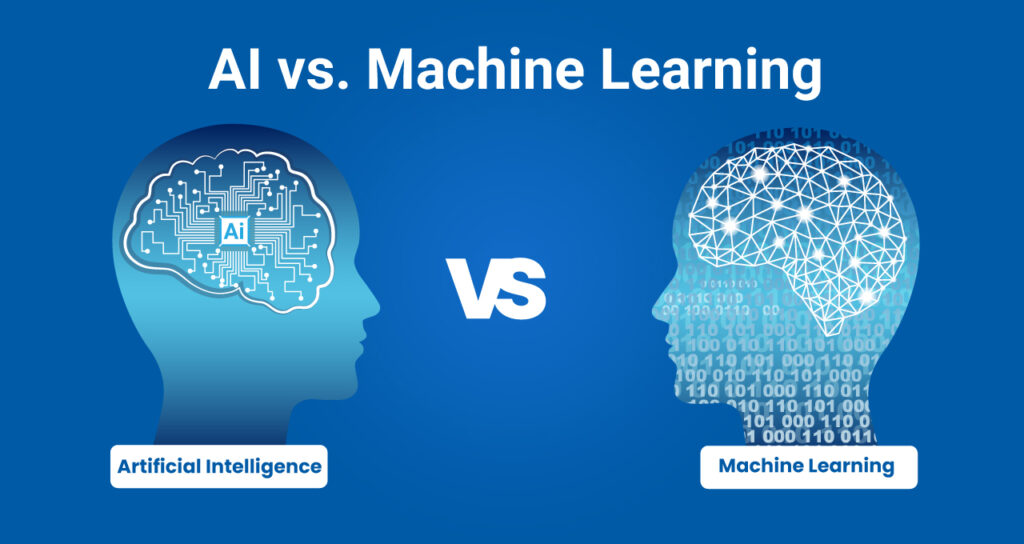
Artificial Intelligence (AI) and Machine Learning (ML) are popular terms in the tech industry, but many people mistakenly use them as if they mean the same thing. This confusion can lead to misunderstandings about what these technologies can do and how they fit into the bigger picture of modern technology.
AI is a broad field of computer science that focuses on creating intelligent machines capable of mimicking human behaviour. On the other hand, ML is a specific branch of AI that allows systems to learn and improve from experience without being explicitly programmed.
It’s important to understand these differences in today’s digital world for several reasons:
- To make informed decisions when implementing technology solutions
- To recognize the strengths and weaknesses of AI and ML systems
- To stay competitive in an increasingly automated business landscape
- To prepare for future advancements in technology
This guide will explain the main differences between AI and ML, including their unique features, applications, and effects on various industries. You’ll learn how these technologies work together to drive innovations that influence our everyday lives.
What is Artificial Intelligence?


Artificial Intelligence (AI) refers to a computer system’s ability to mimic human intelligence and carry out tasks that usually require human cognitive functions. According to the Encyclopedia Britannica, AI is defined as “the ability of a digital computer or computer-controlled robot to perform tasks commonly associated with intelligent beings.”
Capabilities of AI Systems
AI systems exhibit various abilities, including:
- Pattern Recognition: Identifying visual patterns, speech patterns, and behavioural trends
- Problem Solving: Making decisions based on complex data analysis
- Learning: Adapting responses based on new information
- Natural Language Processing: Understanding and Generating Human Language
Everyday Uses of AI Applications
AI applications have become essential in our daily lives:
- Virtual Assistants
- Siri processes voice commands to set reminders
- Alexa controls smart home devices
- Google Assistant provides personalized recommendations
- Predictive Analytics
- Weather forecasting systems
- Stock market prediction tools
- Consumer behaviour analysis
- Healthcare Applications
- Disease diagnosis through image analysis
- Patient care optimization
- Drug discovery acceleration
How AI Works
AI technology encompasses many systems, from basic rule-based approaches to complex neural networks. For instance, a simple chess program follows predefined rules, whereas advanced AI systems like self-driving cars analyze real-time data to make instantaneous decisions. These sophisticated systems employ intricate algorithms to process information, identify patterns, and generate suitable responses.
The Future of AI
The potential of AI continues to grow as computing capabilities advance and new algorithms are developed. Whether it’s facial recognition technology used in security systems or recommendation algorithms employed by streaming platforms, AI plays a pivotal role in shaping our interactions with digital interfaces.
What is Machine Learning?
Machine learning is a revolutionary method in artificial intelligence that allows computer systems to learn and improve from experience without being explicitly programmed. Essentially, ML empowers computers to recognize patterns in large datasets and make decisions with minimal human involvement.
The Different Types of Machine Learning Techniques
The strength of machine learning lies in its various methods:
1. Supervised Learning
- Algorithms learn from labeled data sets
- Systems predict outcomes based on past examples
- Used in spam detection and image classification
- Requires human input for initial training
2. Unsupervised Learning
- Discovers hidden patterns without labelled data
- Groups similar data points together
- Applied in customer segmentation
- Identifies anomalies in data sets
3. Reinforcement Learning
- Systems learn through trial and error
- Algorithms receive rewards for correct actions
- Used in game playing and robotics
- Adapts behaviour based on feedback
How Machine Learning Works
ML systems analyze data using advanced algorithms that identify intricate patterns. These patterns facilitate predictions, classifications, and insights that would be unattainable for humans to derive manually. The technology drives numerous everyday applications, such as Netflix recommendations and fraud detection in banking transactions.
The Importance of Data in Machine Learning
The success of machine learning relies heavily on the quality and quantity of data. ML models need large amounts of precise data to deliver dependable outcomes. As the volume of data increases and computing power grows, ML capabilities continue to evolve across various industries.
The Difference Between AI and ML
Artificial intelligence (AI) is a broad field encompassing various technologies and approaches to create machines capable of performing tasks that typically require human intelligence. Machine learning (ML), on the other hand, is a specific subset of AI that focuses on enabling these systems to learn from data and improve their performance over time.
Key Differences Between AI and ML
Here’s a clear breakdown of their relationship:
| AI Characteristics ML’s Role in AI Makes decisions based on programmed rules | Provides AI with the ability to learn from data |
| Can operate without learning capabilities | Improves accuracy through pattern recognition |
| Encompasses multiple approaches to artificial intelligence | Functions as a specific subset of AI technology |
| Aims to simulate human intelligence | Focuses on data-driven predictions |
How AI and ML Work Together
A practical example: When you use a virtual assistant like Siri, the AI system processes your request and determines appropriate actions. The ML component helps Siri understand your speech patterns better over time, improving its response accuracy through repeated interactions.
This relationship demonstrates how ML is the engine that powers many modern AI applications, enabling them to adapt and evolve based on new information and experiences.
Examples of AI and ML in Real Life
IBM Watson: A Powerful Example of AI and ML
IBM Watson is a powerful example of how AI and ML can work together in real life. In 2011, this supercomputer made history by defeating two Jeopardy! Champions, showcasing its advanced capabilities in:
- Natural language processing
- Information retrieval
- Knowledge representation
- Automated reasoning
How Watson Works: Processing Data with AI and ML
Watson’s AI system processes vast amounts of unstructured data, including:
- Medical records
- Scientific papers
- News articles
- Social media content
The machine learning components of Watson enable it to:
- Learn from Experience: Watson improves its accuracy through continuous exposure to new data
- Recognize Patterns: It identifies complex relationships within datasets
- Generate Hypotheses: The system creates potential solutions based on available information
Watson’s Impact: Applications Across Industries
Watson’s applications extend into multiple sectors:
- Healthcare: Analyzing patient records and suggesting treatment options
- Finance: Detecting fraudulent transactions and assessing risk
- Customer Service: Powering chatbots and virtual assistants
- Research: Accelerating scientific discoveries through data analysis
The Language Processing Power of Watson
The system’s language processing capabilities demonstrate ML in action. Watson breaks down human language into components, identifies context, and generates appropriate responses. This process involves:
- Parsing grammatical structures
- Understanding idioms and colloquialisms
- Recognizing sentiment and intent
- Generating contextually relevant responses
Techniques Used in Machine Learning Models
Machine learning models come in various forms, each designed to tackle specific problems and data patterns. Here’s a breakdown of the primary model types:
Popular Machine Learning Models:
- Decision Trees: These models create a flowchart-like structure to make decisions based on input features
- Neural Networks: Complex systems inspired by human brain architecture, capable of deep learning and pattern recognition
- Support Vector Machines (SVM): Algorithms that find optimal boundaries between different data classes
- Random Forests: Collections of decision trees that work together to produce more accurate predictions
- K-Means Clustering: Unsupervised learning algorithms that group similar data points together
Cross-Validation Techniques
Cross-validation serves as a crucial method for assessing model performance. This technique splits your data into multiple subsets:
- Training Set: Used to teach the model patterns and relationships
- Validation Set: Helps tune model parameters
- Test Set: Evaluates final model performance
The k-fold cross-validation method divides data into ‘k’ equal parts, training the model k times with different combinations of these subsets. This approach:
- Reduces overfitting risks
- Provides robust performance metrics
- It helps identify optimal model parameters
Machine learning practitioners typically use 5-fold or 10-fold cross-validation to balance computational cost with reliable results. The choice of validation technique depends on factors like dataset size, model complexity, and computational resources available.
Applications of AI and ML Technologies in Different Industries
AI and ML technologies are changing how various industries operate, opening up new possibilities for growth and innovation.
Healthcare
- Medical imaging analysis detects diseases through pattern recognition
- Drug discovery processes accelerated through predictive modelling
- Patient care optimization with personalized treatment recommendations
- Real-time monitoring systems for intensive care units
Financial Services
- Fraud detection systems identify suspicious transactions
- Algorithmic trading platforms execute trades at optimal times
- Credit risk assessment through behavioral pattern analysis
- Chatbots handle customer service inquiries 24/7
Entertainment
- Content recommendation engines on streaming platforms
- Video game NPCs with adaptive behavior
- Dynamic pricing for event tickets
- Automated content moderation on social media
Manufacturing
- Predictive maintenance reduces equipment downtime
- Quality control through computer vision systems
- Supply chain optimization using demand forecasting
- Robot-assisted assembly lines
These applications show how flexible AI and ML technologies can be. Each industry uses these tools to solve problems and create opportunities. The healthcare sector uses AI to make diagnoses faster, while financial institutions use ML algorithms to prevent fraud. Entertainment companies improve user experiences with personalized recommendations, and manufacturers increase efficiency with automated systems.
As organizations find new ways to use these technologies for their specific needs, the use of AI and ML continues to grow.
Future Trends in AI and ML Technologies
The rapid evolution of AI and ML technologies promises groundbreaking developments across multiple domains. Recent advancements point to several emerging trends:
1. Enhanced Natural Language Processing
- AI systems will understand and respond to human communication with increased sophistication
- Real-time translation capabilities will break down language barriers
2. Autonomous Systems
- Self-driving vehicles will become mainstream
- Robotics in manufacturing will achieve new levels of precision
3. Ethical AI Development
- Increased focus on bias detection and elimination in AI algorithms
- Implementation of transparent decision-making processes
- Development of regulatory frameworks for AI governance
The societal impact of these advancements raises important questions:
“How do we ensure AI benefits all members of society equally?” “What safeguards should we implement to protect privacy and security?”
These challenges demand a balanced approach between technological progress and ethical considerations. The future success of AI and ML technologies will depend on our ability to address these concerns while fostering innovation.