


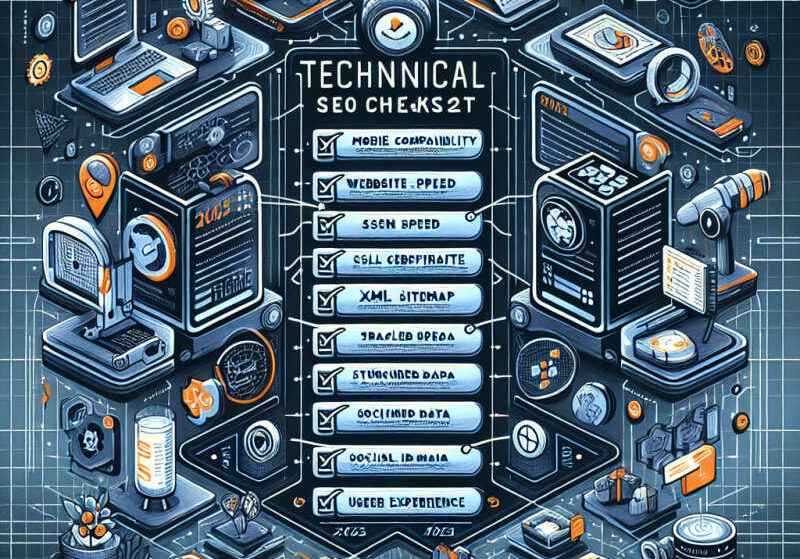
Search is won by sites that get the fundamentals right before chasing trends. This no-nonsense 2025 technical SEO checklist will walk you through the essentials that actually move the needle: tightening crawl control and indexation hygiene, shaping a clean information architecture with purposeful internal links, prioritising performance and Core Web Vitals by template, making JavaScript-rendered content reliably discoverable, implementing robust structured data for rich results, and standing up monitoring and alerting that catch issues before they cost you revenue.
You’ll find practical examples, lightweight code snippets, clear thresholds, and simple matrices designed for teams to execute with confidence, measure impact, and maintain a stable, search-friendly site at scale.
1. Crawl Control and Indexation Hygiene
Start with a crawl map that lists all 200-status URLs and tag every row with canonical, meta robots, URL parameters and pagination. This exposes duplication, thin sections and crawl traps in minutes. Lock down crawl waste using precise robots.txt rules for faceted URLs, internal search, cart and staging paths. Keep XML sitemaps pristine: one index file linking to child sitemaps, with a maximum of 50,000 URLs each. Include only canonical 200s with accurate last-modified dates.
Fix directives ruthlessly: prefer canonical for duplicates, use noindex for thin/utility pages, and avoid conflicting signals that make crawlers guess. Audit Index Coverage in Search Console, group by Excluded reasons, then attack in priority order (crawl anomalies, soft 404s, duplicates without a user-selected canonical). For pagination, provide category pages with unique content and useful filters; do not rely on rel= “next”/rel= “prev”, as they are deprecated and will not improve the user experience.
Experts’ Advice: If a URL doesn’t attract links, satisfy user intent, or serve as internal linking, it shouldn’t be indexable either; consider consolidating or using the noindex directive.
Sample robots.txt Configuration
User-agent: *
Disallow: /search/
Disallow: /cart/
Disallow: /?sort=
Allow: /checkout/success
Sitemap: https://www.example.com/sitemap_index.xml
Quick Status Snapshot Matrix
Use a quick status snapshot to drive actions and maintain your indexation hygiene. Pro tip: Review weekly, not quarterly. Bloat can creep in quickly.
| URL sample | Status | Current directive | Action |
|---|---|---|---|
| /collections/blue-shirts?page=2 | 200 | canonical to page 1 | Make unique; keep |
| /search?q=blue | 200 | none | noindex + block |
| /product/sku-123 | 200 | self-canonical | Keep indexable |
| /blog/tag/seo | 200 | index | Evaluate value |
Actionable Checklist
- Export live 200s and tag directives
- Block waste in robots.txt
- Purge sitemaps to canonical 200s only with correct lastmod
- Apply canonical vs noindex consistently
- Fix Search Console exclusions in priority order
- Strengthen pagination UX with unique copy and filter logic
Experts’ Advice: Your budget isn’t limited by Google; your chaos limits it. Reduce chaos, and your crawl budget, index coverage and rankings will follow.
2. Information Architecture and Internal Linking
Draw the map before you drive. Define content hubs and clusters with intention: select 8–15 cornerstone pages that represent your commercial themes, then attach 5–20 child pages to each to build topical depth. Keep the money-makers ≤3 Clicks from the homepage and eradicate orphan pages with ruthless efficiency.
Lock in navigation discipline: top navigation links to hubs, the footer is for utilities only, and mega menus stop at what real users need. Bake in universal breadcrumbs, align them with the URL structure, and add Breadcrumb schema for clean, rich SERP trails. Anchor text matters. Use descriptive, varied labels, avoid fluff like “click here”, and match search intent without turning it into spam.
Experts’ Advice: document a tight internal linking strategy so teams stop guessing and links actually move rankings.
Plain-English Linking Playbook
Here’s a plain-English linking playbook that scales without breaking UX or crawl budget:
- From the Homepage: link to all hubs (12–16)
- Each Hub: links to all children plus sibling hubs (30–60)
- Every Child: links to its parent hub and 2 siblings (5–10 total)
- Any Article: links to 2–3 related articles plus 1 hub (3–6 total)
Enforce a shallow depth with periodic crawls, repair broken chains, and maintain link counts within limits to protect the PageRank flow. Visualise it like this: [Homepage] → [Hubs] → [Children]; sibling arrows connect related nodes, breadcrumbs mirror the same path. That’s the blueprint that drives crawl efficiency, topic authority, and real SEO performance.
3. Performance and Core Web Vitals Prioritisation
Measure performance by template and stop guessing. Track CrUX for your homepage, hub, product, article, listing views separately, then enforce hard budgets: TTFB < 0.8s, LCP < 2.5s (mobile), CLS < 0.1, INP < 200ms.
Name the LCP element per template and ensure it loads first: preload the hero or headline, serve AVIF/WebP with the correct sizes/srcset, and lazy-load non-critical media. Optimise JS performance: defer non-essential scripts, remove unused packages, and gate third-party tags until user interaction. Nail your CSS strategy: inline critical CSS, load the rest async, avoid @import chains. Push at the edge: CDN/edge caching for safe HTML, enable Early Hints (103) where available, and ship Brotli-compressed assets.
Quick LCP Preload Fix
Small but mighty LCP-preload you can drop in the head:
<link rel="preload" as="image" href="/images/hero-1200.avif"
      imagesrcset="/images/hero-800.avif 800w, /images/hero-1200.avif 1200w"
      imagesizes="(max-width: 600px) 800px, 1200px">
That single line often chops LCP by hundreds of milliseconds.
Case Studies That Move the Needle
E-commerce: The main product image of the product template is identified as LCP at 3.4s. After preload, format shift to AVIF, and 30% less JS, LCP hit <2.3s and INP stabilised under 200ms; organic revenue lifted as crawl and render efficiency improved.
Publishing: Article template LCP was the H1 text at 2.8s. By inlining critical CSS and using font-display: swap, LCP dropped to <2.0s, CLS flattened, and time-to-index improved on fresh posts.
Marketplace: The listing template’s first card image loaded at 3.1s. After preconnecting to the CDN, preloading the first card image, and lazy-loading assets below the fold, LCP landed at <2.3s. Bonus win: HTML cached at the edge with smart revalidation, plus Brotli level 11 for static assets.
The pattern is boringly consistent: measure by template, budget hard, prioritise the LCP, reduce JS, streamline CSS, and squeeze the network. This is how technical SEO gets measurable, durable results in 2025.
4. JavaScript Rendering and Content Discoverability
Ship critical content in the initial HTML using SSR/SSG, so Googlebot doesn’t need to “guess” your page via hydration magic. Keep headlines, product copy, internal links, meta robots, and canonicals rendered server-side, and defer non-critical JavaScript.
Ditch aggressive client-side routing that hides content from the first HTML paint; if you must use it, expose crawlable URLs and keep link href attributes intact. Add noscript fallbacks for vital assets and navigation to ensure content remains visible without JavaScript. Don’t inject robots meta or canonical tags via JavaScript—render them in the server response to avoid indexing roulette. Allow Google to fetch essential JS/CSS in robots.txt so rendering isn’t broken by blocked resources.
Essential JavaScript SEO Checklist
- Defer hydration and split bundles; prioritise critical CSS and above-the-fold HTML
- Keep internal links as real anchors; no JS-only click handlers for primary navigation.
- Render structured data server-side for reliable rich results
- Provide noscript alternatives for key content and links
- Unblock /static/.js and /static/.css in robots.txt where needed
Testing and Validation
Back it up with ruthless testing. Use URL Inspection → View Crawled Page to compare what Google actually saw. Run an HTML snapshot diff (JS on vs JS off) and a no-JS browser audit to catch vanishing content. If the stack leans heavily, consider adopting streaming SSR or selective hydration and monitoring INP after each iteration.
Practical fallback for critical images: keep the modern source and add a noscript image for non-JS contexts; apply the same logic to key category links. The goal: fast initial HTML, crawlable links, stable metadata, and a page that remains understandable even when JavaScript takes a holiday.
5. Structured Data and Rich Result Readiness
Get your schema markup nailed to the pixel, or watch competitors hoover up rich results while you fight for crumbs. Map schema types per template and keep it ruthless: Organisation and Website (with a Sitelinks Search Box) on the homepage; Breadcrumb everywhere the path matters; Product, Offer and AggregateRating on product pages; Article on content hubs; FAQ only when you genuinely have Q&A; VideoObject where video exists.
Define the required and recommended properties per template, pull them cleanly from your CMS (without dummy values or spam), and ensure they are consistent with the visible content.
Experts’ Advice: Build a small internal “schema contract” that lists fields such as name, URL, logo, sameAs, and potentialAction for the homepage; headline, image, datePublished, and author for articles; and sku, offers, price, priceCurrency, and availability for products. It keeps developers aligned and prevents silent breakage during releases.
Validation and Monitoring
Once mapped, run every template through the Rich Results Test and the Schema.org validator; squash errors and most warnings before shipping. Keep an eye on Search Console Enhancements when coverage dips; something in your markup, feeds, or CMS probably changed. Annotate deployments that interact with structured data so you can link fluctuations to actual events, rather than relying on guesswork.
Practical move: maintain a quick mapping table in your repo (Homepage → Organization, WebSite, Logo; Product → Product, Offer, AggregateRating; Article → Article, Breadcrumb) and include a minimal, valid JSON-LD snippet in your pattern library for example a lean product object with name, image, sku, and offers (currency in GBP, stock state, canonical URL).
Experts’ Advice: Automate validation in CI so that any PR that breaks the schema fails quickly. Pair structured data with on-page signals (prices, ratings, author names) to avoid eligibility issues and maintain stable rich snippets.
6. Monitoring, Alerts, and Technical QA
Treat Technical SEO like SRE: your site lives or dies on log discipline, guardrails, and fast incident response. Pull log files weekly and look for Googlebot hit rate trends, 404 spikes, 5xx errors, and blocked paths from robots, firewalls, or misconfigured CDNs. If 5xx rises above 0.5%, the dev on-call gets paged; if 404 exceeds 1%, it’s a routing fix or link hygiene problem.
Ship with a ruthless release checklist: verify staging crawlability (no stray noindex), robots.txt, Core Web Vitals spot checks (LCP/INP/CLS), schema validation (FAQ, Product, Article), and redirect integrity (no chains, no loops). Set up automated guards to catch edits to robots.txt, certificate expirations, sitemap freshness (lastmod not stale for more than 48 hours), canonical drift, and any unexpected 302/500 errors from edge rules.
Centralise truth with dashboards that blend Core Web Vitals, crawl stats, index coverage, and error rates; annotate every release, infrastructure change, and content migration so causality is obvious. Set pragmatic alerts: ping Slack/Email for LCP regression > 15%, 5xx bursts, robots.txt changes, or stale sitemaps. Maintain a tight cadence: conduct a daily glance at key KPIs, a weekly deep dive into anomalies and crawl traps, and a monthly technical audit with a living change log that lists owners and dates, ensuring fixes don’t disappear into the void.
Monitoring Matrix
| Guardrail / KPI | Threshold | Tooling | Action | Example (Realistic) |
|---|---|---|---|---|
| 5xx Error Rate | > 0.5% for 15 min | CDN logs, GSC crawl stats, Grafana | Page dev on-call, rollback release | Traffic surge causes 1.2% 5xx at 11:05; rollback fixes to 0.1% by 11:20 |
| 404 Rate | > 1% daily | Logstash, BigQuery | Repair routes, add 301s, fix internal links | Legacy /blog/ URLs missing after CMS swap; 2.4% 404 until 301 map deployed |
| LCP (P75) | Regression > 15% | CrUX API, RUM, Lighthouse CI | Investigate image weights, preload, CPU blocking | LCP jumps 2.3s → 2.8s on Product pages after hero change; revert oversized WebP |
| Robots.txt Integrity | Any edit detected | File watcher, GitHub Actions | Diff review, auto-rollback if disallow / | Staging rule “Disallow: /” accidentally deployed; auto-revert in 2 minutes |
| Sitemap Freshness | lastmod > 48h | Cron check, XML validator | Regenerate, submit in GSC | News site misses weekend updates; sitemap refresh restores indexing velocity |
| Canonical Drift | > 2% pages | Crawler + diff, Screaming Frog | Fix conflicting canonicals vs. hreflang | Faceted pages point to self, not clean canonical; crawl budget wasted |
Conclusion
Make it boring, make it fast, make it measurable. Pin an always-on release checklist to PR templates, block deploys if noindex or broken redirects are detected, and require a roll-forward plan for risky changes. Add Slack alerts for sudden drops in crawl rate, index coverage anomalies, and unexpected 302 responses from WAF rules. Keep owners visible: “CWV: Sara”, “Crawling: Tom”, “Sitemaps: Priya”.
When something blows up, your logs, dashboards, and change log should tell you exactly what broke, when, and why, so you can fix it before rankings, revenue, or your weekend gets compromised.