


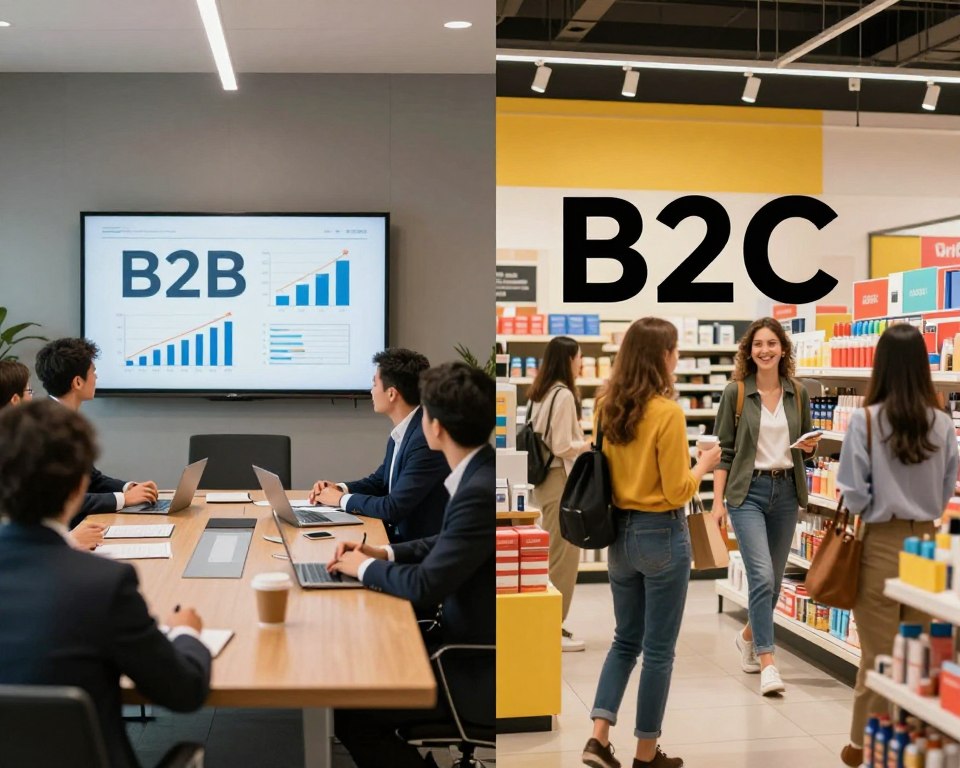
It’s key to know the differences between business-to-business (B2B) and business-to-consumer (B2C) marketing. This knowledge is vital for any company’s success.
The way businesses talk to their audience and sell their products changes a lot between B2B and B2C. This affects how they craft their messages and drive sales.
It’s important for companies to understand the differences between B2B and B2C marketing. This helps them tailor their strategies better.
Knowing these differences lets businesses improve their marketing. They can better engage with customers and boost their profits.
The Fundamental Distinction Between B2B and B2C Marketing
B2B and B2C marketing are two different ways businesses talk to their audience. B2B marketing is about deals between companies, needing a personal touch and strong relationships. On the other hand, B2C marketing is about selling directly to people, using wider marketing efforts.
Key Characteristics of B2B Markets
B2B markets have complex decisions, longer sales times, and focus on building business ties. Personalization and custom solutions are essential in B2B marketing.
Examples of Successful B2B Companies
IBM and Microsoft are great at B2B marketing. They offer special solutions and services to other businesses. Their marketing includes detailed product info and tech support.
| B2B Company | Marketing Strategy |
|---|---|
| IBM | Customized IT solutions |
| Microsoft | Software and technical support |
Core Elements of B2C Markets
B2C markets are all about what consumers want, with a focus on making a brand connection. These deals are simpler and more direct.
Evolution of B2C Marketing in the Digital Age
Digital platforms have changed B2C marketing a lot. Businesses use social media, e-commerce, and targeted ads to connect with people. Keeping up with b2b marketing trends and what consumers like is key.
Your Target Audience: B2B vs B2C Buyers
Marketing needs to know the difference between B2B and B2C buyers. B2B deals are more complex because they involve many people. This is different from B2C, where it’s just one person buying.
The Multiple Stakeholder Challenge
B2B marketing deals with many people making decisions. Each person has their own needs and worries. Marketers must find ways to meet these different needs.
Mapping the B2B Decision-Making Hierarchy
Marketers need to figure out who makes decisions in B2B. This helps them talk to the right people at the right time. Knowing who to talk to makes B2B sales easier.
B2C marketing looks at why people buy things. It’s about what they like, how they feel, and what others think. Marketers use this to make ads that really speak to people.
Demographic vs. Psychographic Segmentation
B2B marketing looks at company details, like size and industry. B2C marketing looks at what people like and value. This helps make marketing that really hits the mark.
Knowing the differences between B2B and B2C buyers helps marketers. They can make plans that really work for each group. This makes marketing much more effective.
Decision-Making Process: Rational vs Emotional
The way B2B and B2C decisions are made is key to marketing strategies. B2B decisions are often based on careful thought and evaluation of product offerings. They aim to improve business operations. On the other hand, B2C marketing targets the emotional side of consumers.
B2B purchases involve a detailed decision-making process. This includes:
- Detailed evaluations of products and services
- Risk assessments to mitigate possible downsides
- Committee-based decisions involving multiple stakeholders
Risk Assessment in B2B Purchases
In B2B deals, risk assessment is vital. Businesses compare risks to benefits, looking at ROI, reliability, and vendor reputation. Good b2b marketing trends help reduce risks with clear communication and solid after-sales support.
Committee-Based Decision Making
B2B decisions are often made by a group of stakeholders. Each has their own priorities. Marketers need to address these diverse concerns with detailed information and build strong relationships.
The Role of Brand Affinity
Brand affinity is important in B2B, even though decisions are mostly rational. A trusted brand can influence choices. Building this trust through consistent b2b vs b2c product offerings is key.
Creating Emotional Connections with Consumers
B2C marketing, on the other hand, focuses on emotional connections. B2C marketing techniques use storytelling, visuals, and relatable messages to influence buying decisions.
Marketers need to understand these differences to create effective strategies. Recognizing the rational nature of B2B decisions and the emotional appeal of B2C marketing helps businesses engage and convert better.
Content Marketing Strategies Across B2B and B2C
It’s key to know the differences in content marketing for B2B and B2C. Marketers need to connect well with their audience.
Content marketing is vital for both B2B and B2C. But, their methods are quite different. This is because of the unique nature of each business model.
In B2B, white papers and case studies are very useful. They help show a company’s expertise and solve problems for clients.
Industry Research and Thought Leadership
B2B marketers use industry research and thought leadership to show they know the latest trends. This builds trust and makes the brand seem forward-thinking.
User-Generated Content Strategies
B2C marketing often uses user-generated content strategies. This encourages customers to share their stories, making the brand more relatable and appealing.
Viral Marketing Techniques
B2C marketers often use viral marketing techniques. They create content that’s funny, surprising, or touching. This makes people share it quickly on social media.
B2B-Focused Platforms
For B2B, LinkedIn is a key platform. It’s great for sharing content, joining discussions, and networking with professionals.
B2C-Oriented Media
B2C marketers use many media, like social media, blogs, and influencer partnerships. They aim to connect with consumers directly and personally.
By making content marketing fit their audience’s needs, both B2B and B2C marketers can get better results. This leads to more engagement and sales.
B2B vs B2C Marketing: Key Differences in Approach
B2B and B2C marketing have different ways of reaching their audiences. This is because of the unique needs of businesses versus individual consumers. The language, events, and platforms used vary greatly between the two.
Technical vs. Simplified Language
B2B marketing speaks in technical terms, fitting the industry’s jargon. On the other hand, B2C marketing uses simple language to appeal to a wider audience. For example, IT professionals are used to technical terms in B2B software marketing. But, a consumer app focuses on easy-to-understand language.
Feature-Focused vs. Benefit-Focused Messaging
B2B marketing highlights product features and specifications. This is because business decisions are often based on these details. In contrast, B2C marketing talks about the benefits and how a product improves daily life. For instance, a B2B server campaign might list its technical specs. But, a B2C smartphone campaign would highlight its camera and battery.
B2B marketers often attend trade shows to meet clients. They showcase products in a professional setting. B2C marketers, on the other hand, focus on retail experiences. They create engaging displays and promotions to draw in customers.
LinkedIn vs. Instagram: Platform Selection
The platforms used also differ between B2B and B2C. LinkedIn is key for B2B marketers, with its professional networking. It allows for targeted ads to business professionals. Instagram, with its focus on visuals, is better for B2C marketing. Businesses can show off products through images and stories.
| Marketing Aspect | B2B Approach | B2C Approach |
|---|---|---|
| Language | Technical | Simplified |
| Messaging | Feature-Focused | Benefit-Focused |
| Event Marketing | Trade Shows | Retail Experiences |
| Platform Selection |
Knowing these differences is key for effective marketing. Businesses need to tailor their strategies for either B2B or B2C markets.
Relationship Building and Customer Loyalty
Building strong customer relationships is key for any business. This is true for both B2B and B2C companies. They need to focus on keeping customers coming back. This helps with repeat business, positive word-of-mouth, and increases customer value over time.
In B2B marketing, the goal is to create lasting partnerships. This means understanding complex decisions and working with many people. Account-based marketing strategies are very important here.
Account-Based Marketing Strategies
Account-based marketing targets specific accounts and decision-makers. It uses personalized content to win them over. This method needs a deep understanding of what the client needs and faces.
- Identify key accounts and decision-makers
- Develop personalized content and messaging
- Engage through multiple channels (email, social media, events)
For B2C companies, building loyalty is about customer success and retention programs. These programs aim to keep customers happy and coming back.
Customer Success and Retention Programs
These programs aim to give customers great experiences. They offer value beyond the first sale and build a community around the brand.
- Implement feedback mechanisms to improve customer experience
- Offer loyalty programs and rewards
- Provide ongoing support and service
Loyalty Programs and Rewards
Loyalty programs and rewards help both B2B and B2C marketers. They encourage customers to come back and stay loyal.
- Design programs that reward repeat purchases or referrals
- Personalize rewards based on customer preferences and behaviors
B2C brands also benefit from community building. This creates a loyal group of customers who feel part of the brand.
Community Building Around Consumer Brands
This means creating places where customers can meet the brand and each other. It builds a sense of belonging.
- Host events or webinars related to the brand’s niche
- Engage with customers on social media
- Create online forums or groups for customer interaction
By using these strategies, businesses can build stronger customer relationships. This leads to more loyalty and long-term growth.
Pricing Strategies and Value Propositions
Knowing how to price is key for businesses in both B2B and B2C markets. The right price can attract and keep customers. It’s a make-or-break factor.
In B2B marketing, pricing is more complex. It involves the value offered to business clients. This can include special prices for big companies or certain industries.
Subscription and Service-Level Agreements
B2B companies often use subscriptions and SLAs. These offer ongoing value to clients. They also help in getting steady income.
Customized Enterprise Pricing
Big companies get special pricing. Prices are adjusted based on their size, service needs, and long-term partnership chances.
In B2C marketing, pricing tricks are used. For example, prices like $9.99 instead of $10 make things seem cheaper. Premium prices show quality.
Discount Strategies and Price Sensitivity
B2C companies use discounts to deal with price worries. Knowing how much customers mind price changes is important for good pricing.
Understanding these pricing strategies and values helps businesses in B2B and B2C. It leads to better sales and customer engagement.
Digital Marketing Tactics: What Works Where
Digital marketing tactics work differently for businesses and consumers. Knowing this is key to making marketing plans that succeed.
Marketing Automation and Lead Nurturing
In B2B marketing, marketing automation is vital for nurturing leads. It helps businesses connect with future clients through tailored content and emails. A study by MarketingSherpa shows that top companies get 50% more leads ready for sales at a 33% lower cost.
SEO for Business Decision-Makers
B2B SEO focuses on keywords used by business leaders. It creates content that meets their needs and solves their problems. HubSpot found that businesses with blogs get 55% more website visitors.
Social Commerce and Shoppable Content
B2C marketing uses social commerce and shoppable content to boost sales on social media. Instagram reports that businesses with shoppable posts see more customer engagement.
Mobile-First Marketing Approaches
Most people use mobile devices to browse the internet. So, a mobile-first approach is critical for both B2B and B2C marketers. It means making websites and content mobile-friendly to enhance user experience.
Professional Networks vs. Social Media
B2B marketing thrives on professional networks like LinkedIn, where businesses connect with other professionals. B2C marketing, on the other hand, does well on platforms like Facebook and Instagram.
Email Marketing Customization by Audience Type
Email marketing varies between B2B and B2C. B2B emails are formal and highlight the value offered. B2C emails are more promotional, aiming to drive sales right away.
| Digital Marketing Tactic | B2B Effectiveness | B2C Effectiveness |
|---|---|---|
| Marketing Automation | High | Moderate |
| SEO for Decision-Makers | High | Moderate |
| Social Commerce | Low | High |
| Mobile-First Approach | High | High |
Understanding the strengths and weaknesses of digital marketing tactics helps businesses tailor their strategies. This way, they can better reach their target audience.
Sales Cycles and Customer Journey Mapping
Understanding sales cycles and customer journey mapping is key for effective marketing. These elements help businesses tailor their strategies to meet their audience’s needs and behaviors.
The sales cycle is the journey from first contact to the final sale. B2B sales cycles are longer and more complex. They involve many decision-makers and a careful buying process.
Lead qualification and scoring are important in both B2B and B2C marketing. They help identify and focus on the best leads. Leads are scored based on their behavior and demographics to see if they’re ready to buy.
Sales and Marketing Alignment
Aligning sales and marketing is vital for success. It makes sure marketing brings in leads that sales can turn into customers. This makes the sales process smoother.
Reducing Friction in the Checkout Process
Improving checkout is key to higher conversion rates. Simplify steps, offer guest checkout, and make payments secure. This makes the process easier and more trustworthy.
Retargeting and Abandoned Cart Recovery
Retargeting and cart recovery help bring back interested customers. They use ads and emails to remind customers to finish their purchase. This encourages them to return and buy.
FAQ
What is the main difference between B2B and B2C marketing?
B2B marketing targets businesses, with longer sales cycles and complex decisions. B2C marketing aims at individual consumers, with quicker sales and emotional buying.
How do B2B and B2C marketing strategies differ in terms of content creation?
B2B marketing creates detailed, technical content like white papers. B2C marketing focuses on engaging, fun content that speaks to individual emotions.
What role does social media play in B2B and B2C marketing?
Social media is key for both, but used differently. B2B uses LinkedIn for leads and thought leadership. B2C uses Instagram and Facebook for brand awareness and engagement.
How do pricing strategies vary between B2B and B2C marketing?
B2B pricing is often customized, like subscription services. B2C uses tactics like discounts to sway consumer choices.
Can businesses effectively use both B2B and B2C marketing approaches?
Yes, businesses can blend B2B and B2C strategies. This approach helps reach and engage different audience segments.
How do sales cycles differ between B2B and B2C marketing?
B2B sales cycles are longer, involving many stakeholders. B2C cycles are quicker, with fewer decision-makers.
What is the significance of customer loyalty in B2B and B2C marketing?
Loyalty is key for both, driving repeat business and positive word-of-mouth. B2B focuses on account-based marketing and customer success. B2C uses loyalty programs and rewards.