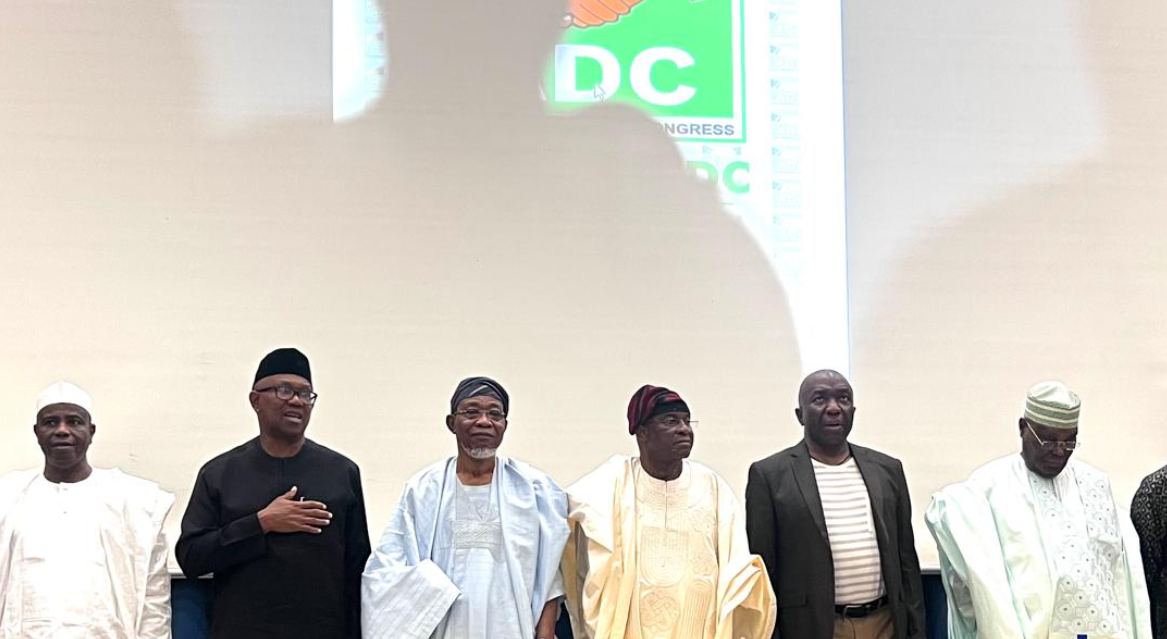
To many, the 2027 general election may seem distant, but Nigerian politicians are already laying the groundwork for how it will unfold. One emerging strategy to unseat incumbent President Bola Tinubu through the ballot is the formation of a new coalition under the Action Democratic Congress (ADC).
This is not the first time a coalition has been formed to unseat a president. In 2013, four opposition parties announced a merger to form a new political party, the All Progressives Congress (APC). This coalition went on to win the 2015 general election, unseating then-president Goodluck Jonathan and producing Muhammadu Buhari.
ADC formed in 2006, has two members currently in the National assembly and a growing support base, and now, the coalition is working to unseat Tinubu, accusing his government of corruption and “putting more focus on the next election, while the majority of Nigerians wallow in hunger and poverty, even as bandits continue to kill Nigerians.”
“This coalition is therefore for all Nigerians who share in our belief that all of us have the patriotic duty to save our country,” the Interim National Chairman of the ADC, Senator David Mark said.
What are ADC’s chances in the 2027 election?
Labour Party, 2023 presidential candidate Peter Obi, former Vice President Atiku Abubakar, former Kaduna Governor Nasir El-Rufai, ex-Rivers Governor Rotimi Amaechi, and other political figures are at the forefront of this coalition.
Peter Obi, through the Obedient Movement, will be a major force in the 2027 general election. In 2023, Obi massively increased the Labour Party’s performance and influence. Obi, who ran as president for the first time under the Labour Party, obtained the third-largest number of votes, at 6.1 million.
Previously, Labour Party had no significant national relevance and had performed poorly in past elections. The success of the Labour Party in the election was made possible through the Obdient movement, which boasts over 6 million followers across different geopolitical zones, with efforts aimed at mobilising 18 million new supporters in 2025.
Other political structures are joining the coalition, with leaders of the Peoples Democratic Party (PDP) in Niger State announcing their defection to the coalition. In Rivers State, the Rivers Liberation Movement (RLM), a political pressure group under the PDP, has also collapsed its structure into the coalition.”
Political analyst Anjorin Robert believes that with this, the ADC has a chance in the 2027 elections. Robert told Within Nigeria that the coalition has a bright chance if politicians who have come together for a merger prioritise the country over their ambitions.
Referring back to the APC merger in 2013, Robert noted that the 2015 victory of the APC was possible because politicians had a common goal.
“If they choose, for the sake of Nigeria and Nigerians, to relegate their interests this once—just the same way it happened in 2013 when APC came alive—it’s possible, and they have a very, very bright chance in the forthcoming election, even though the system will be rigged against them,” he said.
Adding that the political atmosphere in Nigeria is already tense, he said that the coalition is timely because the Tinubu-led government is in panic mode and prioritising politics over governance.
“It is timely. We need an alternative at this point, and as the election is drawing close, we really need an alternative. Otherwise, nobody can tell what will happen after 2027. Nothing seems to be working under this government,” he noted.
What does this mean for Nigerians?
Nigerians have lamented the negative economic impact of Tinubu’s policies, from the removal of fuel subsidy to rising inflation, increasing poverty, and growing insecurity, which has led to a higher death toll in various regions. The coalition presents a viable option for Nigerians to consider as a competitive alternative to the APC.
“With the ADC coalition, opposition leadership is providing a more united alternative for Nigerians,” said Sokoh Abraham, a political analyst.
Abraham stressed that despite the current efforts of the ADC, leading figures in the coalition have mostly appealed to public sentiments around the effects of these policies on Nigerians.
He emphasised that these politicians have not provided a feasible alternative to some of the APC-led administration’s policies.
“On paper, many will say the policies of President Tinubu have led to the emergence of the coalition. Nevertheless, it is important to also note that many of the leading figures in the coalition have not proposed a different policy direction regarding the subsidy removal and the floating of the currency.
“In fact, both Atiku Abubakar and Peter Obi campaigned on subsidy removal during the build-up to the 2023 elections. This has led many to question the intentions of the coalition — whether their goal is simply to grab power by any means.”
Speaking about the possible challenges the coalition may face, he said that fielding a candidate who can gain the support of the majority of Nigerians and overcoming conflicting political interests are major obstacles.
According to him, top members of the coalition have been accused of corruption and of being unable to reduce poverty during their past positions.
“Atiku has been accused of corruption by his boss, Obasanjo, when he was Vice President. Nasir El-Rufai’s time as Governor witnessed religious and ethnic clashes in Southern Kaduna that saw between 1,000–4,000 deaths recorded in Kaduna between 2015 and 2023. Peter Obi, as much as many would want to hail his transparency and frugality, saw Anambra’s poverty index increase during his time as governor, according to the National Bureau of Statistics.
“So, the leading figures of the coalition are not beacons of good leadership and may not be able to convince critical-thinking Nigerians to support them,” he emphasised.