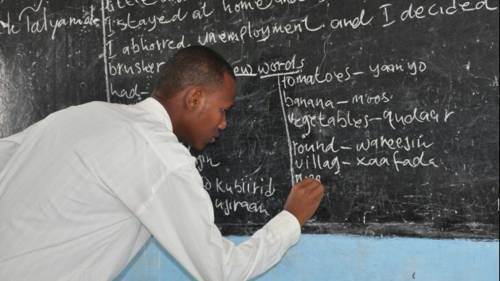
Every October 5 is World Teachers’ Day. Several countries across the globe have come together to recognize it as a special day to honor and recognize the efforts and contributions of teachers.
As Nigeria—the giant of Africa—marks the 31st anniversary of this global event in 2025, teachers of private schools have used the opportunity to call for a better salary structure that would reflect the economic realities of the country.
Some teachers also called on state and local governments to intervene and collaborate with private school owners in fixing what they termed ridiculous pay as a reward for service.
HISTORY OF WORLD TEACHERS’ DAY
A special intergovernmental conference in Paris on October 5, 1996, led to the adoption of the UNESCO/ILO Recommendation concerning the Status of Teachers.
At the conference, they established critical benchmarks for the rights, responsibilities, recruitment, and initial preparation of teachers.
UNESCO proclaimed October 5 as World Teachers’ Day in 1994 to honor the significant step taken by the special intergovernmental conference.
REACTIONS FROM PRIVATE SCHOOL TEACHERS
In celebration of World Teachers’ Day, some private school teachers in Ilesa reached out to WITHIN NIGERIA and expressed their dissatisfaction about the situation, particularly the reward system.
Sola Akintoye, a 27-year-old woman, while conversing with WITHIN NIGERIA, stated that poor remuneration is one of the major challenges facing private schools.
Akintoye, who complained bitterly about poor remuneration, disclosed that the headmaster named Mrs. Ajayi receives the highest pay in their school, and her salary is N45,000.
According to Akintoye, Mrs. Ajayi’s former salary was N30,000, but it was increased to N45,000 after the Federal Government announced a new minimum wage following the removal of the fuel subsidy.
“My salary is N30,000. I teach Basic 2. It requires patience and resilience to teach kids. We close by 4 pm, making it difficult for me to embark on any business to augment my earnings,” a rather sad Akintoye said.
Aderogba Pelumi, a 30-year-old man, told WITHIN NIGERIA that the current earnings of private school teachers do not reflect the economic realities of the country.
Aderogba, a mathematics teacher in a private school (name withheld) in Ilesa, disclosed that his monthly pay of ₦40,000 cannot cater for his personal needs due to inflation.
According to Aderogba, it is high time the government, through the Ministry of Education, alongside school owners, worked to provide an affordable minimum wage for private school teachers to relieve our burdens.
“I would have given up teaching as a career, but my passion keeps me going. Though our monthly pay is meager, it does not arrive early either. It is a terrible situation, and any attempt to demand an increase would always be met with appeals from school owners,” he disclosed. “My wife is also a teacher, and I have two children.”
Sesan Ayankunle, a Basic Science teacher while calling for a review of renumeration told WITHIN NIGERIA that taxation and payment of specific fees into pockets of government are part of factors responsible for gulping revenue of private schools.
According to Sesan, the earnings from tuition fees paid by guardians or parents that could have been used to improve teachers’ lives are typically used by school owners to pay dues and taxes.
Sesan further disclosed that some school owners are greedy and desperate to pursue physical projects that will consume another big amount of revenue at the expense of instructors’ well-being.
“It is a really dangerous situation. We have a conflict of interest between the government and the school owners. We’re pawns. Teachers are now starting enterprises to survive, which will undoubtedly impair their performance. “This will almost certainly have an impact on students’ academic performance,” he added.